


















Lesson 37 of 46 · Social Change, Globalization and Research
Globalization and World Systems
Understand globalization, McDonaldization, glocalization, Appadurai's scapes and Wallerstein's core and periphery, with a value-chain calculator and a diffusion model.
A phone is designed in one country, its parts are made in several others, it is assembled somewhere else, and it is sold worldwide with advertisements that cross borders in seconds. The same pattern holds for clothes, food, music, money and ideas. Globalization is the growing intensity of flows of goods, capital, people, information and culture across national borders. In this lesson you will meet the main ways sociologists describe these flows, ask who gains and who loses, and see two small models.
What you will learn
- Define globalization and name its main drivers.
- Compare cultural-homogenization and hybridization arguments.
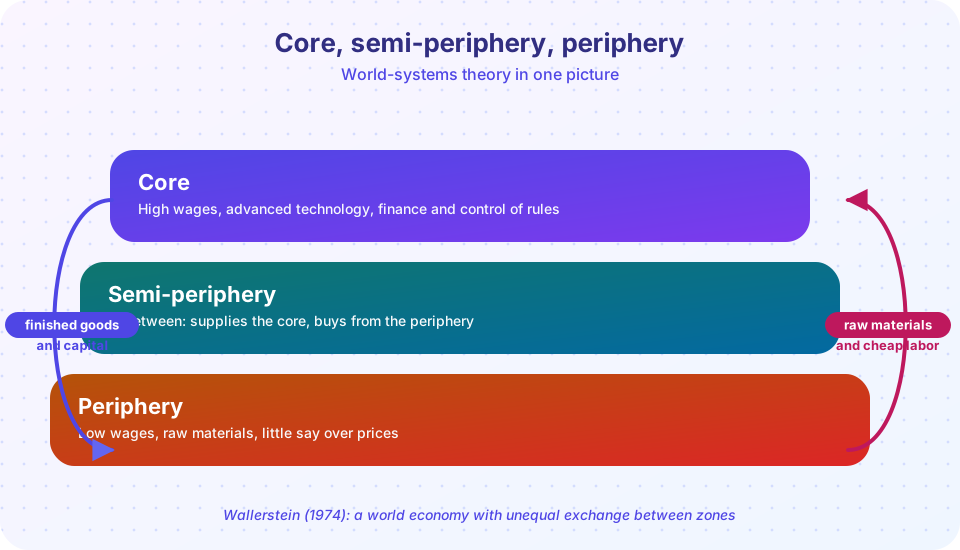
- Explain core, semi-periphery and periphery in world-systems theory.
- Use a diffusion curve to think about how innovations spread.
Key terms
Globalization: increasing flows and interdependence across national borders. McDonaldization: the spread of efficiency, calculability, predictability and control (Ritzer, 1993). Glocalization: global products adapted to local tastes (Roland Robertson). World-systems theory: Wallerstein's view of a single capitalist world economy with unequal zones. Global value chain: the steps of making a product across several countries.
Drivers of globalization
- Transport and communication: container shipping, air travel, the internet and mobile phones shrink distance. David Harvey (1989) called this time-space compression.
- Trade and finance rules: lower tariffs, trade agreements and open capital markets.
- Firms: transnational corporations split production across countries to cut costs or reach markets.
- Migration: people move for work, safety or study, and send money home (remittances).
- Ideas and media: films, music, social media and sports spread shared symbols.
Anthony Giddens stressed how globalization stretches social relations across space: a decision in a distant city can change a local job.
Culture: homogenization or hybridization?
George Ritzer argued in The McDonaldization of Society (1993) that the principles of fast-food restaurants (efficiency, calculability, predictability and control) have spread to education, health, travel and shopping. This implies global sameness.
Others say the story is more varied. Glocalization captures how global products adapt locally, such as menu items that differ by country. Arjun Appadurai (1990) described global flows as separate "scapes": ethnoscapes (people), technoscapes (technology), financescapes (money), mediascapes (images and stories) and ideoscapes (political ideas). They move in different directions and speeds, so cultural change is uneven and creates new hybrid forms rather than one world culture. Resistance also appears: local movements defend language, food and tradition against perceived erosion.
World-systems theory
Immanuel Wallerstein (The Modern World-System, 1974) argued that since the sixteenth century a single capitalist world economy has linked regions in an unequal division of labor.
| Zone | Typical role |
|---|---|
| Core | High-wage, capital-intensive production; finance and technology; strong states |
| Semi-periphery | Mixed: supplies the core with some manufactures, buys raw materials from the periphery |
| Periphery | Low-wage and raw-material production; often weak bargaining power |
Zones are not fixed: some countries have moved upward or downward over time, and economists debate how well the categories fit. This view grew out of dependency theory (André Gunder Frank and others), which challenged modernization theory by arguing that rich and poor regions are linked, and that underdevelopment is partly produced by the global system.
The opposing view points to rapid poverty reduction in parts of East Asia after countries joined global trade, and argues that participation in world markets can lift incomes. Many scholars now combine the views: gains and losses are real, and outcomes depend on how countries enter global markets, on domestic policy and on the power of firms and states.
Within countries, inequality has often risen as well. Branko Milanovic's "elephant curve" (2016) described how, over the decades after 1988, incomes grew fast for many people in the middle of the world distribution (much of Asia) and for the very richest, but slowly for the lower-middle class of rich countries. The details are debated, and they depend on data and time periods.
Press Run (or Ctrl + Enter) to see the result here.
Program input · what you'd type while the program runs
Type the answers before you press Run, one per line. Each time the program reads a line (with input()), it gets the next line from this box.
The split above is made up to practice reasoning about a value chain. Real studies of specific products trace prices, costs and wages across firms and countries, and results vary widely.
How do innovations spread?
Many global changes spread like an epidemic of adoption. The Bass diffusion model (Frank Bass, 1969) describes the share of people who have adopted an innovation by time t. It has two parameters: p, the rate of innovation from outside influences such as advertising, and q, the rate of imitation, influence from people who already adopted. With F(t) = (1 - e^(-(p+q)t)) / (1 + (q/p) e^(-(p+q)t)), the curve is S-shaped.
Press Run (or Ctrl + Enter) to see the result here.
Program input · what you'd type while the program runs
Type the answers before you press Run, one per line. Each time the program reads a line (with input()), it gets the next line from this box.
The model is a general pattern, not a forecast for any product. Real diffusion depends on cost, infrastructure, networks, regulation and culture.
Common misconceptions
"Globalization is new." Long-distance trade and migration are ancient. What is new is the speed and scale of some flows.
"Globalization makes all cultures the same." Evidence shows both convergence and the creation of hybrids and resistance.
"World-systems theory says rich countries are always rich." Wallerstein noted that countries can move between zones, and critics debate how to classify them.
Check your understanding
Quick check · 6 questions
of 6 answered You scored / 6 · perfect!
-
1. Ritzer's McDonaldization emphasizes
He applied the fast-food model to many areas of life. -
2. Glocalization means
Robertson used it to stress local adaptation. -
3. In world-systems theory, the semi-periphery
It supplies the core with some products and buys raw materials from the periphery. -
4. Appadurai's 'scapes' show that
Disjunctions among scapes make cultural change uneven. -
5. In the Bass model, a larger q means
q is the rate of imitation from existing adopters. -
6. Dependency theory challenged modernization theory by arguing that
It brought colonial history and unequal exchange into the explanation.
Summary
- Globalization is increased cross-border flows of goods, money, people, information and culture, driven by transport, communication, trade rules, firms and migration.
- Cultural effects include both sameness (McDonaldization) and hybrids and resistance (glocalization, scapes).
- Wallerstein's world-systems theory describes core, semi-periphery and periphery in a single unequal economy.
- Diffusion models such as the Bass curve describe how innovations spread through influence.
Track your progress
Create a free account to tick off lessons and pick up where you left off on any device.
of Sociology lessons completed