


















Lesson 11 of 46 · Culture and Socialization
Chapter 3 Overview: Culture and Socialization
Preview chapter 3: what culture is, how norms and values work, how people become members of society through socialization, and who teaches us along the way.
Have you ever visited a place where people greeted each other differently, ate at different times or stood closer than you expected, and felt oddly uncomfortable without knowing why? You were noticing culture: a shared way of life that guides what people do, think and value. At home, culture is like the air; you only notice it when it changes.
This chapter looks at two linked ideas. Culture is what a group shares: its language, beliefs, values, norms and objects. Socialization is how each new person learns that culture and builds a self within it. Together they explain how societies continue from one generation to the next, and how people become the individuals they are.
What you will learn
- Why this chapter matters for everything that follows.
- What each lesson covers and how they connect.
- Which skills you will be able to use at the end.
Key terms
Culture: the shared beliefs, values, norms, language and material objects of a group.
Socialization: the lifelong process of learning a culture and forming a self.
Norm: a shared rule about how to behave.
Value: a shared idea of what is good, right or important.
Agent of socialization: a person, group or institution that teaches us the culture.
The chapter at a glance
Culture: a shared way of life
Socialization: becoming a member
Who teaches us?
What each lesson covers
- What Is Culture?: symbols, values, norms, folkways, mores and laws; material and nonmaterial culture; subcultures; ethnocentrism and cultural relativism.
- Socialization Theories: Cooley's looking-glass self, Mead's stages, Goffman's impression management, and what the case of isolated children can and cannot tell us.
- Agents of Socialization: family, peers, school, media, religion and workplaces, plus total institutions and resocialization.
- Chapter 3 Review: a one-page loop diagram, flashcards and a ten-question quiz.
Why this matters
Culture and socialization are where the sociological imagination meets everyday life. They explain how patterns in society become patterns inside us: our tastes, our shame and pride, our sense of what is fair. They also guard against two traps. One is thinking our own way is the only natural way (ethnocentrism). The other is thinking people are puppets of culture, with no say. People learn, interpret and also change culture.
Common misconceptions
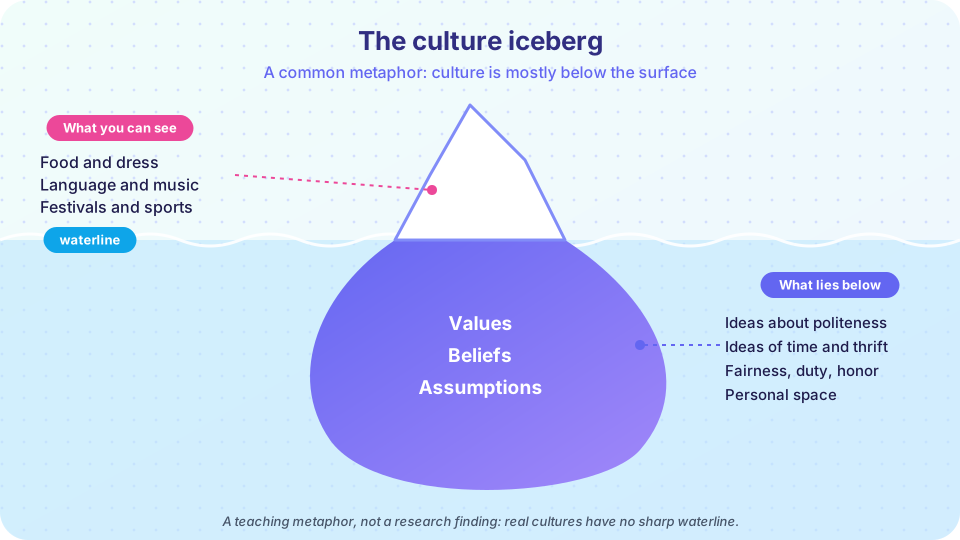
"Culture is just art, music and food." Those are visible parts. Culture also includes values, assumptions and rules about everything from time to fairness.
"Some cultures have culture and others do not." Every human group has a culture; "high culture" and "popular culture" are labels for tastes, not for the presence or absence of culture.
"Socialization stops at age 18." It lasts a lifetime: new jobs, countries and life stages bring new learning.
Try it
Sort these examples into the visible tip of culture and the hidden base. Notice how many of the hidden items drive the visible ones.
Check your understanding
Quick check · 4 questions
of 4 answered You scored / 4 · perfect!
-
1. Socialization is
It is the lifelong process by which people learn the norms, values and roles of their society. -
2. Which is a nonmaterial part of culture?
Values, beliefs and norms are nonmaterial culture; tools and buildings are material. -
3. Why is the iceberg a useful metaphor?
The visible traits are only a small part of what shapes behavior. -
4. Which is an agent of socialization?
Families, peers, schools, media and other groups teach cultural rules.
Summary
- Culture is a group's shared way of life; socialization is how people learn it and form selves.
- The chapter covers culture's parts, theories of the self, and the agents that teach us.
- People are shaped by culture, and they interpret and change it.
Next: What Is Culture?
Track your progress
Create a free account to tick off lessons and pick up where you left off on any device.
of Sociology lessons completed