


















Lesson 14 of 46 · Culture and Socialization
Agents of Socialization
Explore the main agents of socialization (family, peers, school, media, religion, work), the hidden curriculum, anticipatory socialization, total institutions and resocialization.
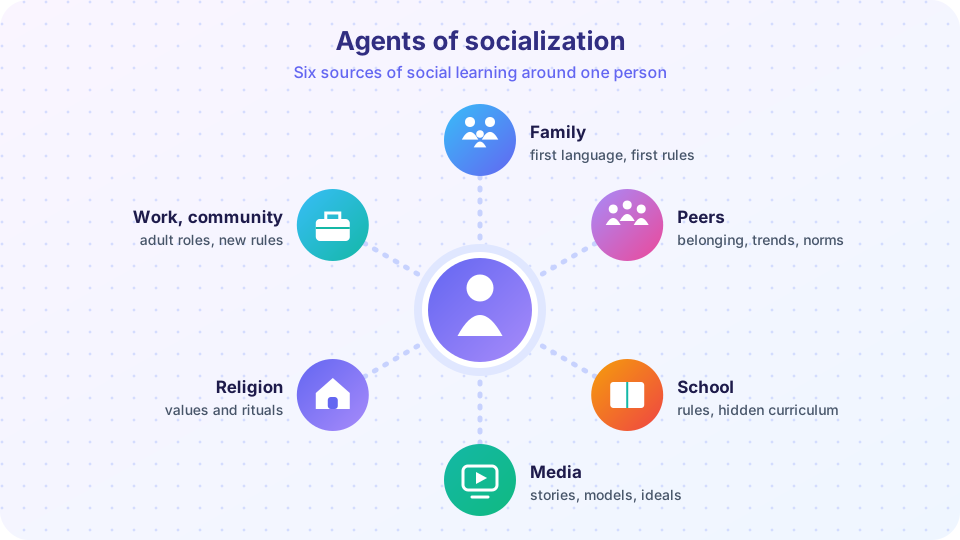
Nobody learns a culture alone. Every day, a flow of people, groups and messages teaches us what to say, wear, want and fear. Sociologists call the sources of this teaching agents of socialization. Some are obvious (a parent correcting a child's table manners), others are subtle (a school timetable that teaches that time is divided into periods and bells), and some we barely notice (a stream of images that tells us what a "successful" person looks like).
What you will learn
- The main agents of socialization and what each teaches.
- How social class can shape the way families raise children.
- What the hidden curriculum, anticipatory socialization, total institutions and resocialization mean.
- Why the influence of each agent is debated and varies across life stages.
Key terms
Agent of socialization: a person, group or institution that teaches culture and shapes the self.
Hidden curriculum: unwritten lessons schools teach, such as obedience, punctuality and competition.
Anticipatory socialization: learning the expectations of a group you hope to join.
Total institution: a place where people live and are tightly controlled, such as a prison or boarding school (Goffman).
Resocialization: a radical change of identity and norms, usually in a new setting.
Family
For most children, the family is the first and often most powerful agent. It teaches language, basic habits, and identity: name, religion, social class position, ethnic background. It sets the first expectations about gender, work and money. Family is a primary group, with intense, long-lasting ties.
Class differences in parenting have been studied closely. In 1969 Melvin Kohn reported that working-class parents in the United States tended to value obedience and conformity, reflecting jobs where following directions is rewarded, while middle-class parents tended to value self-direction, reflecting jobs where independent judgment is rewarded. In Unequal Childhoods (2003) Annette Lareau, studying families in the United States, described a middle-class style of concerted cultivation (organized activities, reasoning with adults, advocating for the child in institutions) and a working-class and poor style she called the accomplishment of natural growth (more unstructured time, clearer boundaries between adults and children). She argued that schools tend to reward the first style. These are patterns from specific studies, with plenty of variation within each class and across countries.
Peers
A peer group consists of people of similar age and status. Peers become especially important in childhood and adolescence, when young people seek autonomy from parents. Peers teach things adults cannot or will not: slang, trends, how to flirt, how to survive among age-mates. Peer groups can encourage both helpful and harmful behavior, and the fear of exclusion can be strong. Unlike family or school, peer relationships are generally among equals, so children practice negotiation and fairness there.
School
Schools teach explicit knowledge: reading, mathematics, science. They also teach a hidden curriculum, a term associated with Philip Jackson (1968): lining up, waiting turns, raising a hand, working to a bell, being evaluated against others. Samuel Bowles and Herbert Gintis argued in 1976 that this curriculum matches the demands of the workplace, preparing different groups for different positions. Critics note that schools also open opportunities and encourage critical thinking, so the picture is mixed. Schools further create peer cultures, with popularity hierarchies and subcultures.
Mass media and digital media
Television, film, music, news and now social platforms offer a constant stream of stories, models and ideals. Media can broaden horizons, teach information and create shared references. George Gerbner's cultivation theory suggested that heavy exposure to television shapes people's picture of the world, for example by making it seem more dangerous than it is. Research on digital media is a fast-moving, contested field: effects often depend on what is consumed, how, and by whom, and many findings are small or mixed. Be wary of confident claims that screens simply "cause" particular outcomes.
Religion, workplace and community
Religious institutions teach moral codes, rituals and a sense of belonging, and in many societies guide life events such as births, marriages and deaths. Workplaces teach occupational norms, from dress to jargon to ethics, and a sense of identity ("I am a nurse"). Communities, clubs and neighborhoods teach local customs and civic participation. In adulthood we continue to be socialized by new jobs, partners, parenthood, migration and retirement.
Anticipatory socialization and resocialization
Anticipatory socialization (Robert Merton's term) is learning about a role in advance, through imitation and rehearsal. A student shadowing a doctor, or a teenager trying on adult clothing, practices for a future status.
Resocialization is the process of discarding old patterns and learning new ones, often after a major change: entering military training, joining a religious order, recovering from addiction, immigrating. Erving Goffman, in Asylums (1961), analyzed total institutions: prisons, psychiatric hospitals, boot camps and some boarding schools, where residents are cut off from the wider world and every part of life is controlled. Entry often involves a "mortification of the self": removal of personal items, uniform clothing and new names, which strip a former identity. He described how residents may comply, resist or adapt in various ways. The concept has been widely used in studying institutional life, and also questioned for describing too uniform a picture.
Socialization across the life course
Socialization changes with age. Children learn basic skills and rules. Adolescents seek identity and independence. Adults learn work and family roles. Older adults adjust to retirement and loss of roles. Gender, class, ethnicity and disability shape the messages each person receives; later chapters return to these. A good sociological analysis asks, for any trait, which agents taught it, when, and with what resistance?
Common misconceptions
"Family is always the strongest influence." It is early and powerful, but peers, schools and media can matter more at certain ages or for certain behaviors.
"Media simply makes people do things." Audiences interpret messages, and effects are often small and depend on context.
"Socialization produces identical people." Agents sometimes conflict, and people respond differently, so outcomes vary.
"Resocialization only happens in extreme places." Everyday transitions, such as starting a new job or moving countries, also involve some resocialization.
Try it
First, an illustration of how the importance of agents might shift over the life course. The weights are invented for teaching and do not come from a study; the point is the shape of the idea, that influences overlap and change.
Press Run (or Ctrl + Enter) to see the result here.
Program input · what you'd type while the program runs
Type the answers before you press Run, one per line. Each time the program reads a line (with input()), it gets the next line from this box.
Second, match each lesson to the agent that most likely taught it.
Check your understanding
Quick check · 5 questions
of 5 answered You scored / 5 · perfect!
-
1. The hidden curriculum refers to
Schools teach norms and habits beyond the official subjects. -
2. Lareau's 'concerted cultivation' describes
She found it to be more common among middle-class families in her US studies. -
3. A student shadows a nurse to learn what the job is like. This is
Learning the expectations of a role you hope to enter is anticipatory socialization. -
4. Goffman's total institutions are characterized by
Prisons, psychiatric hospitals and boot camps are examples. -
5. Which statement about media effects is best supported?
Research findings vary, so confident causal claims should be treated with care.
Summary
- Agents of socialization include family, peers, school, media, religion, workplaces and communities.
- Class can shape parenting styles (Kohn, Lareau), and schools teach a hidden curriculum.
- Anticipatory socialization prepares us for roles; resocialization replaces old patterns, sometimes in total institutions.
- Influence varies across the life course and across individuals, and media effects remain debated.
Next: Chapter 3 Review
Track your progress
Create a free account to tick off lessons and pick up where you left off on any device.
of Sociology lessons completed