


















Lesson 9 of 46 · The Sociological Imagination
Structure and Agency
Understand the structure and agency debate: how social structures shape choices, how people act and change them, and how Giddens and Bourdieu try to combine the two.
Did you choose your language, your first friends, the kind of work you can imagine doing? Partly. But you were also born into a country with a school system, a labor market, a set of laws and a culture that made some choices easy and others nearly unthinkable. Yet people do break away: they migrate, rebel, invent new kinds of music, found movements. Sociology has argued for over a century about how much of social life is shaped by structure and how much by agency. This lesson maps the debate and shows why most modern theorists reject a simple either-or.
What you will learn
- What social structure and agency mean, with everyday examples.
- Why early theories leaned toward structure and others toward action.
- How Marx, Giddens and Bourdieu combine the two.
- How to describe a situation using both ideas.
Key terms
Social structure: relatively stable patterns of relationships, rules and resources that shape what people can do.
Agency: the capacity of people to make choices and act, including acting against expectations.
Reproduction: the way everyday actions keep structures going.
Habitus: Pierre Bourdieu's term for the deeply ingrained habits, tastes and dispositions we acquire from our social position.
Structuration: Anthony Giddens's idea that structure and agency are two sides of one process.
Structure: the patterns that surround us
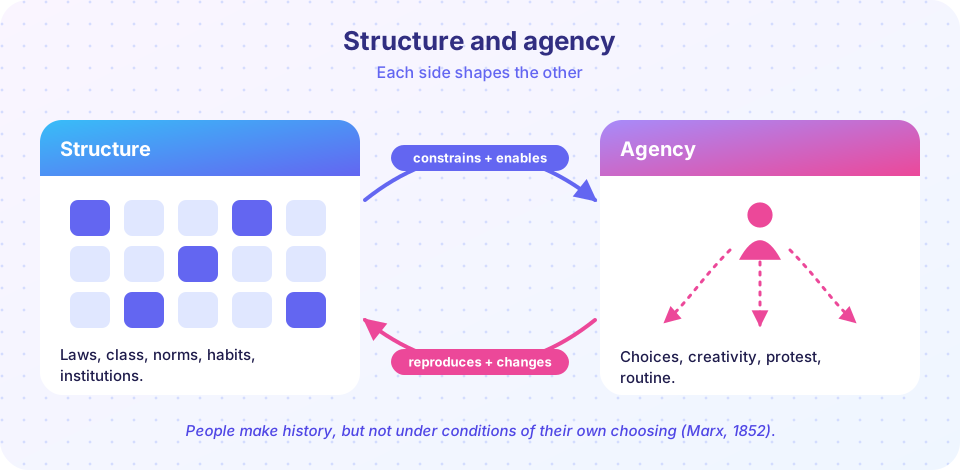
Think of structure as the rules, resources and relationships you did not create but must live within. A law forbids some actions. A labor market offers some jobs and not others. A class system makes certain schools, networks and opportunities more or less accessible. Structure can be material (money, buildings, borders) and cultural (norms, beliefs, language).
Structure does two things at once. It constrains: you cannot easily buy a house if banks will not lend to you. It enables: the rules of grammar let you say things that others understand; a legal system lets strangers trust a contract. Without structure, social life would be chaos. Durkheim emphasized this side: social facts press on individuals from outside.
Agency: people as actors
Agency is the power to act, choose, resist or invent. Even under strict rules people interpret them, bend them, ignore them or protest. Symbolic interactionists, such as Mead and Goffman, stressed that people actively create meanings and shape situations. Weber insisted that social action is shaped by the meanings actors attach to it. Examples of agency include a teenager who defies a dress code, a group of workers who form a union, a community that starts a food cooperative.
Agency is not unlimited free will. People choose from the options they perceive, using the resources they have. A person with little money and no social contacts has the same capacity to choose as anyone, but a narrower menu.
The classic positions
A simple map:
- Structure-first views (some functionalist and some Marxist accounts) treat individuals largely as products of social forces. Durkheim's social facts and Marx's economic base fit here, although Marx himself was subtler.
- Action-first views (some interactionist and rational-choice accounts) start from individuals and explain society as the result of their choices and interpretations.
Marx captured the tension in a line from 1852: people make their own history, but not under circumstances of their choosing; they inherit conditions from the past. That is already a two-sided view.
Combining the two
Two modern thinkers made the combination central.
Anthony Giddens (born 1938) proposed structuration theory. Structure exists only in the way people act: when we follow rules, we reproduce them; when enough people stop following them, structure changes. The language you speak is a structure, but it lives only when people speak it, and it changes as they do. So structure is both the medium and the outcome of action. This is the loop shown in the picture.
Pierre Bourdieu (1930-2002) introduced habitus: the system of habits, tastes and ways of moving, speaking and judging that we absorb from our social position, often unconsciously. A child raised in a home full of books develops a comfort with schooling that feels natural; another child may find school alien. Habitus makes people act in ways that fit their position (reproducing structure) but also allows improvisation. Bourdieu also described forms of capital: economic (money), cultural (education, tastes), social (networks) and symbolic (prestige), which people use in "fields" such as education or art.
Others, such as Margaret Archer, argue that structure and agency should be separated for analysis, because structures exist before the individuals who meet them and later outlast them; she suggests studying how structures condition action, how people act, and how structure is then altered, in sequence over time.
An example: choosing a degree
Imagine a student deciding whether to go to university.
- Structure: tuition fees, the availability of scholarships, the job market, the number of places, family wealth, national policy.
- Agency: her interests, her interpretation of risks, the decision to apply anyway, the way she persuades her family.
- Interaction: thousands of similar choices create a national pattern (enrollment rates by background) which then changes policy and employers' expectations (structure again).
A good sociological account tells all three parts of the story: what limits and opens options, what people actually did, and how the pattern feeds back.
Why the debate matters
If structure explains almost everything, change seems impossible and individuals appear powerless. If agency explains everything, inequality looks like a matter of effort and morality. Both extremes mislead. Policy debates, from school reform to crime prevention, often turn on how much weight they give to each. As a student of sociology you will keep asking: what limits action here, what do people do within and against those limits, and how do their actions change the limits?
Common misconceptions
"Structure is just another word for the government." Structure includes laws, but also norms, language, markets, family patterns and habits.
"Agency means total freedom." Agency is always exercised within constraints and with available resources.
"Structure never changes." Structures change slowly or suddenly through collective action, technological change, war and policy.
"Sociologists deny free will." Most sociologists focus on patterns and conditions, not on denying that people choose.
Try it
First, a model of reproduction and change. A population follows a convention (say, a greeting) mainly because most others do. A few people act differently regardless of convention (agency). Change the share of "rebels" and see whether the convention survives. This toy model uses made-up rules to show how structure is sustained and changed by action.
Press Run (or Ctrl + Enter) to see the result here.
Program input · what you'd type while the program runs
Type the answers before you press Run, one per line. Each time the program reads a line (with input()), it gets the next line from this box.
Second, practice describing a situation with both ideas. Pick a scenario and sort the facts into structure and agency; then see the combined sentence.
Check your understanding
Quick check · 5 questions
of 5 answered You scored / 5 · perfect!
-
1. In sociology, structure refers to
Structure includes laws, norms, institutions and resources that constrain and enable what people do. -
2. Which describes agency?
Agency is the power to act, exercised within the options people have. -
3. Giddens's structuration theory says that structure is
Structures are reproduced or changed by the very actions they make possible. -
4. Bourdieu's habitus is best described as
Habitus is a system of dispositions that feels natural but is socially acquired. -
5. A student starts a petition that leads her school to change a rule. This shows
Collective action altered a rule, an example of action reshaping structure.
Summary
- Structure is the set of patterns, rules and resources that constrain and enable action; agency is the capacity to act and choose.
- Early theories leaned to one side; Marx's line already states both, and modern theorists combine them.
- Giddens sees structure as medium and outcome of action; Bourdieu stresses habitus, capital and fields.
- Good analysis explains what limits and opens options, what people did, and how their actions feed back.
Next: Chapter 2 Review
Track your progress
Create a free account to tick off lessons and pick up where you left off on any device.
of Sociology lessons completed