


















Lesson 8 of 46 · The Sociological Imagination
Durkheim and Suicide
How Émile Durkheim showed that suicide rates reflect social forces: integration and regulation, his four types, the evidence he used and the main criticisms of the study.
Few acts seem more private than a person's decision to end their own life. That is exactly why Émile Durkheim chose it in 1897. If he could show that even suicide follows social patterns, he would prove that sociology had a subject matter of its own, separate from psychology. His book Suicide became a founding model of empirical sociology, and it remains a good example of the sociological imagination at work.
Care note. This lesson discusses suicide as a social science topic, using group statistics and no description of methods. If it is hard to read for any reason, skip it. If you or someone you know is struggling, please talk to a trusted person or contact local emergency services or a crisis line in your country.
What you will learn
- Why Durkheim studied rates rather than individuals, and what a social fact is in this context.
- The two social forces, integration and regulation, and the four types of suicide.
- What patterns Durkheim reported and how he used statistics.
- The main criticisms: ecological fallacy, unreliable statistics, and later reinterpretations.
Key terms
Suicide rate: the number of suicides per 100,000 people in a group and period, which lets groups of different sizes be compared.
Social integration: how strongly people are bound to groups through ties and shared life.
Moral regulation: how firmly norms guide people's wants and conduct.
Anomie: a state of normlessness in which rules and expectations are unclear or have broken down.
Ecological fallacy: wrongly inferring facts about individuals from facts about groups.
The puzzle: stable rates
Durkheim started from a striking observation, made earlier by statisticians such as Adolphe Quetelet: in a given country the number of suicides per 100,000 people changes little from year to year, yet differs systematically between countries, regions and groups. Each death has its own story, but the rates behave like a property of the society. Durkheim concluded that something social must explain them, and that he could find it by comparing rates between groups.
He did not claim that personal troubles are irrelevant. He argued that individual circumstances decide who within a group is at risk on a given day, while social conditions decide how many in the group. That is a division of labor between psychology and sociology that many researchers still use.
Two forces: integration and regulation
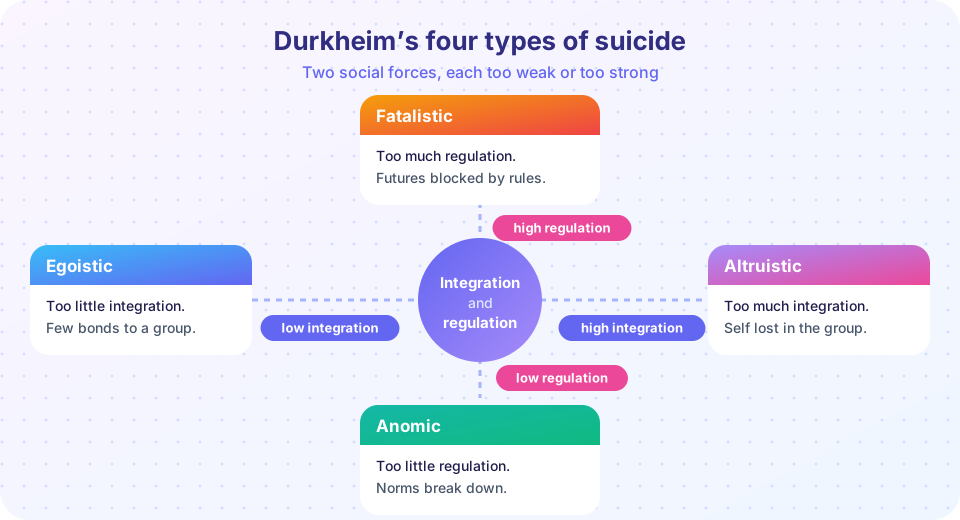
Durkheim proposed that two social forces protect or endanger people:
- Integration: the strength of people's attachment to groups, such as family, religion, community, nation.
- Regulation: how clearly society guides desires and sets limits, so people know what to want and expect.
Each can be too weak or too strong, which gives four types:
| Type | Social condition | Idea in brief |
|---|---|---|
| Egoistic | Too little integration | Few bonds to a group; people are left to themselves |
| Altruistic | Too much integration | The individual is so absorbed that the group's demands outweigh their own life |
| Anomic | Too little regulation | Sudden upheaval, such as economic crash or boom, leaves people without guidance |
| Fatalistic | Too much regulation | Oppressive rules and blocked futures; Durkheim treated this type only briefly, in a footnote |
What Durkheim found
Using official statistics from several European countries, he reported patterns such as these:
- Rates tended to be higher among Protestants than Catholics in comparable regions, and lower among Jews. He argued that Catholic and Jewish communities had stronger integrated communities and shared practices, while Protestantism emphasized individual conscience.
- Rates were higher among the unmarried than the married, and married people with children had the lowest rates, which he read as the protective effect of family integration.
- Rates tended to rise during economic crises and also in some periods of sudden prosperity, which he read as anomie: when conditions change fast, old norms stop guiding aspirations.
- Rates were relatively high among military personnel in some countries, which he linked to the strong group demands of army life (altruistic type).
Notice his method: he looked for correlations between a social variable (religion, marital status, economic change) and the rate, and ruled out explanations such as climate, race or imitation by comparing alternatives. This was a clear model of how to move from a pattern to a social explanation.
Criticisms and later work
Durkheim's study is rightly called a classic, but it is not the final word.
- Ecological fallacy. Durkheim compared group rates, not individuals. A region with more Protestants having a higher rate does not show that Protestants themselves died more often; other factors in the region might be responsible. Modern researchers use individual-level data to avoid this problem.
- Unreliable statistics. Jack Douglas (The Social Meanings of Suicide, 1967) and others argued that official figures reflect how coroners and families classify deaths, and groups with stronger stigma may hide cases. If so, differences between groups might partly reflect reporting, not behavior.
- Vague concepts. "Integration" and "regulation" are hard to measure, and the types overlap.
- Individual explanations. Psychologists and psychiatrists stress that mental illness and personal history matter. Most researchers now accept that both individual and social factors matter.
Even so, later studies using better data often find that social isolation, lack of support and sudden disruption are associated with higher risk, which supports the broad direction of Durkheim's argument. His idea of anomie also grew into Robert Merton's strain theory of deviance (chapter 5).
Why this study matters for learning sociology
Beyond suicide, the book models a whole way of working:
- pick a social fact (a rate),
- compare groups,
- propose a social explanation,
- test it against alternatives,
- and admit limits in the data.
When you meet claims such as "single people are less happy" or "cities cause crime", you can ask the same questions: what is being compared, what else could explain it, and how reliable are the numbers?
Common misconceptions
"Durkheim proved suicide has nothing to do with psychology." He argued for a social explanation of rates, not a denial of individual factors.
"Stable rates mean no one is free to choose." Rates describe patterns across many people; they do not remove individual responsibility or meaning.
"Statistics from the 1800s are reliable." Official statistics reflect how deaths were recorded; later critics showed they can be biased.
Try it
First, a simulation that shows why rates are stable while individual events are unpredictable. Each year, each person in a town has a small, fixed chance of the event. The counts vary a little by chance, but the rate barely moves, and differences between groups with different underlying risk are clear. The numbers are invented and illustrate only the statistical idea.
Press Run (or Ctrl + Enter) to see the result here.
Program input · what you'd type while the program runs
Type the answers before you press Run, one per line. Each time the program reads a line (with input()), it gets the next line from this box.
Second, an interactive map of the two forces. Move the sliders to set how integrated and how regulated a community is, and see which of Durkheim's risks is most prominent. It is a teaching model of his argument, not a prediction tool.
Check your understanding
Quick check · 5 questions
of 5 answered You scored / 5 · perfect!
-
1. Why did Durkheim analyze rates rather than individual cases?
Rates behave like a property of the group, and comparing them across groups lets social explanations be tested. -
2. Which type of suicide did Durkheim link to too little integration?
Egoistic suicide arises when people have few bonds to groups. -
3. What does the ecological fallacy mean here?
A group-level correlation need not hold for each individual in the group. -
4. Anomie describes
It describes weakened or unclear norms, such as in sudden economic upheaval. -
5. Which is a fair criticism of Durkheim's study?
Later scholars such as Jack Douglas showed that official figures reflect classification practices.
Summary
- Durkheim showed that even suicide follows social patterns by comparing rates across groups.
- He proposed two forces, integration and regulation, and four types: egoistic, altruistic, anomic and fatalistic.
- His method modeled how to move from correlation to social explanation, but it has limits: ecological fallacy, shaky statistics and vague concepts.
- Social and individual explanations are complementary, and the topic deserves care and compassion.
Next: Structure and Agency
Track your progress
Create a free account to tick off lessons and pick up where you left off on any device.
of Sociology lessons completed