


















Lesson 25 of 46 · Deviance and Social Control
Chapter 5 Review: Deviance and Social Control
Review chapter 5: deviance as a social definition, Durkheim, Merton, Sutherland, Hirschi, Becker and Lemert, crime statistics, with a recap table and a ten-question quiz.
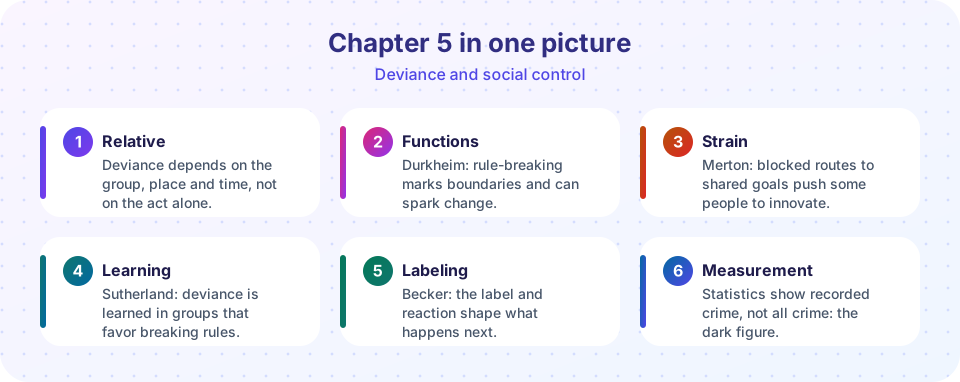
You have now met five ways of explaining rule-breaking and one big warning about how it is counted. This review puts them side by side so you can compare them and spot which theory fits which case.
What you will learn
- Compare the theories of deviance on cause, level and evidence.
- Match a case to the theory that explains it best.
- Rehearse the measurement cautions that apply to any crime statistic.
Key terms
Anomie: weak or confused norms. Strain: pressure between goals and legitimate means. Differential association: learning deviance in close groups. Secondary deviance: deviance that follows a label. Dark figure: crime missing from official counts.
Recap table
| Theory | Key thinkers | Main question | Core claim |
|---|---|---|---|
| Functionalist | Durkheim | What does deviance do for society? | Some deviance is normal; it marks boundaries and can spark change |
| Strain | Merton, Cloward and Ohlin, Agnew | Why do blocked goals lead to rule-breaking? | Shared goals plus unequal means create pressure |
| Learning | Sutherland | How is deviance learned? | Through an excess of favorable definitions in close groups |
| Control | Hirschi | Why do most people conform? | Strong social bonds restrain behavior |
| Labeling | Becker, Lemert, Goffman | What does reaction do? | Labels and sanctions can create secondary deviance and stigma |
No single theory covers everything. Strain is strong on property crime and motives, learning on group patterns, control on why most conform, labeling on how official reactions shape lives. Sociologists often combine them.
A quick tool
Matching cases to theories
- A teenager who joined a group that brags about shoplifting begins to steal: differential association.
- A talented graduate with no way into the profession starts selling fake diplomas: strain (innovation).
- A young person with a minor offense can no longer get a job, and drifts toward repeated offending: labeling (secondary deviance).
- A person with a loving family, a job they value and strong beliefs never offends: control theory (strong bonds).
- A society passes a harsh new law and then points to its own rising arrest numbers as proof of a crime wave: measurement and the dark figure.
Check your understanding
Quick check · 10 questions
of 10 answered You scored / 10 · perfect!
-
1. Which thinker argued that some crime is normal and can promote change?
Durkheim's Rules of Sociological Method (1895) made this claim. -
2. In Merton's typology, ritualism means
The ritualist follows approved means without believing in the goal. -
3. Which theory stresses the learning of definitions favorable to rule-breaking?
Sutherland's theory focuses on learning in intimate groups. -
4. Hirschi's control theory asks why
It starts from conformity and explains it through social bonds. -
5. A label that overrides all other parts of identity is a
Master status can crowd out everything else a person is. -
6. Which is a formal sanction?
Formal sanctions come from organizations with official power. -
7. Police-recorded crime rises 20% after a campaign encourages reporting. The most careful conclusion is
A second source can separate real change from changes in reporting. -
8. Cloward and Ohlin's contribution was to show that
Differential opportunity theory extended Merton's strain idea. -
9. Which source asks households about victimization whether or not they told police?
Victimization surveys reach people outside the police system. -
10. A sociologist says 'deviance is relative.' This means
Norms and their enforcement vary across settings.
Summary
- Deviance is defined by groups and enforced informally or formally.
- Five theories answer different questions; strong analysis often combines them.
- Official statistics reflect reporting and recording as well as behavior.
- Chapter 6 turns to the structure that sits behind much of this: inequality.
Track your progress
Create a free account to tick off lessons and pick up where you left off on any device.
of Sociology lessons completed