


















Lesson 35 of 46 · Institutions: Family, Education, Religion
Chapter 7 Review: Family, Education and Religion
Review chapter 7: social institutions, four lenses, family forms and the second shift, the hidden curriculum and cultural capital, religion and secularization, with a ten-question quiz.
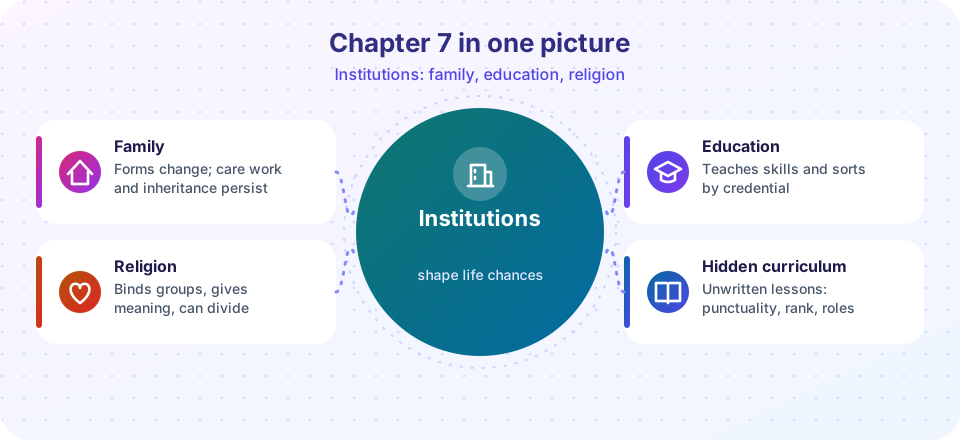
Chapter 7 looked at three institutions that touch almost every life. Each lesson used the same few tools: a function question (what need does it meet?), a conflict question (who benefits?), and a meaning question (what does it mean to the people inside?). This review lets you compare the three side by side.
What you will learn
- Compare family, education and religion using the same four lenses.
- Recall key thinkers and terms from the chapter.
- Check your understanding with a ten-question quiz.
Key terms
Manifest and latent functions: intended versus unintended effects (Merton). Cultural capital: non-monetary advantage such as knowledge and manners (Bourdieu). Second shift: unpaid domestic work after paid work (Hochschild). Collective effervescence: shared emotional energy of group ritual (Durkheim).
Recap table
| Family | Education | Religion | |
|---|---|---|---|
| Functionalist | Care, socialization, stability | Skills, shared values, role allocation | Solidarity, meaning (Durkheim) |
| Conflict | Inheritance of advantage | Cultural reproduction, credentialism | Comfort that can dull protest (Marx); also fuels protest |
| Feminist | Unpaid work, second shift | Gendered expectations | Gender roles in doctrine and leadership |
| Interactionist | Chosen family, negotiated roles | Labels, expectations, self-fulfilling prophecy | Ritual meaning, identity |
| Key names | Parsons, Hochschild, Cherlin, Coontz | Jackson, Bowles and Gintis, Bourdieu, Lareau, Collins | Durkheim, Marx, Weber, Berger, Norris and Inglehart |
Self-check: who is it?
Spot the lens
- A teacher says, "Schools give every child a fair chance to show what they can do." Functionalist (meritocracy).
- A researcher notes that children from professional families know how to talk to teachers in ways schools reward. Conflict (cultural capital).
- A study of dual-earner couples finds women doing most of the cooking and childcare. Feminist (second shift).
- A study of how teenagers decide what counts as a "real" family dinner. Interactionist.
Check your understanding
Quick check · 10 questions
of 10 answered You scored / 10 · perfect!
-
1. Which is a latent function of school?
Latent functions are unintended or unrecognized effects. -
2. Who developed the idea of the hidden curriculum?
Jackson used it in Life in Classrooms (1968). -
3. Which concept best describes unpaid housework done after paid work?
Hochschild's term for the double burden. -
4. Cultural capital belongs to the thinking of
He used it to explain how schools reproduce class advantage. -
5. Durkheim's central claim about religion is that it
He emphasized solidarity. -
6. Weber's Protestant ethic thesis concerns
He linked Calvinist ideas to the spirit of modern capitalism. -
7. A group in high tension with society that splits from a larger religion is typically a
Sects are high-tension and often break off. -
8. The Coleman Report (1966) found that, in its data,
This focused attention on inequalities outside school. -
9. Peter Laslett's historical research suggested that
It challenged a simple extended-to-nuclear story. -
10. Which statement about secularization is best?
That is why the debate continues.
Summary
- Institutions meet needs and also transmit advantage and meaning.
- Four lenses (functionalist, conflict, feminist, interactionist) give different readings of the same institution.
- Family, school and religion each show both stability and change.
- Chapter 8 turns to how societies change and how sociologists study it.
Next: Chapter 8 Overview: Social Change, Globalization and Research
Track your progress
Create a free account to tick off lessons and pick up where you left off on any device.
of Sociology lessons completed