


















Lesson 30 of 46 · Inequality: Class, Race and Gender
Chapter 6 Review: Inequality, Class, Race and Gender
Review chapter 6: class theories, Lorenz curve and Gini, mobility, race as social construction, gender, intersectionality, with a recap table and a ten-question quiz.
Chapter 6 asked who gets what, and why the pattern lasts. This review collects the main tools: three theories of class, two ways to measure inequality, the idea of social construction, and the idea of intersection. Use it to check what you remember and to practice choosing the right concept for a case.
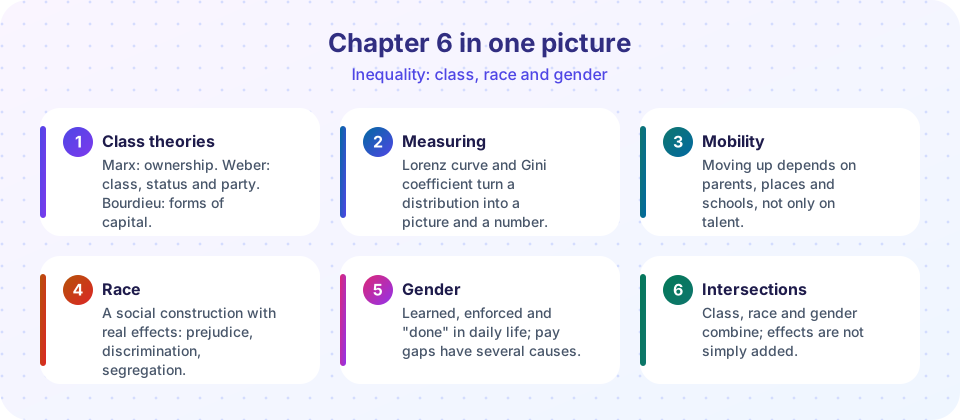
What you will learn
- Compare the main theories and measures of inequality.
- Match a case to the concept that fits it.
- Rehearse the cautions for reading inequality statistics.
Key terms
Stratification: ranking of people by access to resources, power and prestige. Gini coefficient: a number from 0 to 1 summarizing inequality of a distribution. Racial formation: the continual making of racial meanings through politics and culture. Doing gender: producing gender through daily interaction. Intersectionality: the combined effects of overlapping systems of inequality.
Recap table
| Topic | Key ideas | Key names |
|---|---|---|
| Class | Ownership (conflict); class, status, party; economic, cultural, social capital | Marx, Weber, Bourdieu |
| Measuring inequality | Lorenz curve, Gini, top shares, percentile ratios | Lorenz, Gini |
| Mobility | Absolute vs relative; inter- vs intragenerational; link between inequality and mobility | Chetty, Corak |
| Race and ethnicity | Social construction; prejudice vs discrimination vs institutional discrimination; segregation mechanisms | Du Bois, Omi and Winant, Merton, Schelling |
| Gender | Sex vs gender; doing gender; hegemonic masculinity; second shift; motherhood penalty | Beauvoir, West and Zimmerman, Connell, Hochschild |
| Intersectionality | Overlapping systems, combined effects | Crenshaw |
Practice: which concept fits?
Reading inequality evidence: a checklist
- Which measure? Income and wealth differ; Gini and top shares answer different questions.
- Which comparison? Over time, across countries, or across groups?
- Absolute or relative? Everyone can be better off while the gaps widen.
- What is controlled? Adjusting for hours or occupation can hide discrimination built into those variables.
- Which mechanism? A correlation shows a pattern, not by itself why.
Check your understanding
Quick check · 10 questions
of 10 answered You scored / 10 · perfect!
-
1. Which thinker defined class by relation to the means of production?
Marx contrasted owners and workers. -
2. Weber's three dimensions are
Economic position, prestige and organized political power. -
3. On a Lorenz curve, the line of perfect equality is
Each fraction of households would hold the same fraction of income. -
4. A Gini coefficient of 0.53 for a group of ten households means roughly that
Values above about 0.4 usually indicate high inequality in real populations. -
5. Relative mobility concerns
Relative mobility compares the odds across starting positions. -
6. Schelling's model illustrates that
Individual choices can add up to an outcome nobody intended. -
7. Which is institutional discrimination?
Institutional discrimination lives in rules and practices. -
8. Hochschild's 'second shift' refers to
The Second Shift (1989) documented the unequal division of domestic work. -
9. Intersectionality was named by
Crenshaw introduced the term in 1989. -
10. A raw pay gap differs from an adjusted pay gap because the adjusted gap
Adjustment holds measured factors constant, though the controls may themselves reflect constraint.
Summary
- Class theories emphasize ownership, multiple dimensions, or several forms of capital.
- The Lorenz curve and Gini measure how far a distribution is from equality; top shares add detail.
- Race and gender are social constructions with real effects; discrimination operates at individual and institutional levels.
- Intersectionality reminds us that systems overlap.
- Chapter 7 turns to institutions that carry advantage across generations.
Track your progress
Create a free account to tick off lessons and pick up where you left off on any device.
of Sociology lessons completed