


















Lesson 44 of 46 · Projects and Practice
Sociology Glossary
A glossary of sociology terms from deviance, inequality, institutions, change and research methods, with plain definitions, thinkers and a quick term-drill tool.
Sociology has its own vocabulary, and each word carries a bundle of ideas. This glossary gathers the key terms from the whole course, with a short definition and the thinker most linked to the idea. Use it for revision, and try the drill tool at the end.
What you will learn
- Recall short, accurate definitions of core terms.
- Link each term to a thinker and a context.
- Use the terms precisely in your own writing.
Key terms
Concept: an abstract idea that groups together similar things. Theory: a set of linked concepts that explain patterns. Paradigm: a broad perspective such as functionalism, conflict theory or symbolic interactionism.
Foundations
| Term | Definition | Linked thinker |
|---|---|---|
| Sociological imagination | Seeing how personal troubles connect to public issues | C. Wright Mills |
| Social structure | Patterned relationships and positions that shape behavior | Many |
| Norm | A shared rule about how to behave | Sumner (folkways and mores) |
| Value | A shared idea of what is good or desirable | Many |
| Socialization | Learning the norms and roles of a group | Mead, Cooley |
| Role | The behavior expected of a position | Linton, Parsons |
| Institution | A lasting pattern of norms and roles meeting a basic need | Durkheim |
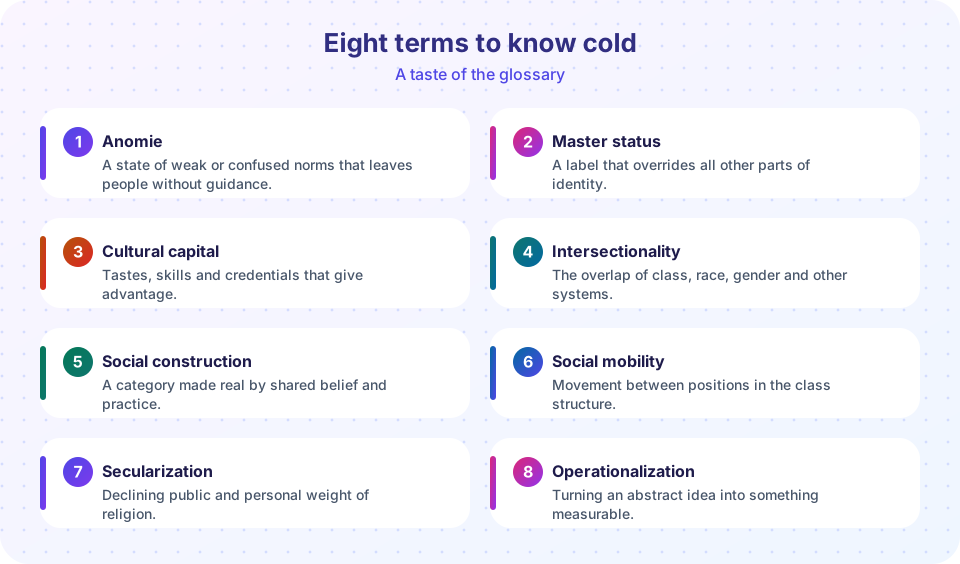
| Social construction | A category made real through shared belief and practice | Berger and Luckmann |
Deviance and social control
| Term | Definition | Linked thinker |
|---|---|---|
| Deviance | Norm-breaking as defined by a group | Becker |
| Anomie | Weak or confused norms | Durkheim |
| Strain | Pressure from a gap between goals and means | Merton |
| Innovation (Merton) | Accepting goals but using unapproved means | Merton |
| Differential association | Learning deviance in close groups | Sutherland |
| Social bond | Attachment, commitment, involvement and belief that restrain deviance | Hirschi |
| Primary / secondary deviance | A first act / deviance that follows being labeled | Lemert |
| Master status | A label that overrides other identities | Hughes, Becker |
| Stigma | A deeply discrediting attribute | Goffman |
| Dark figure of crime | Crime missing from official statistics | Criminology |
Inequality
| Term | Definition | Linked thinker |
|---|---|---|
| Stratification | Ranking of people by resources, power and prestige | Many |
| Class (Marx) | Relation to the means of production | Marx |
| Class, status, party | Weber's three dimensions of stratification | Weber |
| Cultural capital | Knowledge and tastes that bring advantage | Bourdieu |
| Social mobility | Movement between positions | Sorokin |
| Lorenz curve | Plot of cumulative income share against population share | Lorenz |
| Gini coefficient | A 0 to 1 summary of inequality | Gini |
| Racial formation | Racial meanings made and remade through politics | Omi and Winant |
| Institutional discrimination | Unequal outcomes from policies and practices | Carmichael and Hamilton |
| Doing gender | Producing gender in interaction | West and Zimmerman |
| Intersectionality | Overlapping systems of inequality | Crenshaw |
Institutions
| Term | Definition | Linked thinker |
|---|---|---|
| Kinship | Socially recognized ties of blood, marriage and adoption | Anthropology |
| Second shift | Unpaid domestic work after paid work | Hochschild |
| Hidden curriculum | Unwritten lessons taught by school routines | Jackson |
| Correspondence principle | Schools mirror the workplace | Bowles and Gintis |
| Credentialism | Rising certificate requirements as status competition | Collins |
| Collective effervescence | Shared energy of group ritual | Durkheim |
| Protestant ethic | Religious ideas shaping disciplined economic conduct | Weber |
| Secularization | Declining social influence of religion | Comte, Berger, Norris and Inglehart |
Change and research
| Term | Definition | Linked thinker |
|---|---|---|
| Modernization | Shift from traditional to industrial, urban society | Rostow |
| Rationalization | Spread of calculation and bureaucracy | Weber |
| Globalization | Growing cross-border flows and interdependence | Giddens, Robertson |
| McDonaldization | Efficiency, calculability, predictability and control | Ritzer |
| World-systems theory | A single unequal capitalist world economy | Wallerstein |
| Resource mobilization | Movements depend on resources and organization | McCarthy and Zald |
| Framing | How movements define problems and solutions | Snow and Benford |
| Threshold model | Joining depends on how many others have joined | Granovetter |
| Operationalization | Making an abstract concept measurable | Research methods |
| Reliability and validity | Consistency of a measure / measuring what it claims | Research methods |
| Margin of error | Sampling uncertainty in a survey percentage | Statistics |
| Confounder | A third variable that affects both cause and effect | Statistics |
Term drill
Check your understanding
Quick check · 4 questions
of 4 answered You scored / 4 · perfect!
-
1. Which term names pressure from a gap between goals and approved means?
Merton's strain theory. -
2. Who is linked with the term 'second shift'?
The Second Shift (1989). -
3. Which pair of terms belongs together?
The Gini summarizes the area between the Lorenz curve and the line of equality. -
4. A confounder is
It can create a correlation without causation.
Summary
- Terms are tools: each captures a pattern so you can name it, compare it and test it.
- Link terms to thinkers and contexts to remember them.
- Use precise terms in writing, and define them on first use.
Next: Sociology cheat sheet
Track your progress
Create a free account to tick off lessons and pick up where you left off on any device.
of Sociology lessons completed