


















Lesson 32 of 46 · Institutions: Family, Education, Religion
Family and Kinship
Explore family forms and kinship rules, four theoretical lenses on the family, the second shift, and why household patterns are changing, with a time-use model and household classifier.
Almost everyone grows up in some kind of family, and almost every society has some form of kinship. Yet what a family looks like differs enormously: two parents and children, a grandparent in the house, a single parent, a household where several siblings and their partners live together, or a "chosen family" of friends. In this lesson you will learn how sociologists describe those forms, four lenses for explaining what families do, and how family life has been changing.
What you will learn
- Define family, kinship, household, nuclear and extended family.
- Explain descent systems and marriage patterns.
- Apply four lenses to the family.
- Describe the second shift and recent trends in family life.
Key terms
Kinship: relationships of blood, marriage and adoption (and in some cultures, ritual ties) that a society recognizes. Household: people who live together and share living costs; not always a family. Nuclear family: parents and their children; extended family: several generations or relatives living or acting together. Descent: how kinship is traced: patrilineal (through fathers), matrilineal (through mothers) or bilateral (both).
Families and households
A family is a group of people related by kinship, often (but not always) sharing a household. Sociologists use the word carefully because definitions differ across cultures and laws. A household is a unit of residence and shared resources: a person living alone is a household but not a family.
Rules of kinship vary. In some societies descent is traced mainly through the father's line, in others through the mother's, in many through both. Monogamy (one spouse at a time) is the most common legal form today, while polygyny (one husband, several wives) is allowed in some countries. Rules on whom one may marry, where the couple lives, and how property passes also differ.
George Murdock's survey (1949) of hundreds of societies claimed that the nuclear family exists everywhere. Later research has shown that many societies organize care and property around larger kin networks, and that the "universal nuclear family" depends heavily on how one defines it.
Was the extended family replaced by the nuclear family?
Talcott Parsons argued in the 1950s that industrial societies favored the small, mobile nuclear family because workers must move for jobs. Historians such as Peter Laslett (1965) later found that households in pre-industrial England were already often small, so the shift was less sharp than once believed. Many families today are also bound together as "modified extended families" across households through phone calls, money and care.
Four lenses
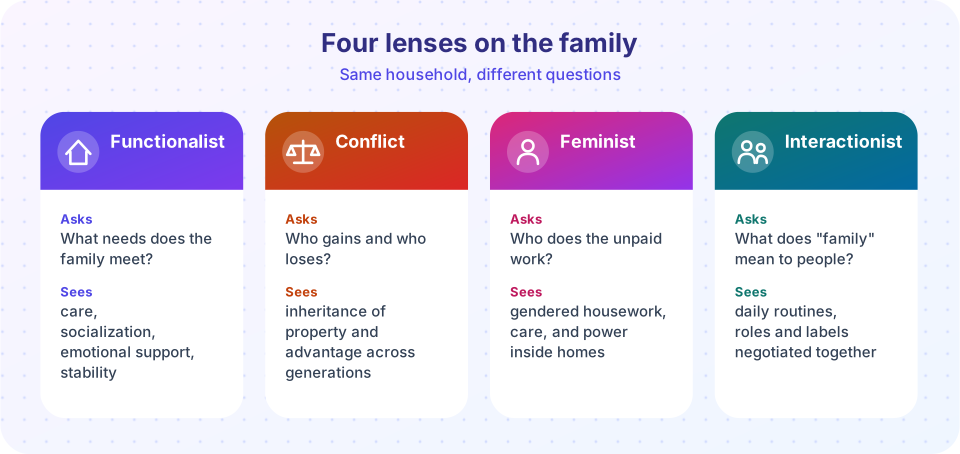
- Functionalist. Families socialize children, provide emotional support and regulate sexuality and reproduction. When these tasks are done well, society runs smoothly.
- Conflict. Families transmit property and advantage. Inheritance, social networks and school choice make family a major engine of inequality. Friedrich Engels linked the monogamous family to private property.
- Feminist. Families are a main site of unequal gender relations: unpaid domestic work, caregiving and sometimes violence. Arlie Hochschild's The Second Shift (1989) showed that women with paid jobs often also did most housework and childcare.
- Interactionist. "Family" is a meaning people construct in daily practice: who counts, what duties are owed, how roles are negotiated. Chosen families and step-families show how meanings are created.
Changing families
Many societies have seen similar trends, with differences in timing and size:
- Later marriage and more cohabitation, and more people who never marry.
- Smaller families and falling birth rates as education and work opportunities expand and as children's survival improves.
- More one-person households and more single-parent households.
- Divorce more common and widely accepted in many places; Andrew Cherlin (2009) described a "marriage-go-round" in the United States with unusually frequent entries and exits.
- Same-sex marriage legal in a growing number of countries.
- Longer lives, creating multi-generation families with more years of care obligations ("the sandwich generation").
Stephanie Coontz (The Way We Never Were, 1992) argued that the 1950s ideal of a breadwinner father and homemaker mother was a short historical blip rather than the long tradition many imagine. Debates continue over how family change affects children's outcomes; many researchers find that income, stability and relationships matter more than the particular structure.
Press Run (or Ctrl + Enter) to see the result here.
Program input · what you'd type while the program runs
Type the answers before you press Run, one per line. Each time the program reads a line (with input()), it gets the next line from this box.
Press Run (or Ctrl + Enter) to see the console output here.
No output.
Common misconceptions
"The traditional family is the nuclear family, and everything else is new." Family forms have always varied, and the 1950s breadwinner-homemaker model was historically unusual and short-lived in many places.
"Family structure alone decides children's outcomes." Income, stability, parenting and neighborhood matter too, and research finds that structure is only one factor.
"Feminist analysis says families are bad." It asks who does what and who benefits; many feminists value family life while criticizing unequal burdens.
Check your understanding
Quick check · 5 questions
of 5 answered You scored / 5 · perfect!
-
1. A household differs from a family because a household
A person living alone is a household but not a family. -
2. Descent traced only through the mother's line is called
Matrilineal descent follows the mother's line. -
3. Which lens emphasizes inheritance of property and advantage through families?
Conflict approaches stress transmission of advantage. -
4. The 'second shift' refers to
Hochschild documented women doing most domestic work in dual-earner couples. -
5. Peter Laslett's research on English households suggested that
It undermined a simple 'extended to nuclear' story.
Summary
- Family and household are not identical; kinship rules, descent and marriage vary across societies.
- Functionalist, conflict, feminist and interactionist lenses highlight different aspects of families.
- Family life is changing: later marriage, smaller families, more diverse households and longer lives.
- The "traditional" family was never one single thing, and household structure is only one influence on well-being.
Next: Education and schooling
Track your progress
Create a free account to tick off lessons and pick up where you left off on any device.
of Sociology lessons completed