


















Lesson 1 of 46 · Getting Started
Course Map: Welcome to Sociology
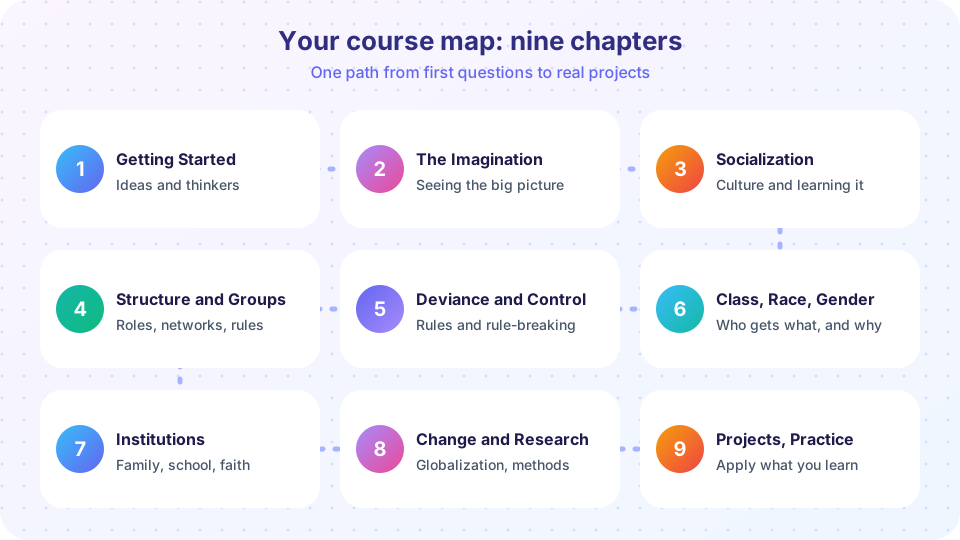
Start here: who this free sociology course is for, what it covers in nine chapters, how to study it, and a short warm-up to see how you already think about society.
Why do some neighborhoods have more libraries and fewer police cars than others? Why do you say "excuse me" to a stranger but not to your sister? Why did your grandparents expect a job for life while you may expect five careers? These questions are about people, but they cannot be answered by looking at one person at a time. They are about society: the patterns of relationships, rules and inequalities that surround every one of us.
Sociology is the discipline that studies those patterns. This course is a complete, friendly introduction that follows the common core of introductory university and upper-secondary syllabi around the world, so it suits school students (about ages 15 to 18), first-year university students and curious adults.
What you will learn
- What sociology is, who built it, and the three classic perspectives (theories) it uses.
- How to look at everyday life with the sociological imagination.
- How culture and socialization shape who we become.
- How roles, groups, networks and organizations structure social life.
- How deviance, inequality, institutions and social change work, and how sociologists research them.
Key terms
Society: a large group of people who share a territory and are bound by institutions, rules and a common culture.
Sociology: the systematic study of human society, social relationships and social patterns.
Social pattern: a regularity in how groups of people behave, such as which age groups vote or which families move.
Theory: a connected set of ideas that explains why a pattern exists.
Evidence: observations, numbers or documents used to test a claim about society.
The nine chapters at a glance
Chapters 1 to 3: the foundations
- Getting Started
- Imagination
- Culture
Chapters 4 to 6: structure and power
- Structure
- Deviance
- Inequality
Chapters 7 to 9: big systems and practice
- Institutions
- Change
- Practice
Chapters 1 to 4 (this part of the course) give you the language and the tools. Chapters 5 to 9 use them on big topics: why societies make and break rules, how inequality is produced, what families, schools and religions do, how the world is changing, and how to do your own small piece of research.
Who this course is for, and what you need
You need no prior knowledge of sociology. You need curiosity and willingness to question things that feel "natural". A little arithmetic helps in the chapters that use data; every calculation is explained and run for you in the code editors.
The course follows an international core. Examples come from many countries, and when a finding is specific to one place (for instance, a famous study in the United States), the lesson says so. Where scholars disagree, you will see the debate instead of a single "official" answer.
Educational information. This course explains how sociologists think. It is general information, not legal, medical or psychological advice. Interactive examples are demonstrations with made-up numbers; they are not surveys of real people.
How to study this course
- Read actively. After each section, close your eyes and restate the idea in your own words, with one example from your own life or country.
- Run the examples. Each lesson has interactive code or widgets. Change a number, predict the result, then run it.
- Use the quiz as a tool, not a verdict. Read the explanations, including for answers you got right.
- Collect evidence, not opinions. Whenever you form a view about society, ask: what evidence would show me I am wrong?
- Review after a few days. Spaced review beats a single long session. The chapter review lessons give you a ready-made routine.
Common misconceptions
"Sociology is just common sense." Common sense can explain any result after the fact, including opposite results. Sociology tests explanations against evidence and often finds that the obvious story is incomplete.
"Sociology blames society and excuses individuals." Explaining why a pattern exists is not the same as excusing a behavior. Sociologists also study choice, creativity and resistance.
"Sociology is only about problems." It also studies friendship, humor, music, cooperation and everyday politeness.
Try it
First, a small planner. The course has roughly 40 lessons. Choose how many lessons you can do each week and see how long it takes.
Second, a warm-up that shows how you tend to explain things. Rate each statement from 1 (strongly disagree) to 5 (strongly agree), edit the list in the code and run it. The script averages your answers on two kinds of explanation. It is a demonstration for reflection, not a psychological or sociological test.
Press Run (or Ctrl + Enter) to see the result here.
Program input · what you'd type while the program runs
Type the answers before you press Run, one per line. Each time the program reads a line (with input()), it gets the next line from this box.
Check your understanding
Quick check · 4 questions
of 4 answered You scored / 4 · perfect!
-
1. Which question is most clearly a sociological one?
Sociology looks for patterns across groups and the social conditions behind them, such as differences between neighborhoods. -
2. What is a theory in sociology?
A theory organizes ideas to explain patterns and can be tested against evidence. -
3. Why is 'sociology is just common sense' misleading?
Common sense is flexible enough to explain almost any outcome afterward. Research checks claims against evidence. -
4. The interactive examples in this course are
They are teaching demonstrations, clearly labeled, and not real data or diagnostic tools.
Summary
- Sociology studies patterns of social life that cannot be seen by looking at individuals alone.
- The course has nine chapters, from foundations through structure, power and institutions to research and practice.
- You need no background; you need curiosity, evidence and willingness to question the obvious.
- Study actively: restate, run the examples, review after a few days.
Next: What Is Sociology?
Track your progress
Create a free account to tick off lessons and pick up where you left off on any device.
of Sociology lessons completed