


















Lesson 15 of 46 · Culture and Socialization
Chapter 3 Review: Culture and Socialization
Review chapter 3: components of culture, norms and sanctions, Cooley, Mead and Goffman, and the agents of socialization, with a loop diagram, flashcards and a quiz.
Culture and socialization form a loop. A group's culture is passed to new members through socialization; socialized people then live, reproduce and sometimes change that culture. This review gathers the chapter's ideas into one picture, one table and one ten-question quiz.
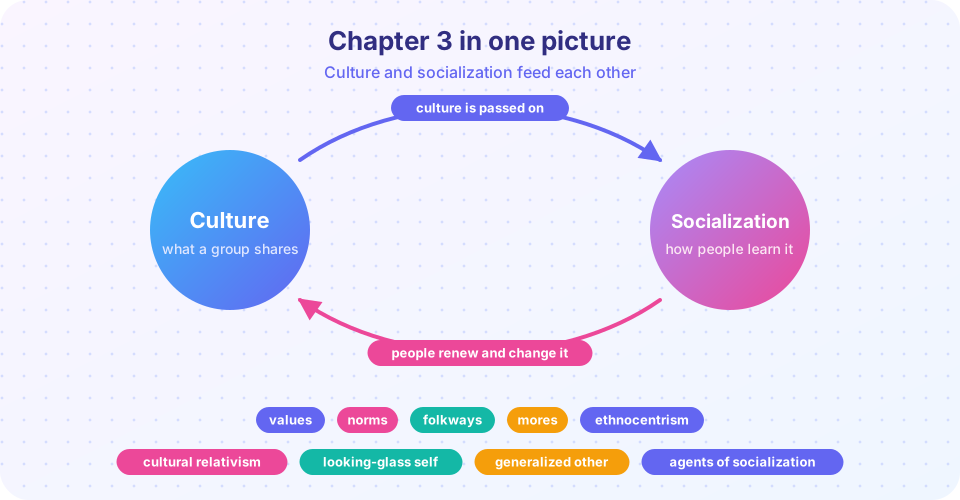
What you will learn
- How the main concepts of chapter 3 fit together.
- Which names and terms to remember for each lesson.
- How to practice with flashcards and the quiz.
Key terms
Culture: the learned, shared symbols, values, beliefs, norms and objects of a group.
Norms: folkways, mores and laws, enforced by sanctions.
Looking-glass self: self-image built from imagined judgments of others (Cooley).
Generalized other: internalized standards of the community (Mead).
Agents of socialization: family, peers, school, media, religion, workplaces and others.
Recap table
| Lesson | Big idea | Names |
|---|---|---|
| What Is Culture? | Symbols, values, norms, objects; folkways, mores, laws; subcultures; ethnocentrism vs relativism | Sumner, Ogburn, Boas, Hofstede |
| Socialization Theories | The self is social; looking-glass self; role-taking stages; impression management | Cooley, Mead, Goffman; Freud, Piaget, Kohlberg |
| Agents of Socialization | Family, peers, school, media, religion, work; hidden curriculum; total institutions | Kohn, Lareau, Jackson, Bowles and Gintis, Goffman |
Linking the ideas
- Values lead to norms, and norms are learned. Socialization is how norms become habits and feelings (shame, pride).
- The self mirrors society. Cooley and Mead show that identity depends on others; Goffman shows how we manage it in front of audiences.
- Agents differ by class and context. Lareau and Kohn show that families socialize children differently, and schools reward some styles.
- Culture changes. Diffusion, innovation and cultural lag mean today's norms are not permanent.
Common misconceptions
"Culture and society are the same thing." A society is a group of people; culture is the shared way of life they follow.
"Ethnocentrism is only a problem for other people." Everyone learns their own culture as normal, so it takes effort to notice.
"Socialization makes everyone alike." Agents conflict, and people interpret and resist.
Try it
First, flashcards for the chapter. Click a card to flip it.
Second, a self-explanation exercise. For each term, write one sentence from your own life in the dictionary and run it. Explaining concepts with your own examples is one of the best study techniques.
Press Run (or Ctrl + Enter) to see the result here.
Program input · what you'd type while the program runs
Type the answers before you press Run, one per line. Each time the program reads a line (with input()), it gets the next line from this box.
Check your understanding
Quick check · 10 questions
of 10 answered You scored / 10 · perfect!
-
1. Which pair is correctly matched?
Cooley described the looking-glass self; Mead the generalized other; the hidden curriculum is associated with Jackson. -
2. A norm backed by formal penalties from the state is a
Laws are written and enforced by the state. -
3. Cultural relativism is best described as
It is a method of understanding, not a rule that nothing can be criticized. -
4. In Mead's stages, the 'game' stage involves
The game stage requires anticipating many people's expectations at once. -
5. Goffman's front stage and back stage illustrate
People manage impressions differently depending on the audience. -
6. Lareau's study suggested that schools tend to reward
She argued that middle-class parenting styles fit school expectations better, in the families she studied. -
7. Which is a limit of evidence from isolated children such as Genie?
Confounding by abuse and neglect makes interpretation difficult. -
8. Cultural lag happens when
Ogburn noted that nonmaterial culture often trails material change. -
9. Which is an example of anticipatory socialization?
Preparing for a role you hope to enter is anticipatory socialization; the uniform example is resocialization. -
10. Which statement about media effects does the chapter support?
Evidence is mixed, so confident causal claims deserve caution.
Summary
- Culture is learned and shared; norms range from folkways to laws and are enforced by sanctions.
- The self is social: Cooley's mirror, Mead's role-taking, Goffman's performances.
- Agents of socialization (family, peers, school, media, work) overlap and change across life; class and context matter.
- Culture and socialization form a loop of reproduction and change.
Track your progress
Create a free account to tick off lessons and pick up where you left off on any device.
of Sociology lessons completed