


















Lesson 6 of 46 · The Sociological Imagination
Chapter 2 Overview: The Sociological Imagination
Preview chapter 2: how to see personal troubles as public issues, Durkheim's study of suicide, and the old debate about whether structure or individual action shapes life.
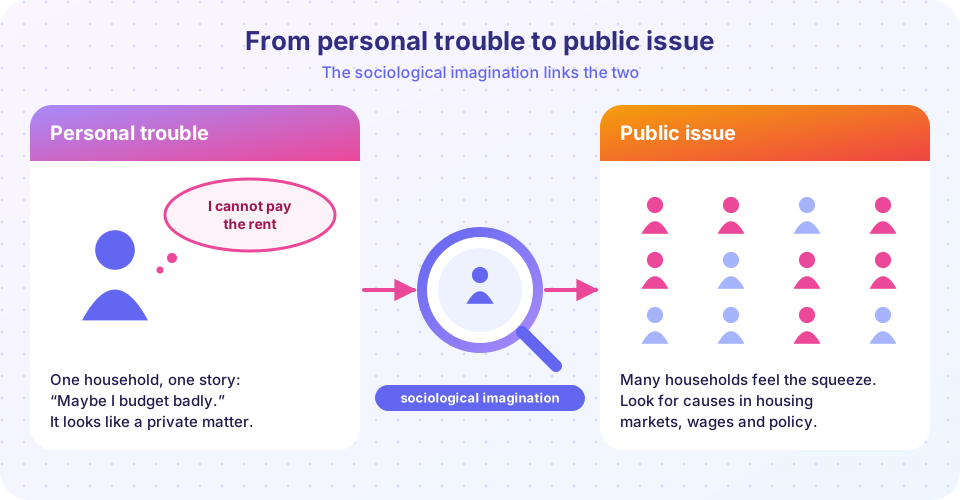
You lose your job. It feels like a personal disaster, and you may blame yourself. Now imagine that a quarter of the people in your town lose theirs in the same year because a factory closes. The pain is the same, but the explanation has moved. It is no longer only about you; it is about how an economy is organized. Seeing that shift, from an individual story to a social pattern and back again, is what the American sociologist C. Wright Mills (1916-1962) called the sociological imagination.
This chapter teaches that way of seeing, shows it at work in Émile Durkheim's famous study of suicide, and examines the oldest argument in the field: do social structures make us who we are, or do individuals make society?
What you will learn
- Why the chapter's central skill is moving between biography and history.
- What each lesson in the chapter covers and how they fit together.
- What you will be able to do by the end of the chapter.
Key terms
Sociological imagination: the ability to see the link between personal experience and larger social forces.
Personal trouble: a problem experienced by an individual within their own circle of life.
Public issue: a problem that affects many people and arises from the structure of society.
Social structure: the recurring patterns of relationships and institutions that organize society.
The chapter at a glance
Step 1: spot the trouble
Step 2: find the pattern
Step 3: test with evidence
What each lesson covers
- The Sociological Imagination: Mills's idea in depth, the difference between troubles and issues, and three questions you can ask about any situation.
- Durkheim and Suicide: how Durkheim turned a most private act into a study of social forces, his four types, and what later scholars say about his data.
- Structure and Agency: how much of life is shaped by rules and institutions, how much by choice, and how recent theorists combine the two.
- Chapter 2 Review: a staircase summary, flashcards and a ten-question quiz.
Why this matters to you
The sociological imagination is a habit, not a fact to memorize. Once you have it, headlines about "lazy students" or "reckless drivers" prompt new questions: what conditions make this more likely? Does the pattern differ between places and eras? What would change it? It does not tell you what to value, but it makes your claims about people more careful and more honest.
Common misconceptions
"The sociological imagination means individuals are never responsible." It asks you to look at both: what people do and the conditions under which they do it.
"Personal troubles are not real problems." They are real and painful. The point is to ask whether the cause also lies beyond the person.
Try it
Sort these statements into personal troubles and public issues, then reveal what Mills would say. Some are both, depending on scale; that ambiguity is the point.
Check your understanding
Quick check · 4 questions
of 4 answered You scored / 4 · perfect!
-
1. The sociological imagination links
Mills described it as connecting biography and history, private troubles and public issues. -
2. A factory closes and a quarter of the town loses work. This is best described as
When many people share a problem rooted in structure, it is a public issue. -
3. Which statement is the better summary of the chapter's attitude?
The chapter builds a balanced view of structure and action. -
4. Who coined the term 'sociological imagination'?
Mills published The Sociological Imagination in 1959.
Summary
- The sociological imagination is the habit of linking personal experience to larger social patterns.
- This chapter covers Mills's idea, Durkheim's suicide study, and the structure-agency debate.
- The aim is balance: social conditions matter, and so do people's choices.
Track your progress
Create a free account to tick off lessons and pick up where you left off on any device.
of Sociology lessons completed