


















Lesson 20 of 46 · Social Structure and Groups
Chapter 4 Review: Social Structure and Groups
Review chapter 4: status and roles, groups and networks, bureaucracy and McDonaldization, with a zoom-out diagram, flashcards, a study planner and a ten-question quiz.
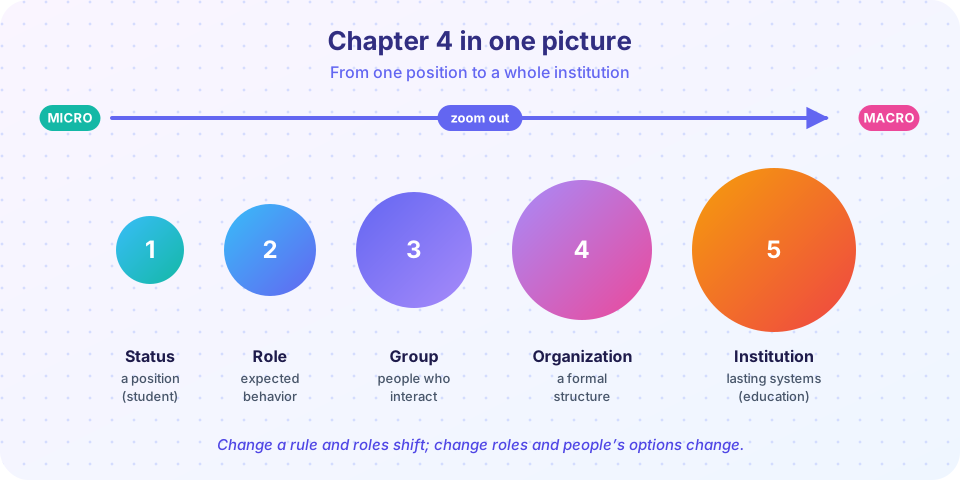
Chapter 4 zoomed out step by step: from one person's position (status), to the behavior expected there (role), to the groups and networks that connect people, and finally to the large organizations that coordinate whole societies. This review puts the five levels in one picture, one table and one ten-question quiz.
What you will learn
- How status, role, group, network and organization link together.
- Which names and ideas to remember for each lesson.
- How to turn the chapter into questions you can ask about real life.
Key terms
Status and role: a position, and the behavior expected of its holder.
Role conflict and role strain: tension between roles, and tension within one role.
Primary and secondary groups: intimate, personal groups versus larger, goal-oriented ones.
Weak tie: a relationship with an acquaintance that bridges circles.
Bureaucracy: hierarchy, written rules, specialization, impersonality and merit.
Recap table
| Lesson | Big idea | Names |
|---|---|---|
| Status and Roles | Statuses (ascribed, achieved, master) carry role expectations; role set; conflict vs strain; role exit | Linton, Hughes, Merton, Goffman, Ebaugh |
| Groups and Networks | Primary and secondary groups; in-group and out-group; ties grow as n(n - 1)/2; conformity and obedience; weak ties | Cooley, Sumner, Simmel, Asch, Milgram, Granovetter |
| Organizations and Bureaucracy | Ideal-type bureaucracy; dysfunctions; iron law of oligarchy; McDonaldization | Weber, Merton, Michels, Ritzer |
Questions to carry into real life
- Status and role. What statuses does this person hold, and what is expected in each? Where do roles conflict?
- Group. Is this a primary or secondary group? Who is in and who is out?
- Network. Who are the bridges? What information flows through weak ties?
- Organization. Which bureaucratic features are visible, and where do informal rules take over?
- Level. Would changing a rule (organization) change roles, groups and people's options?
Common misconceptions
"Strong ties are always better than weak ties." Each helps with different things: strong ties for support, weak ties for new information.
"Rules in organizations are always neutral." Rules can apply equally in form and still affect groups differently.
"A role is who you are." A role is a set of expectations; people interpret and negotiate them.
Try it
First, flashcards for the chapter.
Second, a planner for the whole of chapters 1 to 4. It lists the review dates for each chapter, spaced out. Change the start date and the chapter completion dates.
Press Run (or Ctrl + Enter) to see the result here.
Program input · what you'd type while the program runs
Type the answers before you press Run, one per line. Each time the program reads a line (with input()), it gets the next line from this box.
Check your understanding
Quick check · 10 questions
of 10 answered You scored / 10 · perfect!
-
1. Which is an example of an achieved status?
Qualified electrician is gained by effort, unlike the ascribed statuses. -
2. A nurse is asked to work on the night of her child's concert. This is
Demands of two different roles clash. -
3. How many possible ties are there among 5 people?
5 x 4 / 2 = 10. -
4. Granovetter's 'strength of weak ties' argument says that
Weak ties connect different clusters, giving access to different information. -
5. In Asch's experiments, how did most participants behave on the critical trials?
About three-quarters conformed at least once; across all critical trials, conformity was around a third. -
6. Which is a feature of Weber's ideal-type bureaucracy?
The same rules apply regardless of personal relationships. -
7. Michels's iron law of oligarchy suggests that
As organizations grow, leaders gain expertise and control of information. -
8. Which pair is correctly matched?
Hughes introduced master status, Weber the iron cage and Merton the role set. -
9. A manager asked to be both a friend and a strict boss faces
Contradictory expectations within a single role create strain. -
10. Which statement best sums up the chapter?
Structure shapes action, and action in turn reproduces or changes structure.
Summary
- Statuses and roles are the basic units of structure; role conflict and strain show where expectations collide.
- Groups differ in intimacy and goals; networks of weak and strong ties shape information and influence.
- Bureaucracy brings fairness and efficiency along with dysfunctions; McDonaldization extends its logic.
- Next chapter: deviance and social control, which asks how societies make and enforce rules.
Track your progress
Create a free account to tick off lessons and pick up where you left off on any device.
of Sociology lessons completed