


















Lesson 29 of 46 · Inequality: Class, Race and Gender
Gender and Intersectionality
Sex versus gender, doing gender, the motherhood penalty, why pay gaps have several causes, and Crenshaw's intersectionality, with a pay-gap decomposition and Likert scorer.
Gender is one of the first things people notice about each other, and one of the most organized. Who does the cooking, who runs the company, who gets interrupted in meetings, what a child is told to play with: all of this is shaped by ideas about gender. In this lesson you will learn how sociologists separate sex from gender, why they say gender is something people do, how to read a pay gap, and why Kimberlé Crenshaw argued that gender cannot be studied apart from race and class.
What you will learn
- Distinguish sex, gender identity and gender roles.
- Explain "doing gender" and the concept of hegemonic masculinity.
- Break a pay gap into parts and say what each part means.
- Define intersectionality and give an example.
Key terms
Sex: biological characteristics (chromosomes, hormones, anatomy) used to classify bodies. Gender: the social meanings, roles and expectations attached to being women, men or another gender. Gender identity: a person's internal sense of their own gender. Doing gender: the idea that gender is produced in everyday interaction (West and Zimmerman, 1987). Intersectionality: the way overlapping systems such as race, class and gender combine in people's experience (Crenshaw, 1989).
From sex to gender
Sociologists separate sex (biological classification) from gender (the social layer). The difference matters because many differences between women and men turn out to vary a great deal across societies and periods. Who counts as a "natural" nurse, ruler, farmer or warrior differs between cultures. Simone de Beauvoir wrote in The Second Sex (1949) that one is not born, but rather becomes, a woman.
Many societies recognize more than two gender categories: for example hijra in South Asia, two-spirit people in some Indigenous North American communities and fa'afafine in Samoa. Today sociologists also study transgender and non-binary experience and how institutions such as forms, schools and law respond.
Socialization teaches gender from early childhood: toys, clothes, praise, chores and media. But socialization is not a one-way stamp. People negotiate, resist and reshape what they learn.
Doing gender
Candace West and Don Zimmerman (1987) argued that gender is not just something people have, but something they accomplish through interaction: how they dress, speak, stand and are held accountable by others for acting like a "proper" man or woman. The social order depends on repeated performances and on others' reactions to them.
R. W. Connell (1995) proposed hegemonic masculinity: the culturally dominant ideal of masculinity (toughness, control, breadwinning) that most men do not fully match but are measured against. It also helps keep some men and all women in subordinate positions.
Gender inequality at work and at home
Across most countries, women's average earnings are lower than men's. The size of the raw gap varies by country and measure, but it is often in the range of 10-20% for median full-time earnings in high-income countries. Sociologists and economists then ask where it comes from. Common contributors:
- Occupational segregation: jobs dominated by women often pay less, and pay in an occupation tends to fall when many women enter.
- Hours and career interruptions: because of care responsibilities, women more often work fewer paid hours or take breaks. Claudia Goldin (Nobel Prize, 2023) emphasized "greedy jobs" that reward long, inflexible hours disproportionately.
- The motherhood penalty: in a 2007 audit experiment by Shelley Correll, Stephen Benard and In Paik, otherwise identical applicants who were mothers were rated less competent and offered lower starting pay, while fathers did not suffer the same penalty.
- Direct discrimination and unequal bargaining.
Arlie Hochschild (The Second Shift, 1989) documented how, even when both partners had paid jobs, women often did most of the housework and childcare, a "second shift" of unpaid work at home. Time-use studies in many countries still find women doing more unpaid care, though the gap has narrowed in some places.
Reading a pay gap
A raw gap compares average pay of all women with all men. An adjusted gap compares women and men with similar hours, experience and occupation. Neither is "the truth." The raw gap shows the overall inequality in outcomes. The adjusted gap isolates the part not explained by the measured factors. But some of those "controls", for example occupation or hours, may themselves be shaped by constraint or discrimination, so controlling for them can hide part of the problem. A serious analysis shows both and explains the reasoning.
Press Run (or Ctrl + Enter) to see the result here.
Program input · what you'd type while the program runs
Type the answers before you press Run, one per line. Each time the program reads a line (with input()), it gets the next line from this box.
Intersectionality
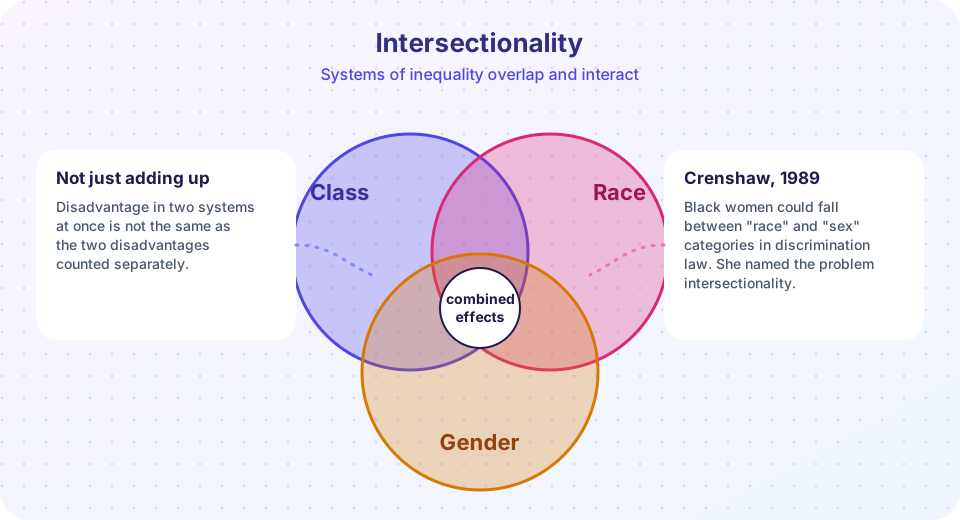
In 1989 Kimberlé Crenshaw examined a legal case, DeGraffenreid v. General Motors, in which Black women argued that the company's hiring policy discriminated against them. The court looked for discrimination as women (the company had hired women, who were white) and as Black people (it had hired Black people, who were men) and found neither. Crenshaw argued that the court failed to see discrimination that arose at the intersection. She called the approach intersectionality.
The key claim: the experience of being, for example, a poor Black woman is not just "gender disadvantage plus race disadvantage plus class disadvantage." The systems interact, sometimes producing unique disadvantages and sometimes unexpected advantages. Researchers now use intersectional approaches in health, education and employment, and debate how best to measure interactions statistically.
Reverse coding matters. If some statements are worded traditionally and others egalitarianly, a straight average would cancel out. Flipping the scale (6 minus the answer on a 1-5 scale) puts every item in the same direction before averaging.
Common misconceptions
"Gender differences are all biological, or all social." Sociology emphasizes the social layer, but it does not deny biology. The evidence shows that many gaps vary strongly across societies and time.
"The adjusted gap is the 'real' gap." It answers a narrower question. A good analysis reports both and explains what the controls hide.
"Intersectionality is only about identity." Crenshaw's point began with law and institutions: how rules fail people who sit at several boundaries at once.
Check your understanding
Quick check · 5 questions
of 5 answered You scored / 5 · perfect!
-
1. Doing gender means that
West and Zimmerman (1987) argued gender is an ongoing accomplishment. -
2. A raw pay gap compares
The raw gap does not control for hours, occupation or experience. -
3. In the Correll, Benard and Paik experiment, which pattern was reported?
Identical applicants who were mothers were rated lower and offered less pay. -
4. Crenshaw's intersectionality highlights that
Her example showed courts missing discrimination at the boundary of race and sex. -
5. Why reverse-code some Likert items?
Otherwise agreeing with opposite statements would cancel out.
Summary
- Sex is biological classification; gender is the social layer of roles, expectations and identity.
- Gender is "done" in interaction, and hegemonic masculinity sets an ideal that shapes hierarchies among men and between women and men.
- Pay gaps come from segregation, hours, penalties and discrimination; both raw and adjusted gaps are informative.
- Intersectionality shows how race, class and gender systems overlap.
Next: Chapter 6 review
Track your progress
Create a free account to tick off lessons and pick up where you left off on any device.
of Sociology lessons completed