


















Lesson 22 of 46 · Deviance and Social Control
Strain Theory and Anomie
Why is some deviance normal? Learn Durkheim's anomie, Merton's five adaptations to strain, and later extensions, with a toy simulation of blocked opportunity.
In 1895 Émile Durkheim shocked readers by arguing that crime is normal: a society without any rule-breaking would be a society with no room for difference or change. In 1938 Robert K. Merton built on that idea and asked a sharper question. What happens when a society tells everyone to chase the same goals but gives only some people the legitimate means to reach them? This lesson follows both thinkers.
What you will learn
- Explain Durkheim's claims that crime is normal and functional.
- Define anomie and describe its link to rapid social change.
- Classify behavior with Merton's five adaptations.
- Name later developments: differential opportunity and general strain theory.
Key terms
Anomie: a condition of weak or conflicting norms; Durkheim's word for "normlessness." Cultural goals: what a society says is worth pursuing, such as wealth or status. Institutional means: the approved routes to those goals, such as schooling and steady work. Strain: the pressure felt when goals and means do not match.
Durkheim: the normality of crime
Durkheim argued in The Rules of Sociological Method (1895) that crime appears in every society, so it is a normal social fact rather than a disease. His reasoning has three parts.
- Boundaries. Punishing an act reminds everyone where the moral line is. A public trial is a lesson in the rules.
- Solidarity. A shared sense of outrage pulls a community together.
- Change. Today's deviance is sometimes tomorrow's morality. People who broke rules once, such as Socrates or abolitionists, helped move norms forward.
He did not say that all crime is good. He said that some amount of deviance is unavoidable and that too much, or a sudden rise, signals trouble.
In The Division of Labour in Society (1893) and Suicide (1897) Durkheim developed anomie. When a society changes very fast, through economic booms, crashes or upheaval, old norms stop guiding people and new ones are not yet clear. Desires have no limit to push against. Suicide compared rates across groups and countries and linked them to how tightly people were integrated and regulated. It is often called the first great quantitative study in sociology, though later critics noted problems with its data and its reasoning.
Merton: strain between goals and means
Merton, writing in the United States, borrowed the word anomie but gave it a new meaning. In his view American culture stressed success, in particular money, to everyone. Yet access to good schools, safe neighborhoods and well-paid jobs was unequal. The result is strain.
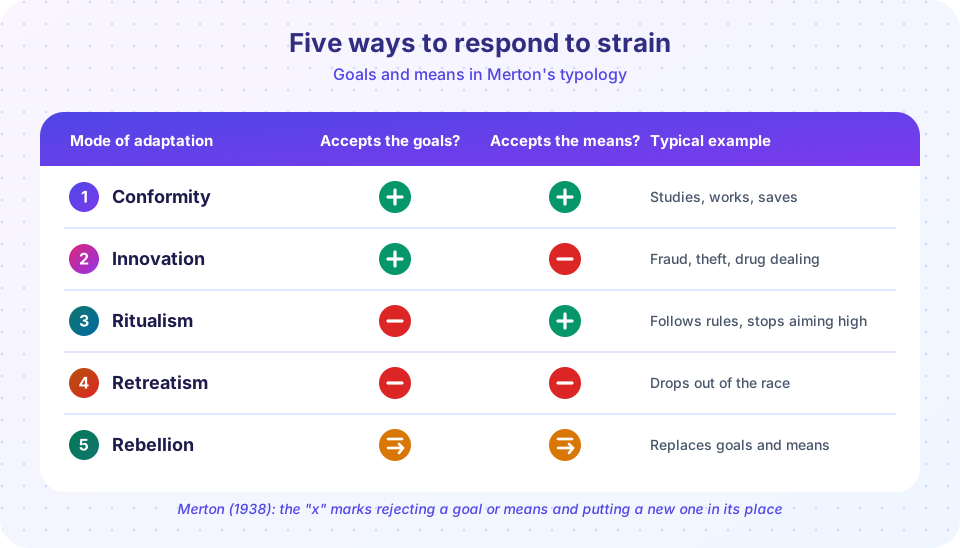
He listed five ways people adapt:
| Adaptation | Goals | Means | Example |
|---|---|---|---|
| Conformity | accept | accept | A student studies hard for a good job |
| Innovation | accept | reject | Someone commits fraud to get rich |
| Ritualism | reject | accept | A clerk follows every rule but has stopped hoping for advancement |
| Retreatism | reject | reject | Someone drops out of mainstream life |
| Rebellion | replace | replace | A group builds a new political order |
Merton stressed that most people conform, even when strained. The theory is about patterns of pressure, not about individual character. It also points to a sociological explanation of why crime rates, such as theft or fraud, may be higher where legitimate opportunity is scarcer.
Worked example
A young person wants to run a successful business, which is the cultural goal. They have no savings, no connections and no access to loans. A neighbor offers quick money for carrying packages for a gang. Merton's reading: the goal is accepted (success), the means are blocked, so a new means (innovation) is adopted. A different person in the same situation might ritually keep a low-paid job without hope (ritualism) or give up (retreatism). Strain explains the pressure, not which route any single person takes.
Press Run (or Ctrl + Enter) to see the result here.
Program input · what you'd type while the program runs
Type the answers before you press Run, one per line. Each time the program reads a line (with input()), it gets the next line from this box.
Extensions and critiques
- Differential opportunity. Richard Cloward and Lloyd Ohlin (1960) added that illegitimate routes are unequally available too. Not everyone blocked from legitimate success can find a gang or a criminal network to join.
- General strain theory. Robert Agnew (1992) widened strain beyond money: losing something valued, facing painful treatment, or failing to reach goals can all produce anger and pressure to cope, sometimes through deviance.
- Critiques. Strain theory explains a lot of property crime but less about violent or expressive crime, and it assumes everyone shares the same goals. Some people value family, faith or community over wealth.
Press Run (or Ctrl + Enter) to see the result here.
Program input · what you'd type while the program runs
Type the answers before you press Run, one per line. Each time the program reads a line (with input()), it gets the next line from this box.
The simulation is not data. It only shows what Merton's logic predicts if its assumptions hold. Testing the theory needs real measures of aspirations, opportunities and behavior.
Common misconceptions
"Strain theory says poor people are criminals." Merton predicted pressure from blocked opportunity, but most people under strain conform. Also, high-status people commit crimes such as fraud (Sutherland's "white-collar crime," next lesson).
"Durkheim praised crime." He claimed that some deviance is normal and has social functions, not that harm is good.
Check your understanding
Quick check · 5 questions
of 5 answered You scored / 5 · perfect!
-
1. Durkheim argued that crime is normal because
He treated some deviance as a universal social fact with functions. -
2. In Merton's typology, a person who accepts society's success goal but uses illegal means is
Innovation means accepting goals while rejecting the approved means. -
3. Which adaptation describes someone who keeps following the rules but no longer believes in advancement?
Ritualists reject (or abandon) the goals but keep the means. -
4. What did Cloward and Ohlin add to strain theory?
Their differential opportunity theory (1960) stressed that routes into deviance are unevenly spread too. -
5. Which statement about the toy simulation is correct?
It is a labelled demonstration; real tests need real measures.
Summary
- Durkheim: crime is normal, marks moral boundaries, builds solidarity and can drive change; anomie is weak regulation during rapid change.
- Merton: when goals are shared but legitimate means are unequal, strain pushes some toward innovation, ritualism, retreatism or rebellion.
- Most people conform even under strain; the theory describes pressure, not destiny.
- Later work added unequal illegitimate opportunity and wider kinds of strain.
Track your progress
Create a free account to tick off lessons and pick up where you left off on any device.
of Sociology lessons completed