


















Lesson 36 of 46 · Social Change, Globalization and Research
Chapter 8 Overview: Social Change, Globalization and Research
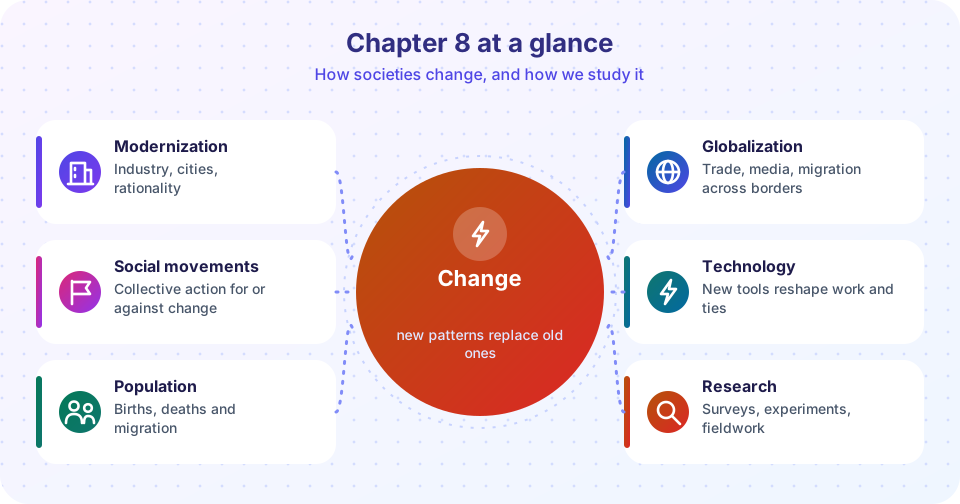
A map of chapter 8: how sociologists explain modernization, globalization, movements and population change, and how they gather evidence about society.
Societies are never frozen. A hundred years ago most people in the world lived in villages and worked the land; today more than half live in cities. Technology, trade, migration, ideas and protest keep rearranging daily life. Social change is the transformation of cultures, institutions and social structures over time. This chapter asks how sociologists describe change, what drives it, and how they find evidence for their claims.
What you will learn
- Describe classic theories of modernization and their critics.
- Name major drivers of change: technology, population, ideas, conflict and movements.
- Explain why research methods matter for claims about change.
- Read a stylized demographic-transition diagram.
Key terms
Modernization: the shift from agrarian, tradition-based societies to industrial, urban, rationalized ones. Gemeinschaft and Gesellschaft: "community" and "society" (Tönnies, 1887): close personal ties versus impersonal, contract-based ties. Demographic transition: the shift from high birth and death rates to low ones as societies develop. Globalization: growing flows of goods, money, people, information and culture across borders.
Classic ideas about change
Nineteenth-century thinkers saw modern society emerging from industry and cities.
- Ferdinand Tönnies contrasted Gemeinschaft (small, personal communities) with Gesellschaft (large, contract-based societies).
- Émile Durkheim contrasted mechanical solidarity (likeness, in small traditional groups) with organic solidarity (interdependence through a division of labor).
- Max Weber described rationalization: calculation, rules and bureaucracy spreading into more areas of life.
- Karl Marx saw change as driven by conflict between classes over who controls production.
Modernization theory (mid-twentieth century, including Walt Rostow's Stages of Economic Growth, 1960) imagined all countries following the path of the early industrializers. Critics said this ignored colonial history and global power. Dependency theory (André Gunder Frank) and world-systems theory (Immanuel Wallerstein) argued that wealth in some regions depends on the poverty of others. Lesson 2 of this chapter looks at that debate.
A snapshot of population change
Population is a major driver of change. The demographic transition model describes how societies move from high birth and death rates to low ones, with a period of rapid growth in between when deaths fall before births do. It is a simplification, because timing, speed and causes differ across countries, but it helps frame questions about urbanization, families and aging.
The lessons in this chapter
| Lesson | Focus |
|---|---|
| Globalization and world systems | Flows across borders, core and periphery, culture and resistance |
| Social movements and collective action | Why people join, resource mobilization, threshold models |
| Sociological research methods | Surveys, experiments, fieldwork, sampling, correlation and causation |
| Chapter 8 review | Compare and quiz |
What drives change?
How do we know?
Each method sees something different.
Common misconceptions
"Change always means progress." Sociologists describe change without assuming it is good. The same change can help some groups and harm others.
"All countries follow the same path." Modernization theory assumed so; later work stresses colonial history, global power and local choices.
Check your understanding
Quick check · 4 questions
of 4 answered You scored / 4 · perfect!
-
1. Tönnies' Gemeinschaft refers to
Gesellschaft is the impersonal, contract-based form. -
2. In the demographic transition, rapid growth occurs because
The gap between falling death rates and still-high birth rates drives growth. -
3. Dependency and world-systems theories were mainly a reply to
They argued that poverty and wealth are linked across the world economy. -
4. Weber's term for the spread of calculation, rules and bureaucracy is
Rationalization is a central theme in his account of modernity.
Summary
- Classic theorists described the move from community to society, and from mechanical to organic solidarity.
- Modernization theory was criticized by dependency and world-systems perspectives.
- Population change, technology, ideas and movements all drive change.
- Good claims about change need good research methods, covered in this chapter.
Track your progress
Create a free account to tick off lessons and pick up where you left off on any device.
of Sociology lessons completed