


















Lesson 5 of 46 · Getting Started
Chapter 1 Review: Getting Started
Review chapter 1 of sociology: definition, levels of analysis, the founders and the three perspectives, with a recap table, flashcards and a ten-question quiz.
You now have the foundations: what sociology is, where it came from and how its main perspectives look at the world. This review pulls the chapter together in one picture, one table and one quiz. Do the quiz first without looking back, then use the flashcards for anything you missed.
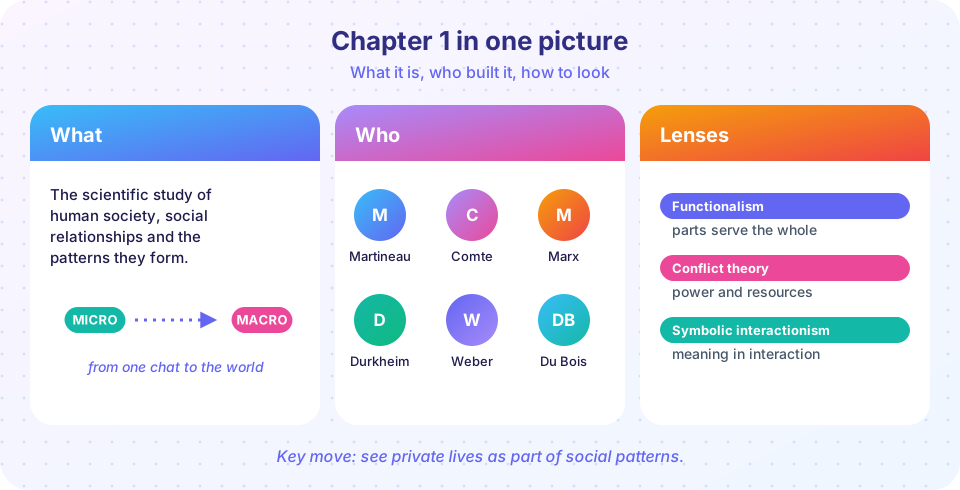
What you will learn
- A one-page summary of chapter 1 you can reuse for revision.
- Which ideas to link together: levels, founders and perspectives.
- A spaced-review routine for the next two weeks.
Recap table
| Topic | Key idea | Names to remember |
|---|---|---|
| Definition | Study of how social relationships, groups and institutions shape lives | Comte (named it, 1838) |
| Levels | Micro (interaction), meso (groups, organizations), macro (societies, global) | |
| Social facts | Shared ways of acting that exist outside individuals and constrain them | Durkheim |
| Class conflict | Owners and workers clash over resources | Marx |
| Meaning and rationalization | Interpretive understanding; rules and calculation spread | Weber |
| Color line, double consciousness | Early empirical study of a Black community; race and society | Du Bois |
| Reform and research | Hull-House, mapping neighborhoods | Addams |
| Self and interaction | The self arises through taking the role of others | Mead, Blumer, Goffman |
| Functionalism | Parts serve the whole; manifest and latent functions | Durkheim, Parsons, Merton |
| Conflict theory | Power, competing interests, inequality | Marx, Weber, Du Bois, Mills |
| Symbolic interactionism | Meanings made in interaction; Thomas theorem | Mead, Blumer, Goffman |
| Feminist theory, intersectionality | Gender and other inequalities overlap | Crenshaw, Collins |
Three connections worth making
- Levels and perspectives. Functionalism and conflict theory mostly work at the macro level; symbolic interactionism works at the micro level. But a macro question can be asked from a micro angle (how do structures show up in a classroom?).
- Founders and perspectives. Durkheim's social facts fed functionalism; Marx's class conflict fed conflict theory; Weber influenced both conflict theory and interpretive work; Mead led to interactionism.
- Who was left out. Martineau, Du Bois and Addams reshaped the field's history. The canon is a story told by people, and it can be rewritten.
Common misconceptions
"The three perspectives are three rival truths." They are complementary lenses. Each answers different questions.
"The founders discovered sociology alone." They built on one another, and many contributors were overlooked.
"Micro means unimportant." Everyday interaction is where structures become real for people.
Try it
First, flashcards for the chapter's terms. Click a card to flip it, then mark whether you knew it. The deck keeps the ones you missed at the front.
Second, a spaced-review planner. Enter the date you finished the chapter and see when to review it. Spacing reviews over days is better supported by memory research than cramming.
Press Run (or Ctrl + Enter) to see the result here.
Program input · what you'd type while the program runs
Type the answers before you press Run, one per line. Each time the program reads a line (with input()), it gets the next line from this box.
Check your understanding
Quick check · 9 questions
of 9 answered You scored / 9 · perfect!
-
1. Which statement about the three main perspectives is accurate?
Sociologists often combine perspectives, using each to see what the others miss. -
2. Who coined the word 'sociology'?
Comte introduced the term in 1838. -
3. Studying how a nation's economy affects unemployment across classes is
Large structures and patterns are macro-level. -
4. Which pairing is correct?
Verstehen is Weber's, and the law of three stages is Comte's. -
5. A rumor about a sound bank makes depositors panic and the bank fails. This illustrates
A false definition of the situation produced real consequences. -
6. Which is a latent function of schooling?
Childcare is an unintended side effect; teaching and certifying are intended. -
7. W. E. B. Du Bois is best known in this chapter for
He wrote The Philadelphia Negro (1899) and The Souls of Black Folk (1903). -
8. Which statement about social patterns is best?
Social patterns describe tendencies and probabilities. -
9. Intersectionality means
The idea comes from Kimberlé Crenshaw and Black feminist thought.
Summary
- Sociology studies how relationships, groups and institutions shape lives, at micro, meso and macro levels.
- The classical thinkers (Comte, Marx, Durkheim, Weber) were joined by Martineau, Du Bois, Addams, Simmel and Mead.
- Functionalism, conflict theory and symbolic interactionism, plus feminist and intersectional approaches, are complementary lenses.
- Review with spaced practice, not one long session.
Track your progress
Create a free account to tick off lessons and pick up where you left off on any device.
of Sociology lessons completed