


















Lesson 12 of 46 · Culture and Socialization
What Is Culture?
Learn the parts of culture: symbols, values, norms, folkways, mores and laws; material and nonmaterial culture; subcultures; and the difference between ethnocentrism and relativism.
Humans do not live by instinct alone. A spider spins a web without lessons; a person has to learn how to greet a neighbor, how to eat soup, what to say at a funeral and what to feel about a flag. That learned, shared, symbolic way of life is culture, and it is humanity's main tool for living together. In sociology, culture is not a polite word for the arts. It means everything a group shares and passes on: language, beliefs, values, rules and the objects they make and use.
What you will learn
- The main components of culture: symbols and language, values, norms and material objects.
- How to tell folkways, mores and laws apart, and how sanctions work.
- What subcultures, countercultures and the dominant culture are.
- The difference between ethnocentrism and cultural relativism, and the limits of each.
Key terms
Culture: the learned, shared beliefs, values, norms, symbols and objects of a group.
Value: a shared judgment about what is good, desirable or important.
Norm: a shared rule or expectation about behavior in a situation.
Sanction: a reward or punishment that enforces norms.
Subculture: a group within a larger society whose values and practices differ in some ways from the dominant culture.
Ethnocentrism: judging other cultures by the standards of your own.
Components of culture
Sociologists often divide culture into nonmaterial and material parts.
Nonmaterial culture includes:
- Symbols and language. A symbol is anything that carries meaning: a word, a gesture, a flag, an emoji. Language lets us store and share knowledge across generations. The Sapir-Whorf hypothesis claims language shapes thought. Its strong form (language determines what we can think) is rejected by most researchers, but a weaker form, that language nudges attention and categories, has some support and remains debated.
- Values. Broad ideals such as freedom, equality, honor, family loyalty or achievement. Values differ between cultures and conflict within them.
- Beliefs. Shared convictions about what is true, from scientific claims to religious ideas.
- Norms. Rules for behavior, described below.
Material culture covers physical objects: tools, buildings, clothes, food, art, technology. Objects carry meaning: a wedding ring is metal, but also a symbol.
Sociologists have noted cultural universals, features found in every known society, such as language, some form of family, funeral rites, cooking, music and rules about incest. George Murdock compiled a famous list in the 1940s. What counts as a family or what music sounds like differs widely: the universal is the category, not the content.
From values to laws: a ladder of norms
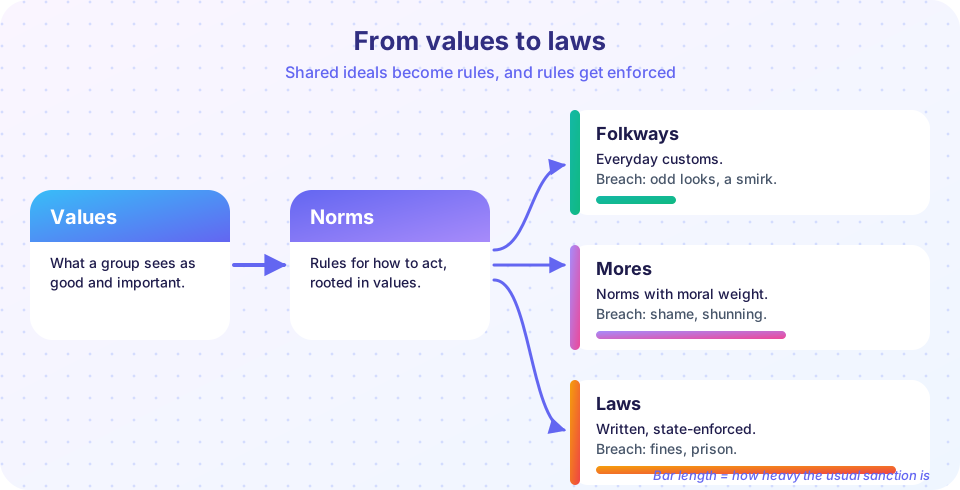
Values are abstract. Norms apply them. William Graham Sumner (1906) distinguished two kinds of informal norms, and sociologists add a third:
- Folkways are everyday customs: using a fork, queuing, which hand to wave. Breaking them draws mild disapproval, a stare or a joke.
- Mores (pronounced MOR-ays) are norms with moral weight: honesty, loyalty, respect for the dead. Violation brings strong disapproval, shame or exclusion. A strongly forbidden mores is a taboo.
- Laws are norms written down and enforced by the state, with fines, prison or other formal penalties.
The same norm can move between levels. Smoking in public once was a folkway; in many places it is now restricted by law. Different societies draw lines differently: what is a folkway in one place may be a mores or law elsewhere.
Norms are enforced by sanctions. Positive sanctions reward conformity (praise, a promotion). Negative sanctions punish deviance (a frown, a fine). Formal sanctions come from official bodies; informal sanctions come from everyday people. Most norms are enforced informally and mostly internalized: we follow them without thinking, because we feel embarrassment or guilt.
Subcultures, countercultures and the dominant culture
Societies are rarely culturally uniform. The dominant culture is the set of values and practices most widely held or backed by the most powerful groups. A subculture shares most of the dominant culture but has distinctive values or styles: skateboarders, gamers, a religious minority, a profession such as nurses with their own jokes and slang. A counterculture actively opposes dominant values, as some 1960s youth movements did. Large societies are often multicultural, with several cultural traditions coexisting, and policy debates ask how to treat differences: assimilation, integration or pluralism.
Pierre Bourdieu argued that tastes labeled "high culture" (opera, classical art) often work as cultural capital, signs of status that help some people succeed. This does not make opera less valuable, but it shows that culture is tied to social position.
How culture changes and spreads
Cultures change through innovation (new technologies, ideas), diffusion (borrowing from other groups: foods, languages, music) and cultural lag, William Ogburn's 1922 term for when material culture (new technology) changes faster than nonmaterial culture (laws and norms). Social media arrived before our rules of etiquette and privacy caught up. Globalization speeds diffusion through trade, migration and media. Some argue it homogenizes cultures; others point to hybridization, where people blend global and local elements.
Judging other cultures
Ethnocentrism, a term Sumner popularized, is judging other cultures by the standards of your own and treating your own as superior or "natural". It makes it hard to understand others and can fuel prejudice. The remedy proposed by Franz Boas and later anthropologists is cultural relativism: try to understand a practice within its own cultural context before judging it. Relativism is a method, not a claim that every practice is equally good. Critics note that strict moral relativism leaves no way to criticize harm, such as violations of human rights, and that cultures are internally divided: who speaks for "the culture"? Many scholars now aim for understanding first, with judgments based on evidence and widely shared human-rights principles.
A related idea is the use of broad "dimensions" to compare national cultures, such as Geert Hofstede's individualism-collectivism scale, built from surveys of IBM employees in the 1960s and 1970s. It is widely cited and widely criticized for treating nations as uniform and for its narrow origin. Use such scales as rough tools, not as descriptions of any individual.
Common misconceptions
"Culture is the same as nationality or race." Culture is learned, not inherited, and is diverse within every nation. Race is a social category, not a cultural one.
"Individuals have no choice because culture decides." People interpret, bend and change cultural rules; see agency in chapter 2.
"Relativism means anything goes." Relativism is a way of understanding. It does not forbid evaluating practices once they are understood.
"Cultural change means losing culture." Change is normal; cultures survive by adapting.
Try it
First, a classification game. Decide whether each breach is a violation of a folkway, a mores or a law. Remember that answers vary across societies: the game uses typical examples from many modern societies.
Second, a Likert scorer that shows how scales like Hofstede's work in principle. Edit the ratings (1 to 5) and run. The six items are original and the result is a demonstration of scoring, not a validated measure of you or any country.
Press Run (or Ctrl + Enter) to see the result here.
Program input · what you'd type while the program runs
Type the answers before you press Run, one per line. Each time the program reads a line (with input()), it gets the next line from this box.
Check your understanding
Quick check · 5 questions
of 5 answered You scored / 5 · perfect!
-
1. Which pair correctly distinguishes folkways and mores?
Sumner distinguished mild everyday customs (folkways) from norms with strong moral significance (mores). -
2. A sociologist describes a counterculture as one that
A counterculture rejects key values of the dominant culture, unlike a subculture. -
3. Ethnocentrism means
It treats one's own way as the natural or superior standard. -
4. Cultural lag, as described by William Ogburn, happens when
Norms and laws often take time to catch up with new technology. -
5. Which is a strength of cultural relativism?
It is a method for understanding. It does not forbid later evaluation.
Summary
- Culture is the learned, shared symbols, values, beliefs, norms and objects of a group.
- Norms form a ladder: folkways, mores and laws, enforced by positive and negative, formal and informal sanctions.
- Societies contain subcultures and countercultures, and cultures change through innovation, diffusion and cultural lag.
- Ethnocentrism judges others by one's own standards; relativism tries to understand first, but cannot be an excuse for harm.
Next: Socialization Theories
Track your progress
Create a free account to tick off lessons and pick up where you left off on any device.
of Sociology lessons completed