


















Lesson 21 of 46 · Deviance and Social Control
Chapter 5 Overview: Deviance and Social Control
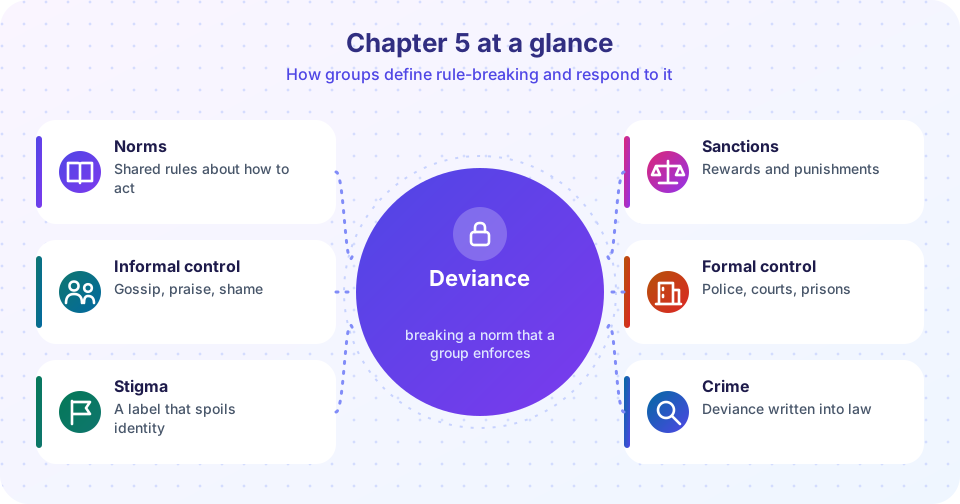
A map of chapter 5: what sociologists mean by deviance, how groups enforce norms through informal and formal control, and what the next lessons cover.
Every group has rules. Some are written into law, such as "do not steal." Others are unwritten, such as "do not talk loudly in a library." Deviance is behavior that breaks a norm that a group cares about enough to enforce. This chapter asks two big questions. Why do people break rules? And who decides which rule-breaking counts, and what happens next?
What you will learn
- Define deviance and explain why it is relative, not fixed.
- Tell informal social control from formal social control.
- Preview the main theories: functionalist, strain, learning, labeling and control.
- Explain why crime statistics need careful reading.
Key terms
Deviance: behavior that violates a norm a group enforces. Social control: the ways a group encourages conformity and discourages deviance. Sanction: a reward or punishment that responds to behavior. Stigma: a deeply discrediting label attached to a person. Crime: deviance that breaks a criminal law.
Deviance is relative
Sociologists do not use "deviant" as an insult. The word describes a relationship between an act and a group. Wearing a swimsuit is normal at a beach and a norm violation in a courtroom. Drinking alcohol is legal in some countries, banned in others, and treated as a rite in some religious settings and a sin in others. The same act can be praised, ignored or punished depending on where and when it happens, and who does it.
This is why the chapter treats deviance as something socially defined. It does not mean all rules are arbitrary. Most societies punish killing people within the group. But even there, the details differ: self-defense, war, executions and medical decisions are judged by different standards in different times and places.
Social control: two kinds
Groups use two toolkits to keep behavior in line.
- Informal social control works through everyday relationships: a raised eyebrow, gossip, praise, teasing, shame, being left out. It is the most common form and often the most effective, because people care what family, friends and neighbors think.
- Formal social control works through organizations that have official power: the police, courts, prisons, regulators, school disciplinary boards. It relies on written rules and recorded decisions.
Sanctions come in positive and negative forms. A promotion, a medal and a thank-you note are positive sanctions. A fine, a suspension and a prison term are negative sanctions.
The big questions and the theories that answer them
| Question | Theory family | Lesson |
|---|---|---|
| Why is some deviance normal and even useful? | Functionalism (Durkheim) | Strain theory and anomie |
| Why do people turn to rule-breaking when legitimate paths are blocked? | Strain theory (Merton) | Strain theory and anomie |
| How is deviance learned? | Differential association (Sutherland) | Labeling and differential association |
| Who gets labeled, and what does the label do? | Labeling theory (Becker, Lemert) | Labeling and differential association |
| How much crime is there, really? | Measurement | Crime statistics and the dark figure |
Why do people break rules?
Who enforces the rules?
Most control is informal.
How do we count it?
Each method misses something.
Common misconceptions
"Deviant means bad or abnormal." In sociology it only means norm-breaking. Some deviance is admired later: many reformers and artists once broke the rules of their time.
"Crime statistics tell us exactly how much crime there is." They count what is reported and recorded. Lesson 4 of this chapter shows how much can be missed.
Check your understanding
Quick check · 4 questions
of 4 answered You scored / 4 · perfect!
-
1. Which statement best matches the sociological meaning of deviance?
Deviance is defined relative to a group's enforced norms, not by morality or rarity. -
2. A neighbor stops speaking to someone who plays loud music at night. This is an example of
No official organization is involved; the group responds through everyday relationships. -
3. Which is a formal negative sanction?
Courts are formal organizations, and a fine is a punishment. -
4. Why do sociologists call deviance 'relative'?
The same act can be accepted in one setting and punished in another.
Summary
- Deviance is norm-breaking as defined by a group; it is relative to time, place and audience.
- Social control is informal (relationships) or formal (organizations with official power).
- Five families of explanation come next: functionalist, strain, learning, labeling and control.
- Statistics about crime and deviance depend on how they are gathered.
Next: Strain theory and anomie
Track your progress
Create a free account to tick off lessons and pick up where you left off on any device.
of Sociology lessons completed