


















Lesson 40 of 46 · Social Change, Globalization and Research
Chapter 8 Review: Social Change, Globalization and Research
Review chapter 8: modernization and its critics, globalization, world-systems theory, social movements, sampling, margins of error and causation, with a recap table and ten-question quiz.
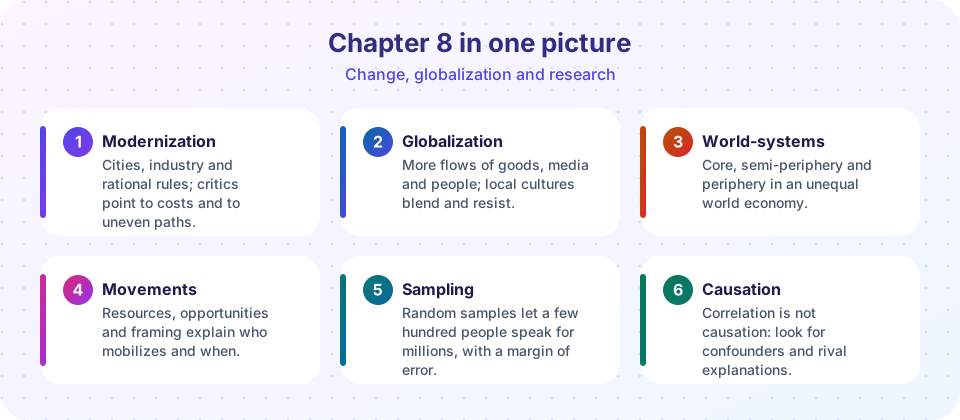
This chapter had two jobs. One was to describe how societies change, through modernization, globalization and social movements. The other was to show how sociologists check such claims: with samples, measures, margins of error and careful thinking about cause. This review ties both jobs together.
What you will learn
- Recall the main theories and terms about change.
- Practice computing a margin of error.
- Test your understanding with a ten-question quiz.
Key terms
Modernization theory: the claim that societies follow a similar path from traditional to industrial. World-systems theory: an unequal world economy with core, semi-periphery and periphery. Threshold model: each person joins collective action once enough others have. Margin of error: the range of sampling uncertainty in a survey percentage.
Recap table
| Topic | Key ideas | Key names |
|---|---|---|
| Classic change theories | Community to society; mechanical to organic solidarity; rationalization | Tönnies, Durkheim, Weber |
| Modernization and critics | Stages of growth; dependency; world-systems | Rostow, Frank, Wallerstein |
| Globalization | McDonaldization; glocalization; scapes | Ritzer, Robertson, Appadurai |
| Social movements | Deprivation; resource mobilization; political process; framing; threshold models | Gurr, McCarthy and Zald, Tilly, McAdam, Snow and Benford, Granovetter |
| Research | Reliability and validity; random sampling; margin of error; confounders; ethics | Durkheim, Whyte, Gallup |
Quick calculator
Pulling it together
- Same event, different lenses. The rise of a protest movement can be read as relative deprivation (grievance), resource mobilization (organization), political opportunity (a divided government), framing (a persuasive slogan) or a tipping point in thresholds.
- Globalization and inequality. World-systems theory says unequal exchange persists; the opposing view points to trade-led poverty reduction. A good answer cites evidence for both.
- Claims about change need evidence. A headline that "online media is destroying community" needs a measure of community, a comparison over time, a representative sample, and an argument that rules out confounders.
Check your understanding
Quick check · 10 questions
of 10 answered You scored / 10 · perfect!
-
1. Tönnies contrasted
Community and society. -
2. World-systems theory was developed by
The Modern World-System (1974). -
3. Which pair is correct?
Ritzer's McDonaldization is about efficiency, calculability, predictability and control. -
4. Resource mobilization theory emphasizes
McCarthy and Zald stressed the resources movements need. -
5. In Granovetter's model, a person with threshold 0
Others need to see participation first, but this person does not. -
6. A large sample drawn from a biased list
Size reduces random error, not bias. -
7. The margin of error of a survey percentage falls when
It shrinks with the square root of n; quadrupling n halves it. -
8. A confounder is
It can produce a correlation without causation. -
9. Which method best supports claims about cause?
Random assignment makes groups comparable. -
10. Dependency theory challenged modernization theory by
It argued underdevelopment is partly produced by the world system.
Summary
- Classic theorists described the shift to modern society; critics showed that paths differ and that global power matters.
- Globalization produces both convergence and hybridity; world-systems theory stresses unequal exchange.
- Movements form where grievances, resources, opportunities and frames align, and thresholds can tip crowds.
- Good research uses valid measures, random samples, margins of error and designs that rule out confounders.
- The final chapter applies these tools in projects and practice.
Next: Project: Survey analysis
Track your progress
Create a free account to tick off lessons and pick up where you left off on any device.
of Sociology lessons completed