


















Lesson 45 of 46 · Projects and Practice
Sociology Cheat Sheet
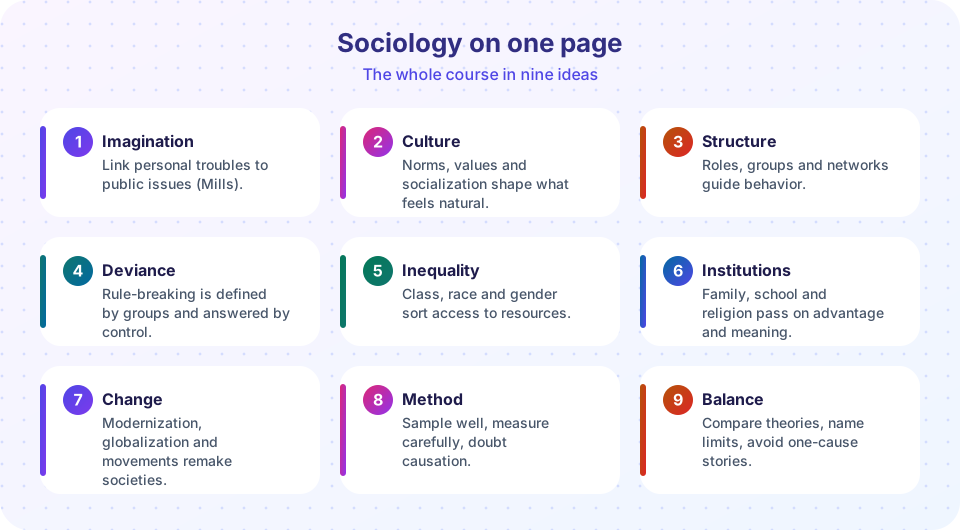
A one-page sociology recap: nine big ideas, the main theories and thinkers, key formulas for Gini and margin of error, and a checklist for judging social claims.
This page compresses the course into something you can read in ten minutes before an exam or a discussion. It does not replace the lessons, but it shows how the big ideas fit together.
What you will learn
- Recall the main perspectives and what each asks.
- Recall the essential formulas for measuring inequality and survey error.
- Use a checklist to judge claims about society.
Key terms
Functionalism: society as a system of parts meeting needs. Conflict theory: society as competition over resources and power. Symbolic interactionism: society built from everyday meanings and interaction. Intersectionality: overlapping systems of inequality.
The three classic perspectives
| Functionalism | Conflict theory | Symbolic interactionism | |
|---|---|---|---|
| Core question | What does this do for society? | Who benefits, who loses? | What does this mean to people? |
| Level | Macro | Macro | Micro |
| Key thinkers | Durkheim, Parsons, Merton | Marx, Weber, Bourdieu | Mead, Cooley, Goffman, Becker |
| On deviance | Normal, marks boundaries | Rules reflect power | Label and reaction create it |
| On education | Teaches values, allocates roles | Reproduces advantage | Expectations and labels |
| On family | Care and socialization | Inheritance of advantage | Negotiated meanings |
Feminist and intersectional approaches cut across these: they ask who does the work and how overlapping systems combine.
Thinkers at a glance
| Thinker | Big idea |
|---|---|
| Durkheim | Social facts; anomie; solidarity; collective effervescence |
| Marx | Class conflict; ownership of the means of production |
| Weber | Class, status, party; rationalization; Protestant ethic |
| Merton | Strain; manifest and latent functions |
| Becker, Lemert, Goffman | Labeling, secondary deviance, stigma |
| Bourdieu | Economic, cultural and social capital |
| Crenshaw | Intersectionality |
| Wallerstein | World-systems: core, semi-periphery, periphery |
| Granovetter | Threshold models of collective behavior |
Formulas you should know
- Gini coefficient for sorted incomes:
G = 2 * Σ(i * x_i) / (n * Σx) - (n + 1) / n - Margin of error (95%, proportion
p, samplen):1.96 * sqrt(p * (1 - p) / n) - Two-proportion z-test:
z = (p1 - p2) / sqrt(pooled * (1 - pooled) * (1/n1 + 1/n2)) - Flat tax with equal payout: new Gini = old Gini *
(1 - t) - Palma ratio: top 10% share divided by bottom 40% share
Checklist for judging a claim about society
- Define terms. What exactly is "crime," "class," "inequality," "religion"?
- Check the measure. Who collected the data, how, and what is missing?
- Check the sample. Random or convenience? How big, how biased?
- Compare. Over time, across places, across groups.
- Look for confounders and reverse causation.
- Ask which perspectives apply, and what each would emphasize.
- State limits. What the evidence cannot show.
Common misconceptions
"Sociology just states the obvious." Many findings are surprising or contested, such as Schelling's segregation model, the dark figure of crime or the effects of selective enforcement.
"One theory is right." Each perspective highlights something real, and strong analyses combine them.
Check your understanding
Quick check · 3 questions
of 3 answered You scored / 3 · perfect!
-
1. Which perspective asks 'Who benefits and who loses?'
Conflict theory focuses on power and unequal advantage. -
2. A flat 30% tax with an equal payout multiplies the Gini by
The factor is 1 - t. -
3. What is the first step of the claims checklist?
Vague terms make claims untestable.
Summary
- Functionalism, conflict theory and symbolic interactionism ask different questions; feminist and intersectional approaches add more.
- Key thinkers and ideas link the chapters: Durkheim, Marx, Weber, Merton, Bourdieu, Crenshaw, Wallerstein, Granovetter.
- Know the Gini, margin-of-error and z-test formulas.
- Use the checklist to judge any claim about society.
Next: Further study
Track your progress
Create a free account to tick off lessons and pick up where you left off on any device.
of Sociology lessons completed