


















Lesson 18 of 46 · Social Structure and Groups
Groups and Networks
Learn primary and secondary groups, in-groups and out-groups, why group size matters, the Asch and Milgram experiments, and Granovetter's strength of weak ties in social networks.
You are never just an individual among strangers. You belong to groups: a family, a class, a team, a friend circle, a nation. You are also tied, directly and indirectly, to thousands of other people through a web of acquaintances. Sociologists study both: groups, which are bounded sets of people who interact and feel they belong together, and networks, which are the patterns of ties that run through and between groups. Both shape what we believe, whom we trust, which jobs we hear about and how easily we resist pressure.
What you will learn
- The differences between a group, an aggregate and a category.
- Primary and secondary groups, in-groups and out-groups, and reference groups.
- How group size changes interaction, from Simmel's dyad and triad onward.
- What the Asch and Milgram studies showed about conformity and obedience, and what critics say.
- What networks are, and why weak ties can be strong.
Key terms
Primary group: a small, intimate group with lasting, personal ties (Cooley), such as family.
Secondary group: a larger, more formal group based on specific goals, such as a company or a class.
In-group and out-group: the group you identify with, and the group set against it (Sumner).
Reference group: a group whose standards you use to judge yourself.
Weak tie: a relationship with an acquaintance, as opposed to a close friend or relative (Granovetter).
Groups, aggregates and categories
Not every collection of people is a group. An aggregate is people in the same place without interaction, such as commuters on a platform. A category shares a characteristic but not necessarily a relationship, such as all left-handed people. A group has regular interaction, shared identity and some sense of "we". The same people can move between types: strangers in a lift stuck between floors can become a group.
Primary and secondary groups
Charles Horton Cooley called family, close friends and similar small groups primary groups: relationships are personal, intense and valued for themselves ("you are important because you are you"). Secondary groups are larger, more impersonal and goal-oriented: employer, a university class, a political party. We are valued for what we do ("your role"). Modern life is full of secondary groups, but primary ties still provide emotional support, and many secondary groups develop primary bonds in small teams.
Robert Bales and others also distinguished instrumental leaders, who focus on tasks and goals, and expressive leaders, who focus on morale and relationships. Effective groups often need both.
In-groups, out-groups and reference groups
William Graham Sumner noted that people tend to divide the world into in-groups, to which they feel loyalty, and out-groups, which they see as rivals or strangers. This distinction supports solidarity but also stereotypes and discrimination. Classic psychology experiments by Henri Tajfel in the 1970s found that even arbitrary labels ("group A", "group B") could produce favoritism toward one's own group, showing how easily such divisions arise.
A reference group provides standards for judgment, whether or not you belong to it. A beginner violinist may compare herself to a professional orchestra; an employee compares his pay to that of friends in similar jobs. Reference groups explain why people can feel deprived even when their situation has objectively improved, a concept called relative deprivation.
Size and structure: Simmel's insights
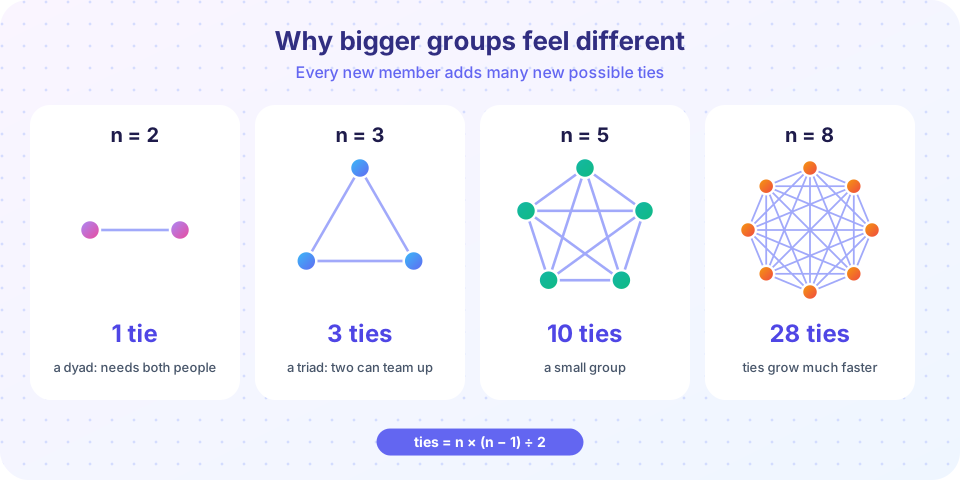
Georg Simmel observed that group size changes the nature of interaction.
- A dyad (two people) is intimate but fragile: if one leaves, the group ends.
- A triad (three) can be more stable, since a third person can mediate, but it also allows coalitions: two against one.
- As groups grow, ties multiply: n people can have n times (n minus 1) divided by two possible ties. Five people have 10, eight have 28, thirty have 435. Larger groups tend to develop formal rules, roles and leaders to manage this complexity, a first step toward organization.
Conformity and obedience
Groups influence individual behavior, sometimes strongly. Two famous experiments illustrate this:
- Solomon Asch (1951, 1956). Participants judged which of three lines matched a standard line. When a group of confederates, secretly working with the experimenter, unanimously gave a wrong answer, about three-quarters of participants went along with the group at least once, although on all the critical trials taken together, the proportion of conforming answers was around a third. Many reported doubting their own eyes, others knew the group was wrong but did not want to stand out. A single dissenter reduced conformity sharply.
- Stanley Milgram (1961-63). Participants were told to give increasingly strong electric shocks (actually fake) to a "learner" when he made errors. In the best-known baseline condition, about two-thirds went all the way to the highest level. Milgram concluded that ordinary people may obey authority even when it conflicts with conscience. Variations showed obedience dropped when the authority was absent, when others refused, or when the victim was close.
Both studies are classics but have limits. Asch's participants were mostly male US students; Milgram's work raised ethical objections about deception and stress, and more recent analyses of archived materials suggest that participants' behavior and beliefs were more varied than the simple "blind obedience" story. Replications under modern ethical rules use milder versions.
Groupthink, a term from Irving Janis (1972), describes how cohesive groups can suppress doubts and make poor decisions, as in some foreign-policy mistakes. It is a hypothesis with illustrative cases rather than a precisely measured effect.
Social networks
A social network is a set of people (nodes) and relationships (ties) among them. Network analysis asks who is connected to whom, how dense the ties are, who sits at the center and who bridges separate clusters.
In 1973 Mark Granovetter published "The Strength of Weak Ties". He surveyed professional and technical workers in a Boston suburb who had recently changed jobs, and found that many had learned of the job through someone they saw only occasionally, not a close friend. His explanation: close friends tend to know the same people and the same information (their circles overlap), while acquaintances belong to different circles and can carry new information across them. Weak ties act as bridges between clusters. This idea has been influential in studies of job searches, innovation and the spread of information. Later research finds it depends on context: for support and trust, strong ties matter more.
Stanley Milgram's 1967 "small world" experiment, in which letters were passed through acquaintances toward a target person, popularized the idea of "six degrees of separation". In 1998 Duncan Watts and Steven Strogatz showed mathematically that a few random long-distance ties can shrink the average distance between people in a mostly clustered network, a result you will try below.
Social capital means the resources people can obtain through their ties. Robert Putnam's Bowling Alone (2000) argued that civic participation in the United States had declined, reducing social capital; other scholars debate the evidence and the role of new forms of connection. Pierre Bourdieu and James Coleman gave earlier definitions.
Common misconceptions
"Everyone is six steps from everyone." Studies find short paths in many networks, but the exact number varies and Milgram's original experiment had low completion rates.
"Conformity is always bad." Conformity helps coordination and cooperation; it is a problem when it silences accurate or moral judgment.
"Obedience studies show people are cruel." They show how situations and authority shape behavior; participants often showed strong distress.
"Weak ties are always more useful." They help with information and opportunities, but strong ties provide emotional support and trust.
Try it
First, an interactive conformity demonstration inspired by Asch. You will see a standard line and three comparison lines. Simulated "other participants" answer first, and on some rounds they all give a wrong answer. This is a classroom-style demonstration with simulated others, not the original experiment.
Second, a small-world simulation. Start with 100 people on a ring, each tied to their four nearest neighbors (a very clustered network). Rewire a small share of ties to random people and measure the average number of steps between pairs. This is a simulation with an invented network, showing the Watts-Strogatz idea that a few weak, long-distance ties shrink distances.
Press Run (or Ctrl + Enter) to see the result here.
Program input · what you'd type while the program runs
Type the answers before you press Run, one per line. Each time the program reads a line (with input()), it gets the next line from this box.
Check your understanding
Quick check · 5 questions
of 5 answered You scored / 5 · perfect!
-
1. Which is a primary group?
Primary groups are small, intimate and personal, such as family and close friends. -
2. Granovetter found that many job seekers learned about their job through
Weak ties can bring new information from outside one's close circle. -
3. In Asch's experiments, what reduced conformity sharply?
When even one other person gave the correct answer, participants conformed much less. -
4. How many possible ties are there among 8 people?
n x (n - 1) / 2 = 8 x 7 / 2 = 28. -
5. A limitation of the Milgram obedience studies is that
Ethical issues and newer reanalysis of archives complicate the popular summary.
Summary
- A group has interaction and shared identity; aggregates and categories do not.
- Primary groups are intimate; secondary groups are formal and goal-oriented; in-groups and out-groups shape loyalty and prejudice.
- Group size changes interaction: ties grow as n(n - 1)/2.
- Asch and Milgram show the power of groups and authority, with important limits and critiques.
- Networks are patterns of ties; weak ties can bridge clusters and carry new information.
Track your progress
Create a free account to tick off lessons and pick up where you left off on any device.
of Sociology lessons completed