


















Lesson 19 of 46 · Social Structure and Groups
Organizations and Bureaucracy
Understand formal organizations and Weber's ideal-type bureaucracy, its strengths and dysfunctions, Michels's iron law of oligarchy, McDonaldization and alternatives to hierarchy.
You were probably born in a hospital, educated in a school, will work in a company or agency, and will deal with a government office for papers. Modern societies are built from formal organizations: large groups deliberately designed to achieve goals efficiently. They are everywhere, and they can be a blessing (they build bridges and run vaccination programs) or a curse (they trap people in forms and rules). The sociological study of organizations began with Max Weber's analysis of bureaucracy.
What you will learn
- What a formal organization is and the main types.
- Weber's ideal-type bureaucracy and why it was an innovation.
- Dysfunctions of bureaucracy, Michels's iron law of oligarchy and informal groups.
- What McDonaldization means and what alternatives to hierarchy exist.
Key terms
Formal organization: a large secondary group with explicit goals, rules and a division of labor.
Bureaucracy: an organization based on hierarchy, written rules, specialization, impersonality and merit-based careers.
Ideal type: a deliberately simplified model used for comparison with real cases.
Iron law of oligarchy: Robert Michels's claim that organizations tend to be run by a small elite.
McDonaldization: George Ritzer's term for the spread of fast-food principles (efficiency, calculability, predictability, control) to other areas of life.
Why organizations?
Complex tasks (running a railway, educating millions, selling insurance) need coordination among many people who do not know each other. Formal organizations solve this by assigning roles, writing rules and keeping records. Amitai Etzioni distinguished three types by how they obtain compliance: utilitarian organizations (businesses) use pay; normative organizations (clubs, charities, churches) rely on shared commitment; coercive organizations (prisons) use force. Many organizations mix types.
Weber's ideal-type bureaucracy
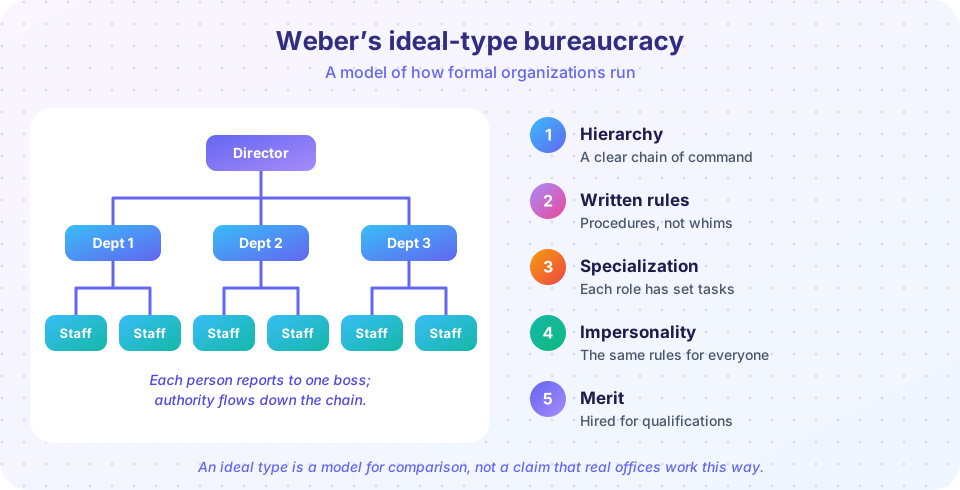
Weber (1864-1920) observed that modern states and companies were becoming more rationalized: guided by calculation and rules instead of tradition or personal favor. He described bureaucracy through an ideal type, a deliberately clear model against which actual organizations can be compared. Its main features:
- Hierarchy of offices. Each office is under the control of a higher one; there is a clear chain of command.
- Written rules and records. Procedures are explicit and decisions are documented.
- Specialization. Tasks are divided so each person develops expertise.
- Impersonality. Rules apply equally regardless of personal connections, so decisions are not based on favoritism.
- Merit-based careers. People are hired and promoted for qualifications and performance, not family or friendship.
Compared with rule by custom, kinship or personal loyalty, this was a major advance in fairness, predictability and efficiency: you can trust a tax office to apply the same rules to you as to your neighbor. Weber also warned of the cost: the spread of rationalization could create an "iron cage" in which people are trapped in rule-bound systems that value efficiency over meaning.
Problems with bureaucracy
Everyday talk of "red tape" captures real issues that sociologists have documented:
- Ritualism and goal displacement. Following rules becomes more important than achieving the goal. Robert Merton called the habit of rigid rule-following trained incapacity: skills that served well in one setting hinder adaptation to new conditions.
- Alienation and lack of flexibility. Specialized tasks can feel meaningless, and rules may not fit unusual cases.
- Inequality inside organizations. Women and minorities have often been excluded from top posts, and rules that appear neutral can have unequal effects.
- Oligarchy. Robert Michels (1911) studied socialist parties and unions and argued that, as organizations grow, leaders gain expertise, control of information and contacts, and tend to concentrate power regardless of democratic intentions. He called this the iron law of oligarchy. Later research finds exceptions where active membership and checks resist concentration.
- Satirical "laws". C. Northcote Parkinson joked in 1955 that work expands to fill the time available, and Laurence Peter in 1969 that people are promoted to their level of incompetence. They are humor, not research findings, but they point at real dynamics.
The informal organization
Real organizations also have informal structures: friendships, shortcuts, gossip and unwritten norms. The Hawthorne studies at a Western Electric plant in the late 1920s and 1930s drew attention to the importance of group norms among workers, which shaped output more than managers' plans. The popular "Hawthorne effect" (people change behavior when watched) has been debated, because the original data were weaker than often claimed. Informal networks can keep a workplace flexible, or they can resist change.
McDonaldization and rationalization today
George Ritzer (1993) argued that the principles of the fast-food restaurant now govern more and more sectors: shopping malls, call centers, education, health care. Its four elements:
- Efficiency: the quickest route to a goal.
- Calculability: emphasis on quantity (size, speed, scores) over quality.
- Predictability: the same service everywhere.
- Control: standardized procedures and technology that reduce human discretion.
Ritzer saw benefits (low cost, convenience) but also irrationalities of rationality: dehumanization, loss of choice and creativity, and homogenization. Critics say he overstated uniformity and overlooked how people customize and resist. Today some digital platforms apply similar principles through algorithmic management, with scheduling and performance tracked by software.
Alternatives to hierarchy
Organizations vary in structure. Some are flat, with fewer layers and more autonomy for teams. Cooperatives are owned and run democratically by workers. Network organizations rely on loose collaboration between firms. Researchers find that no one form works best everywhere: standard rules suit stable, repeated tasks (like issuing passports), and flexible structures suit rapidly changing ones (like software start-ups).
Common misconceptions
"Bureaucracy is just red tape." It also provides fairness, accountability and expertise; the problems arise when rules become ends in themselves.
"Weber thought bureaucracy was ideal in a moral sense." An ideal type is a model, not a recommendation. Weber was ambivalent about its costs.
"Organizations are only formal." Informal relationships often decide how work is actually done.
"The iron law means democracy is impossible." It identifies a strong tendency, but organizations differ and checks on power can work.
Try it
First, the arithmetic of hierarchy. If each manager supervises at most span people, how many layers does an organization of N people need? Edit the numbers and run. The model is a simplification (it ignores part-time or matrix roles), but it shows why large organizations need many levels or very wide spans.
Press Run (or Ctrl + Enter) to see the result here.
Program input · what you'd type while the program runs
Type the answers before you press Run, one per line. Each time the program reads a line (with input()), it gets the next line from this box.
Second, match each example to the feature of Weber's bureaucracy it illustrates.
Check your understanding
Quick check · 5 questions
of 5 answered You scored / 5 · perfect!
-
1. Which is NOT one of Weber's characteristics of bureaucracy?
Bureaucracy rests on merit and impersonality, not favoritism or kinship. -
2. An 'ideal type' is
An ideal type is a conceptual tool, not a moral ideal. -
3. Michels's iron law of oligarchy claims that
He argued that growth and expertise concentrate power in few hands. -
4. Which of these is an element of McDonaldization?
Ritzer's four elements are efficiency, calculability, predictability and control. -
5. In the layers model, what happens when the span of control gets wider?
If each manager supervises more people, fewer levels are needed to cover everyone.
Summary
- Formal organizations coordinate large numbers of people through roles, rules and records.
- Weber's ideal-type bureaucracy has hierarchy, written rules, specialization, impersonality and merit, a source of fairness and efficiency.
- Dysfunctions include ritualism, trained incapacity and oligarchy; informal networks shape real behavior.
- McDonaldization extends efficiency, calculability, predictability and control to many areas, with costs and criticisms.
- Different tasks suit different structures; flat and cooperative forms are alternatives.
Next: Chapter 4 Review
Track your progress
Create a free account to tick off lessons and pick up where you left off on any device.
of Sociology lessons completed