


















Lesson 46 of 46 · Projects and Practice
Further Study: Where to Go After Sociology
Plan your next steps after this sociology course: specialties to explore, classic books, neighboring subjects on this site, and skills that turn sociology into a career.
You now have a toolkit: the major theories, the key measures of inequality and the habits of careful evidence. This final lesson shows where to take it. Sociology is wide, and you can go deeper in a specialty, combine it with a neighboring field, or turn it into practical skills.
What you will learn
- Name specialties within sociology you could explore next.
- Connect sociology to neighboring subjects on this site.
- Pick a starting reading list.
- Turn sociological skills into practical projects.
Key terms
Subfield: a specialized area within a discipline, such as criminology or demography. Interdisciplinary: combining methods and ideas from more than one subject. Applied sociology: using sociological methods to solve practical problems for organizations and communities.
Specialties to explore
- Criminology and sociology of law: crime, policing, punishment and the law (a natural continuation of chapter 5).
- Stratification and inequality: class, mobility, wealth, race, gender and migration (chapter 6).
- Sociology of education and family: schools, households, children and life courses (chapter 7).
- Sociology of religion and culture: belief, ritual, art, media and taste.
- Demography and urban sociology: population change, cities, housing and neighborhoods.
- Medical and health sociology: how social conditions shape health and care.
- Economic sociology and work: markets, firms, jobs and unions.
- Political sociology and social movements: power, states and protest (chapter 8).
- Digital sociology: online communities, platforms, algorithms and social media.
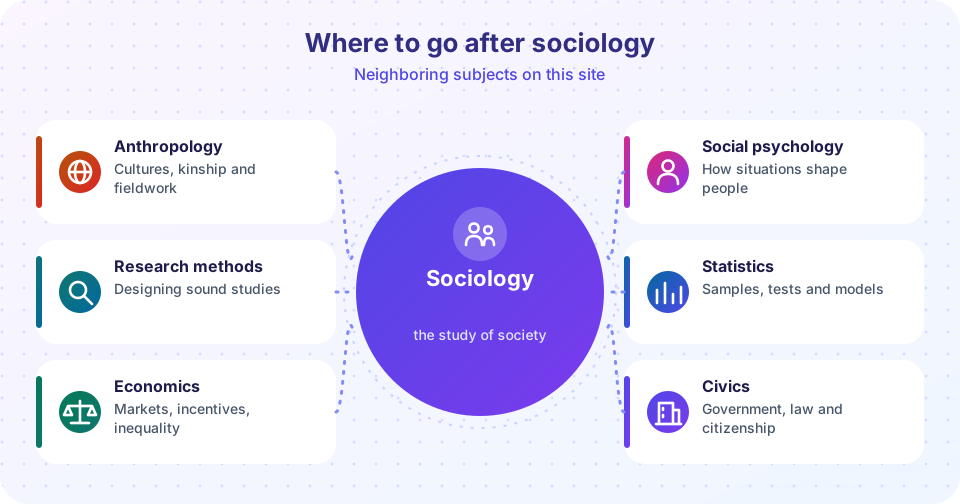
Neighboring subjects on this site
| If you want to... | Go to |
|---|---|
| Study cultures, kinship and fieldwork | Anthropology |
| See how situations shape people | Social psychology |
| Understand how the mind works | Introduction to psychology |
| Design stronger studies | Research methods in psychology |
| Make sense of samples, tests and models | Statistics and probability |
| See how markets and incentives work | Microeconomics and Macroeconomics |
| Understand governments, law and citizenship | Civics and government |
| Put social change in a long timeline | World history |
| Apply ideas to your own money decisions | Personal finance |
A starter reading list
These are classics, each worth a slow read:
- C. Wright Mills, The Sociological Imagination (1959)
- Peter Berger, Invitation to Sociology (1963)
- Erving Goffman, The Presentation of Self in Everyday Life (1959)
- Howard Becker, Outsiders (1963)
- W. E. B. Du Bois, The Souls of Black Folk (1903)
- Arlie Hochschild, The Second Shift (1989)
- Annette Lareau, Unequal Childhoods (2003)
- Robert Putnam, Bowling Alone (2000), on declining civic participation, and the debates it started
- Mark Granovetter, "The Strength of Weak Ties" (1973), an article on how networks spread information and opportunity
Pair each reading with the question: what evidence supports this, and what would count against it?
Skills sociology gives you
- Writing with evidence: claim, evidence, limit.
- Reading data: rates, margins of error, correlation versus causation.
- Interviewing and observing: asking open questions and noticing context.
- Designing surveys: clear questions, sampling and ethics.
- Seeing structure: noticing how rules, incentives and networks shape outcomes.
People who study sociology often work in research, policy analysis, education, public health, community organizations, market and user research, human resources and journalism. Combining sociology with statistics or programming is especially valuable.
Project ideas
- Neighborhood study. Compare two neighborhoods using public data (with an ethical, safe approach).
- School culture audit. Describe the hidden curriculum in a school or club, then write about its unwritten rules.
- Media content analysis. Choose 30 news headlines and code how groups are portrayed. Explain your coding scheme.
- Reproduce a measure. Compute Gini or top-10% share for a country from open data and compare years.
- Model a mechanism. Extend the Schelling or threshold model with one new rule and describe what changes.
Common misconceptions
"Sociology is only about problems." It also studies cooperation, trust, culture and everyday order.
"You need to pick one theory." Most researchers use several, depending on the question.
"Sociology is not a practical subject." The skills of evidence, writing and measurement are widely used.
Check your understanding
Quick check · 3 questions
of 3 answered You scored / 3 · perfect!
-
1. Which subfield focuses on crime, policing and punishment?
It continues the themes of the deviance chapter. -
2. Applied sociology means
It brings research skills to organizations and communities. -
3. A sensible question to ask about any classic reading is
That habit turns reading into critical analysis.
Summary
- Sociology branches into many specialties, from criminology to digital sociology.
- Neighboring subjects on this site (anthropology, social psychology, statistics, economics, civics) deepen different parts of the toolkit.
- Classic readings are best read with a question about evidence.
- The skills of measurement, argument and observation transfer widely.
Return to the Sociology course page to revisit any lesson.
Track your progress
Create a free account to tick off lessons and pick up where you left off on any device.
of Sociology lessons completed