


















Lesson 10 of 46 · The Sociological Imagination
Chapter 2 Review: The Sociological Imagination
Review chapter 2: Mills's troubles and issues, Durkheim's four types of suicide, and the structure and agency debate, with a staircase summary, flashcards and a quiz.
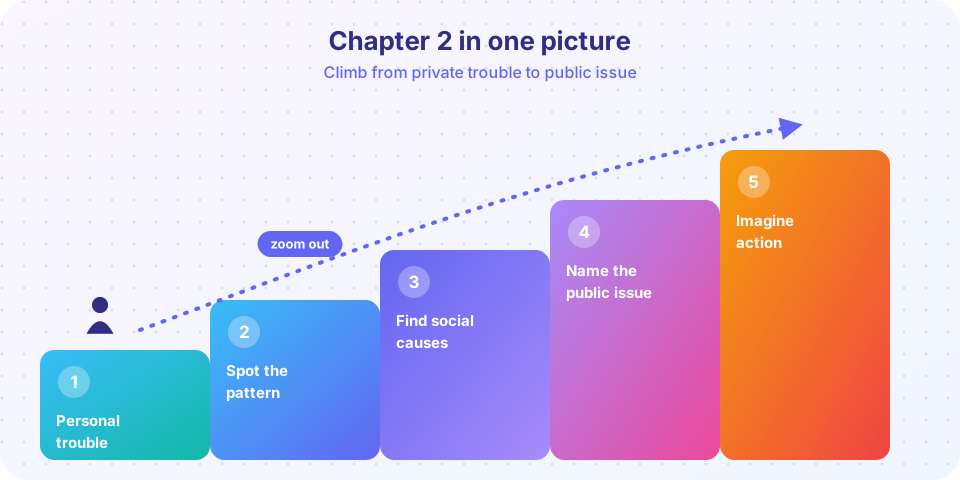
Chapter 2 taught one skill in three ways. Mills gave it a name, Durkheim showed it working on a hard case, and the structure-agency debate asked how far it can go. This review ties them into one staircase, one table, a deck of flashcards and a ten-question quiz.
What you will learn
- The five-step habit of moving from a personal trouble to a public issue.
- How Durkheim's method is an example of that habit.
- How to describe any situation with both structure and agency.
Key terms
Sociological imagination: seeing the link between personal experience and social forces.
Public issue: a problem rooted in how society is organized.
Anomie: normlessness when rules break down.
Habitus: ingrained dispositions from one's social position.
Structuration: structure is both the medium and the outcome of action.
Recap table
| Lesson | Big idea | Names |
|---|---|---|
| The Sociological Imagination | Link biography and history; troubles vs issues; ask structure, history, people | C. Wright Mills |
| Durkheim and Suicide | Rates reveal social forces; integration and regulation; four types; criticisms | Émile Durkheim, Jack Douglas |
| Structure and Agency | Rules and resources constrain and enable; people act, reproduce and change | Marx, Giddens, Bourdieu, Archer |
The five steps, applied
Use this routine on any headline.
- Start with the trouble. "Young adults can't afford to move out."
- Spot the pattern. Check whether many people share it, with data.
- Find the social causes. Housing costs, wages, credit rules, culture of independence.
- Name the public issue. A housing and labor-market problem, not just poor budgeting.
- Imagine action. What could individuals, communities and policy-makers change? Values enter here.
Common misconceptions
"Seeing social causes removes responsibility." It adds context. You can explain a pattern and still hold people responsible for their choices.
"Durkheim's study is outdated, so it is useless." Its data have limits, but its method of comparing rates and testing alternatives is still taught.
"Structure and agency are opposites." Modern theories treat them as two sides of one process.
Try it
First, flashcards for the chapter.
Second, practice the five steps. Fill in the dictionary with your own example and run it to get a tidy summary you can keep in your notes.
Press Run (or Ctrl + Enter) to see the result here.
Program input · what you'd type while the program runs
Type the answers before you press Run, one per line. Each time the program reads a line (with input()), it gets the next line from this box.
Check your understanding
Quick check · 9 questions
of 9 answered You scored / 9 · perfect!
-
1. Mills's example of 15 million unemployed out of 50 million workers is meant to show
At that scale the explanation lies in the organization of society, not individual shortcomings. -
2. Which is the first step of the five-step habit?
The climb begins with a concrete personal experience. -
3. Durkheim linked altruistic suicide to
When the group absorbs the individual, altruistic suicide is more likely. -
4. Which is a criticism of Durkheim's study?
The ecological fallacy and recording practices are the main methodological criticisms. -
5. Anomie means
It describes weakened norms in times of upheaval. -
6. Giddens's structuration theory says
Structures exist in and through people's actions. -
7. Bourdieu's habitus refers to
Habitus is a system of dispositions from social background. -
8. Which statement best reflects the chapter's balanced view?
Both levels matter and influence each other. -
9. A student notices that many classmates share a problem and checks housing data. This is mainly
Checking whether others share the trouble, with data, is the pattern step.
Summary
- The sociological imagination moves from personal trouble to pattern, causes, issue and action.
- Durkheim's suicide study models comparing rates, proposing social explanations and admitting limits.
- Structure and agency shape each other; Giddens and Bourdieu show how.
- Next you will study the building blocks of everyday life: culture and socialization.
Track your progress
Create a free account to tick off lessons and pick up where you left off on any device.
of Sociology lessons completed