


















Lesson 17 of 46 · Social Structure and Groups
Status and Roles
Learn the sociological meaning of status and role: ascribed and achieved statuses, master status, role sets, role conflict, role strain and role exit, with worked examples.
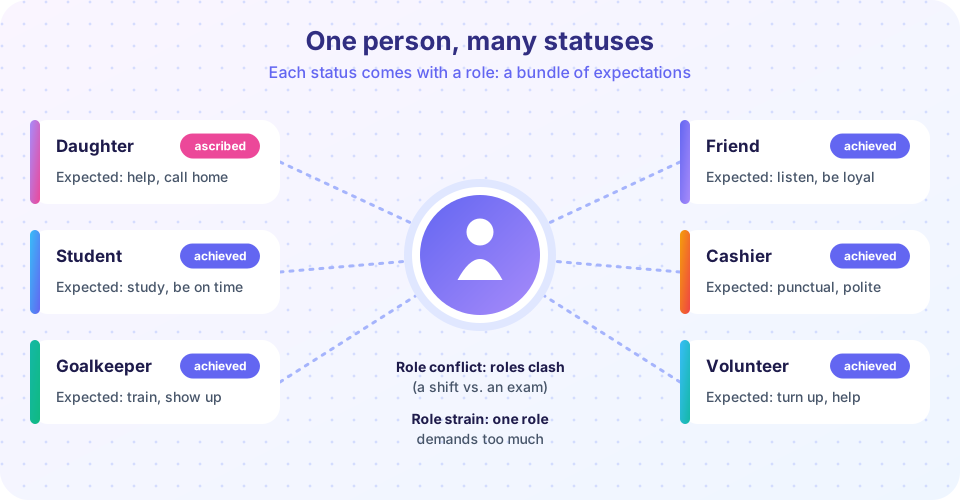
Ask a person "Who are you?" and the answers are often positions: a daughter, a student, a goalkeeper, a friend, a citizen. Each of these comes with an invisible job description: a goalkeeper is expected to train, to stay calm under pressure and to talk to the defenders. These positions and their expectations are the most basic building blocks of social structure. They explain why very different people behave alike once they occupy the same position, and why a person can feel pulled in several directions at once.
What you will learn
- The difference between status and role, and between ascribed and achieved statuses.
- What a status set, a role set and a master status are.
- How role conflict and role strain differ, and how people cope.
- How roles are learned, performed and left.
Key terms
Status: a socially defined position, such as parent, nurse or citizen.
Role: the set of behaviors, rights and obligations expected of someone in a status.
Ascribed status: a status assigned at birth or involuntarily, such as being someone's child or one's age.
Achieved status: a status gained through effort or choice, such as athlete or engineer.
Master status: a status that dominates how others see a person, overriding the rest.
Status and role
Anthropologist Ralph Linton (1936) gave the classic distinction. A status is a position in a social system; a role is the dynamic part: the behavior expected of the person who holds it. You occupy a status and play a role. The word status here does not mean prestige; "high-status" is a separate idea. Everyone has many statuses: your status set.
Ascribed statuses are assigned without choice: age, being a son or daughter, and in many societies ethnicity or caste. Achieved statuses result from some choice or effort: graduate, spouse, athlete, convict. The line blurs: a person chooses to have a baby but cannot choose to cease being a parent, and in unequal societies the family one is born into affects which achieved statuses are available. Status can also be prestige, the social honor attached to a position (physicians are often rated more highly than street cleaners in surveys across many countries), a topic for the inequality chapter.
Master status
Some statuses overshadow the others. Everett Hughes (1945) called such a position a master status. A person's occupation, gender, race, disability or criminal record can become the main lens through which others see them. Erving Goffman (1963) studied stigma: an attribute that discredits a person in the eyes of others. A person with a criminal record may find that employers see only that status, regardless of skills. A master status is not a property of the person but of how others respond to it, and it can be positive: a famous musician may be treated as "the artist" in every setting.
Roles and role sets
Roles come with expectations from other people. Robert Merton noted that a single status has a role set: the array of relationships that come with it. A schoolteacher's role set includes students, fellow teachers, the principal, parents and the education authority. Each has slightly different expectations: students may want fun, parents want grades, the authority wants test results.
Role expectations are learned through socialization and enforced by sanctions. They are also negotiated: people interpret and adjust them. Goffman used role distance for the way people show they are not fully "just" their role, such as a surgeon joking with the team. Cultural context matters: expectations about "a good daughter" or "a good employee" differ between societies and change over time.
Role conflict and role strain
Two kinds of tension appear:
- Role conflict occurs between roles: the demands of two statuses clash. A nurse is asked to work a night shift on the day of her child's school concert. A student who is also a part-time cashier must choose between an exam and a shift.
- Role strain occurs within one role: the expectations attached to that role are contradictory or too heavy. A manager is expected to be both a friendly colleague and a strict supervisor; a teacher must be both a nurturing guide and an impartial judge.
People cope in various ways: prioritizing one role, compartmentalizing (separating roles in time and place), negotiating with others, seeking support, or leaving a role. Organizations and states can reduce strain through policies such as flexible hours or parental leave, which shows again how personal troubles connect to public issues.
Role exit
Sociologist Helen Rose Fuchs Ebaugh (1988) studied people who leave roles that were central to their identity, such as nuns who left convents or divorced spouses. She described a typical process: first doubts, then seeking alternatives, a turning point, and finally building an "ex-role" identity, which continues to carry traces of the past. Role exit shows that statuses are tied to identity and that leaving them takes work.
Are we our roles? The Stanford prison debate
Experiments like Philip Zimbardo's 1971 Stanford prison study were long used to claim that people slip quickly into assigned roles of guard or prisoner. Later work challenged that conclusion: archival research and reanalysis suggested participants received cues about how to behave, and the study lacked proper controls. The episode is now often used as a lesson in how roles shape behavior, but also in how hard it is to interpret dramatic demonstrations. A cautious reading is that roles and settings influence behavior strongly, yet people interpret and sometimes resist them.
Common misconceptions
"Status means being rich or famous." In sociology, a status is any recognized position. Prestige is a separate dimension.
"Ascribed statuses never change." Their meaning and consequences change: ideas about age, gender and ethnicity vary by time and place.
"Role conflict and role strain are the same." Conflict is between roles; strain is within one role.
"We are our roles." People hold many roles, interpret them and sometimes resist or change them.
Try it
First, a time-budget model of role conflict. A week has 168 hours. Enter hours each role demands, and the model reports overload and which roles must give. It uses invented numbers and a simple rule, as an illustration of how conflicts arise from limited time.
Press Run (or Ctrl + Enter) to see the result here.
Program input · what you'd type while the program runs
Type the answers before you press Run, one per line. Each time the program reads a line (with input()), it gets the next line from this box.
Second, explore a role set. Choose a status to see the people with expectations of its holder and what each expects. Notice where expectations pull in different directions.
Check your understanding
Quick check · 5 questions
of 5 answered You scored / 5 · perfect!
-
1. Which pair correctly describes status and role?
You occupy a status and play a role. -
2. A student with a part-time job must choose between an exam and a shift. This is
Conflict occurs between the demands of two different roles. -
3. A manager asked to be both a friend and a strict boss experiences
Contradictory expectations within a single role produce role strain. -
4. A master status is
Everett Hughes used the term for positions that overshadow a person's other statuses. -
5. Which is the best conclusion from the debate about the Stanford prison study?
Later critiques showed methodological problems, but social settings still shape behavior.
Summary
- A status is a position and a role is the behavior expected of its holder; statuses may be ascribed or achieved, and a master status can overshadow the rest.
- A role set is the web of relationships attached to one status, with different expectations from different people.
- Role conflict occurs between roles, role strain within one role; people cope by prioritizing, compartmentalizing, negotiating or leaving.
- Roles shape behavior without turning people into scripts.
Next: Groups and Networks
Track your progress
Create a free account to tick off lessons and pick up where you left off on any device.
of Sociology lessons completed