


















Lesson 31 of 46 · Institutions: Family, Education, Religion
Chapter 7 Overview: Institutions, Family, Education and Religion
A map of chapter 7: what social institutions are, why sociologists study family, education and religion, and the main theories that explain what institutions do.
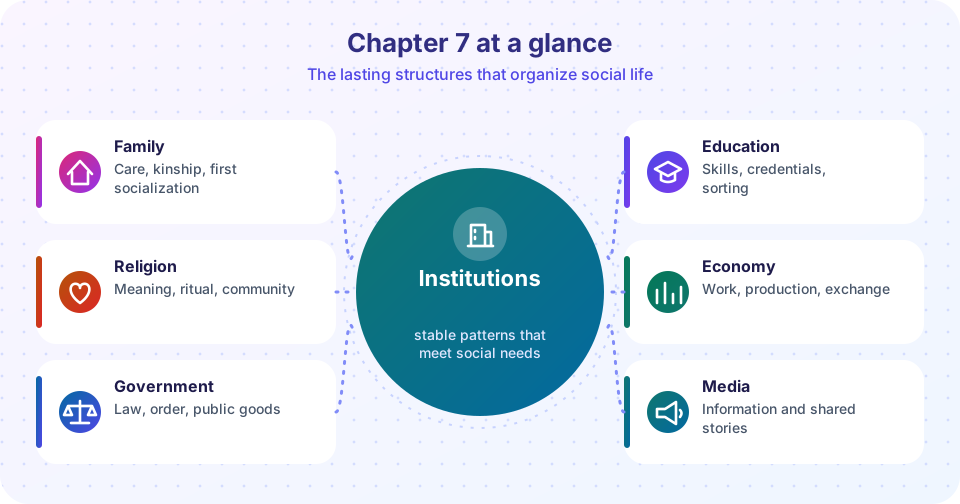
Think about an ordinary day: you wake up in a household, go to a school or workplace, buy food in a market, obey traffic laws, maybe celebrate a holiday. Each of these steps is guided by a social institution, a stable, widely recognized set of norms, roles and organizations built around a basic social need. You rarely notice institutions, much as you rarely notice air, yet they shape almost every opportunity you have.
What you will learn
- Define social institution and list major examples.
- Compare functionalist, conflict, feminist and interactionist views of institutions.
- Preview the family, education and religion lessons.
- Explain how institutions both enable and constrain people.
Key terms
Social institution: a lasting pattern of norms, roles and organizations that meets a basic social need. Role: the behavior expected of someone in a position, such as parent or teacher. Socialization: learning the norms and values of a group. Latent function: an unintended or unrecognized effect of an institution (Merton).
What institutions do
The classic functionalist view, from Émile Durkheim and later Talcott Parsons, is that institutions meet needs: families raise children, schools teach skills and values, religions give shared meaning, economies produce goods, governments keep order. Robert Merton added that institutions have manifest functions (obvious, intended) and latent functions (unintended). For example, the manifest function of school is teaching; a latent function is providing childcare so that parents can work and a place where friendships form.
The conflict view, from Karl Marx and later scholars such as Pierre Bourdieu, asks who benefits. Institutions can pass advantage from one generation to the next: property through families, credentials through schools, legitimacy through beliefs. Feminist approaches examine how institutions distribute work, power and respect by gender. Symbolic interactionists look at how people in daily interaction create and negotiate the meaning of roles such as "good student" or "real family."
None of these is the single right lens. Strong analysis picks the lens that fits the question, and often combines them.
The lessons in this chapter
| Lesson | Focus |
|---|---|
| Family and kinship | Forms of family, four theoretical lenses, the second shift and changing households |
| Education and schooling | Functions of schools, the hidden curriculum, cultural capital, credentials |
| Religion and society | Durkheim, Marx, Weber; church and sect; the secularization debate |
| Chapter 7 review | Compare and quiz |
What is an institution?
Four lenses
Three institutions
Common misconceptions
"Institutions are buildings." An institution is a pattern of norms and roles. A school building is an organization within the education institution.
"Institutions are fixed." Families, schools and religious groups change, sometimes fast. Chapter 8 returns to this.
Check your understanding
Quick check · 4 questions
of 4 answered You scored / 4 · perfect!
-
1. A social institution is best defined as
Institutions are patterns, not just buildings or single organizations. -
2. A latent function of school is
Latent functions are unintended or unrecognized effects. -
3. Which lens asks 'who benefits from this arrangement?'
Conflict approaches focus on power and unequal advantage. -
4. Which lens focuses on how people create meanings in everyday interaction?
Interactionists study the meanings people build in interaction.
Summary
- Institutions are lasting patterns of norms, roles and organizations that meet basic social needs.
- Four lenses (functionalist, conflict, feminist, interactionist) ask different questions of the same institution.
- Merton's manifest and latent functions separate intended from unintended effects.
- Next come family, education and religion.
Next: Family and kinship
Track your progress
Create a free account to tick off lessons and pick up where you left off on any device.
of Sociology lessons completed