


















Lesson 33 of 46 · Institutions: Family, Education, Religion
Education and Schooling
What do schools do? Compare functionalist and conflict views, learn the hidden curriculum, cultural capital, credentialism and teacher expectations, with two simulations.
Schools are among the first big institutions children meet outside the family. They teach reading and mathematics, but they also teach how to queue, how to wait, how to be evaluated and how to deal with authority. For most of the last two centuries, schooling has also become the main gateway to jobs. Sociologists ask what schools really do, for whom, and whether they reduce inequality or help pass it on.
What you will learn
- Compare functionalist and conflict views of schooling.
- Define the hidden curriculum and give examples.
- Explain cultural capital, concerted cultivation and credentialism.
- Interpret evidence on family background versus school effects.
Key terms
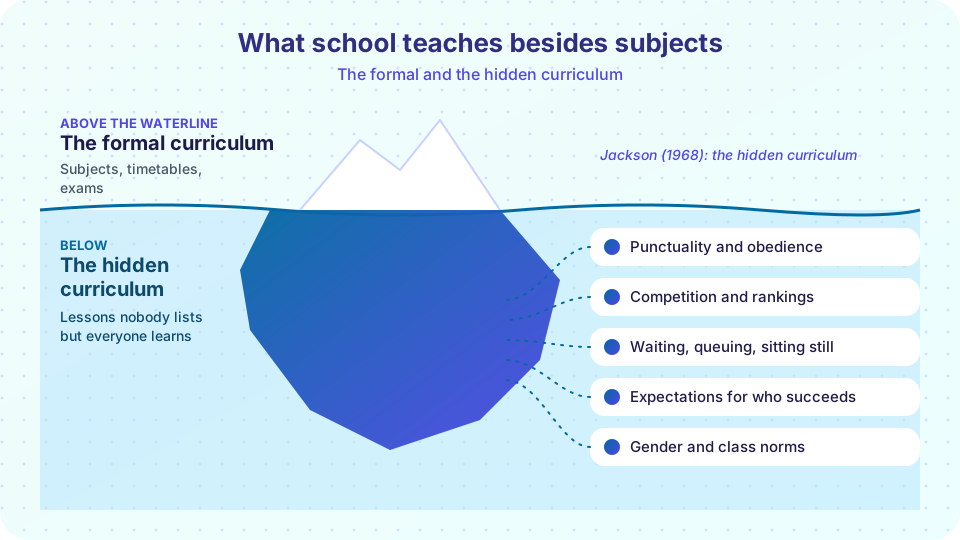
Formal curriculum: the planned subjects and skills. Hidden curriculum: unwritten lessons about norms, discipline and hierarchy (Jackson, 1968). Cultural capital: knowledge and habits that school rewards but not all homes provide (Bourdieu). Credentialism: requiring ever higher certificates for jobs, often beyond what skills demand. Self-fulfilling prophecy: a belief that causes itself to come true by shaping behavior (Merton).
Functionalist views
Émile Durkheim thought schools turn children into members of society by teaching shared values and a sense of belonging; he wrote of "moral education." Talcott Parsons added that the school is a bridge between the family, where children are judged by who they are, and adult life, where they are judged by what they can do. Functionalists also point to role allocation: schooling sorts people toward jobs according to talent and effort. This is the ideal of meritocracy, a word first used satirically by Michael Young in 1958.
Conflict views
Conflict theorists ask whether the sorting is fair.
- Correspondence principle. Samuel Bowles and Herbert Gintis (Schooling in Capitalist America, 1976) argued that schools mirror the workplace: obedience, punctuality, grades as pay, rank as status. Different schools prepare children for different positions in the labor hierarchy.
- Cultural reproduction. Pierre Bourdieu and Jean-Claude Passeron (1970) argued that schools reward the language, tastes and manners of dominant groups, so children from those backgrounds appear naturally gifted. Schooling then turns inherited advantage into earned-looking credentials.
- Credentialism. Randall Collins (The Credential Society, 1979) argued that rising education requirements partly reflect competition for status. Degrees act as signals as well as skills.
The hidden curriculum
Philip Jackson (1968) noticed that classrooms teach through their routines: wait your turn, raise your hand, accept evaluation, work for approval. Others have added lessons about gender, class and race: who is called on, who is disciplined, what counts as a "good" student. The hidden curriculum is not always bad. Children also learn cooperation and persistence. The point is that these lessons are real, unplanned and unevenly rewarded.
Does family or school matter more?
The Equality of Educational Opportunity report (the Coleman Report, 1966) surprised many by finding that, in the United States, differences between students' family backgrounds explained more of the variation in test scores than differences in school resources such as spending and facilities. Later research has qualified this: good teachers and schools do matter, especially for disadvantaged children, but out-of-school inequalities are large, and schools are often sorted by neighborhood so the two are intertwined.
Annette Lareau's Unequal Childhoods (2003) followed families in the United States and described two styles. Middle-class parents tended to use concerted cultivation: organized activities, reasoning with children, and encouraging them to question adults. Working-class and poor parents more often practiced the accomplishment of natural growth: more unstructured play, clearer separation between adult and child worlds, and respect for authority. Schools tend to reward the first style, so the differences carry over to classrooms.
Paul Willis (Learning to Labour, 1977) studied a group of working-class boys in an English school ("the lads") who rejected school culture as a form of resistance. Their resistance, he argued, helped steer them into the same factory jobs their fathers had.
Press Run (or Ctrl + Enter) to see the result here.
Program input · what you'd type while the program runs
Type the answers before you press Run, one per line. Each time the program reads a line (with input()), it gets the next line from this box.
Press Run (or Ctrl + Enter) to see the result here.
Program input · what you'd type while the program runs
Type the answers before you press Run, one per line. Each time the program reads a line (with input()), it gets the next line from this box.
Robert Rosenthal and Lenore Jacobson reported in Pygmalion in the Classroom (1968) that when teachers were told that some pupils were about to "bloom," those pupils gained more. Their method was criticized and replications were mixed. Later research tends to find that teacher expectations have real but usually modest effects, larger for some groups and settings. The simulation above is a model of the mechanism, with invented numbers, not evidence of the size of the effect.
Common misconceptions
"Schools are purely meritocratic." Many studies find that family background shapes both access and rewards. At the same time, schools can and do improve life chances for many children.
"The hidden curriculum is a conspiracy." It describes unplanned side effects of routines and expectations, not a plot.
"Family background is destiny." Background shifts the odds. Good teachers, schools and policies matter, especially for disadvantaged students.
Check your understanding
Quick check · 6 questions
of 6 answered You scored / 6 · perfect!
-
1. Which is an example of the hidden curriculum?
It is about unwritten lessons in norms, discipline and hierarchy. -
2. Bowles and Gintis' correspondence principle says that schools
They argued that school relations parallel work relations and prepare children for different positions. -
3. Bourdieu's cultural capital helps explain why
Schools reward knowledge and habits that some homes supply more than others. -
4. The Coleman Report (1966) is remembered for finding that
Later work qualified this, but it shifted attention to out-of-school inequality. -
5. Credentialism means
Collins argued degrees act partly as status signals. -
6. Lareau's 'concerted cultivation' describes
It contrasted with the accomplishment of natural growth.
Summary
- Functionalists see schools as teaching shared values and allocating roles by merit.
- Conflict theorists see schools reproducing inequality through correspondence, cultural capital and credentials.
- The hidden curriculum teaches norms and hierarchy through routines.
- Family background and school effects are intertwined; teacher expectations have real but usually modest effects.
Next: Religion and society
Track your progress
Create a free account to tick off lessons and pick up where you left off on any device.
of Sociology lessons completed