


















Lesson 4 of 46 · Getting Started
Theoretical Perspectives: Functionalism, Conflict and Interactionism
Compare the three classic sociological perspectives, functionalism, conflict theory and symbolic interactionism, plus feminist and intersectional approaches, using one example.
Give three sociologists the same school and you will get three different stories. One asks what the school does for society. Another asks who gains and who loses from how it is organized. A third asks what a school day means to the people in it. None is simply right or wrong: each is a perspective, a general way of looking that tells you which questions to ask and which evidence to notice. Learning to switch between them is one of the most useful skills in sociology.
What you will learn
- The core assumptions and key thinkers of functionalism, conflict theory and symbolic interactionism.
- Manifest and latent functions, the Thomas theorem and self-fulfilling prophecies.
- How feminist theory and intersectionality extend and challenge the classics.
- How to apply several perspectives to one topic and compare them fairly.
Key terms
Perspective (paradigm): a broad framework of assumptions that guides what questions you ask.
Function: the contribution a part of society makes to the stability of the whole (functionalism).
Manifest and latent functions: intended and unintended effects of a social pattern (Robert Merton).
Thomas theorem: "If men define situations as real, they are real in their consequences" (W. I. Thomas, 1928).
Intersectionality: the idea that race, class, gender and other forms of inequality overlap and combine (Kimberlé Crenshaw, 1989).
Functionalism: society as a system
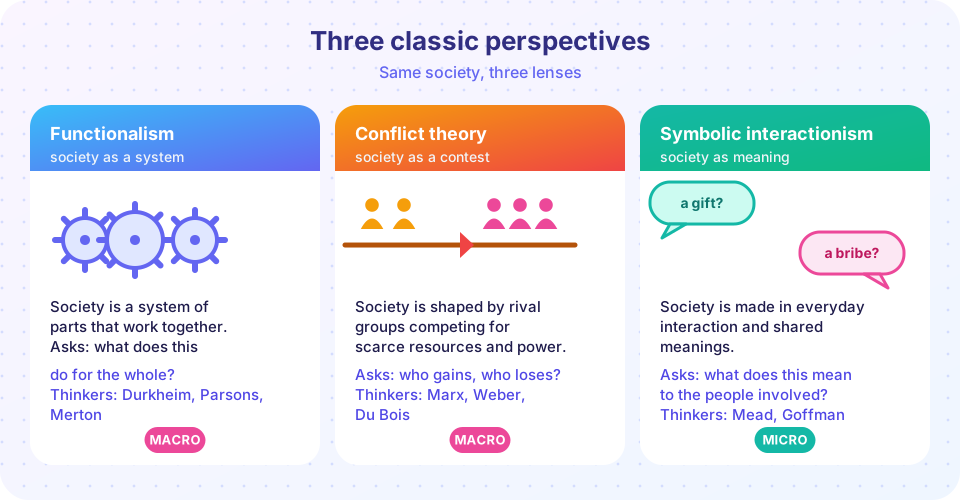
Structural functionalism treats society like a living body or machine whose parts (family, school, economy, government) each serve a purpose and fit together. Its roots are in Comte, Herbert Spencer and especially Émile Durkheim, who asked what religion, punishment or the division of labor contribute to social order. In the mid-twentieth century Talcott Parsons built large system models, and Robert Merton refined them.
Merton's most useful move was to separate manifest functions (intended and recognized) from latent functions (unintended and often unrecognized). A school's manifest function is to teach skills. Its latent functions include providing daycare so parents can work, creating friendships and sorting young people into future jobs. He also noted dysfunctions: effects that harm stability, such as bureaucratic rules that waste time.
Strengths: functionalism highlights how institutions connect and why patterns persist. Weaknesses: it can make whatever exists look necessary, and it tends to overlook power, conflict and change. Critics charged that it defended the status quo.
Conflict theory: society as a struggle over resources
Conflict theory starts from the idea that societies contain groups with different interests, and that order is often the result of the more powerful imposing their will. Karl Marx focused on class, the capitalist owners versus the workers. Max Weber added status and party as other dimensions of power. W. E. B. Du Bois analyzed how racial hierarchies were built and maintained. Later scholars such as C. Wright Mills (The Power Elite, 1956) studied how small groups hold power.
Applied to a school, conflict theory asks who designed the curriculum, why wealthy districts often have better-funded schools, and whether schooling reproduces inequality by giving some children advantages that look like merit. It also asks how schools could be changed.
Strengths: it makes power and inequality central and explains change. Weaknesses: it can understate cooperation and shared values, and critics argue some versions reduce everything to economic interest.
Symbolic interactionism: society as meaning in interaction
Symbolic interactionism works at the micro level. It argues that people act toward things based on the meanings those things have for them, that meanings come from social interaction, and that meanings are adjusted through interpretation (Herbert Blumer's three premises, 1969). Its roots are in George Herbert Mead. Erving Goffman pushed it into the dramaturgical approach: people manage impressions like actors, with a "front stage" for audiences and a "back stage" for relaxing. Howard Becker and others developed the labeling approach to deviance.
A key tool is the Thomas theorem. Robert Merton called a related process the self-fulfilling prophecy: a false definition of a situation causes behavior that makes it true. In his example, a rumor that a sound bank is in trouble sends depositors running to withdraw their money; the bank, short of cash, then really does fail. The rumor was false, but its consequences were real.
Strengths: it shows how identities and social order are built in everyday life. Weaknesses: it can neglect large structures and inequalities, and its concepts are harder to measure.
Feminist theory and intersectionality
Feminist theories ask how gender organizes society and whose experiences count as knowledge. Early sociology was largely written by men about men's worlds. Feminist scholars highlighted unpaid care work, gender inequality in workplaces and families, and violence. They also argued that research should include women's standpoint. Intersectionality, named by legal scholar Kimberlé Crenshaw in 1989 and building on earlier Black feminist thought (such as the Combahee River Collective and Patricia Hill Collins), argues that gender, race, class and other categories cannot be studied one at a time because they combine. A Black working-class woman's experience is not simply "racism plus sexism plus classism" but a distinct position.
Other perspectives you may meet include postmodern approaches (suspicion of grand theories), rational choice theory (people weigh costs and benefits) and postcolonial theory (how empire shaped knowledge and inequality).
Using the lenses together
A quick method. To apply a perspective, ask its signature question. Functionalism: What does this do for the whole? Conflict: Who benefits, and who loses? Interactionism: What does this mean to the people involved? Feminism/intersectionality: How does it differ by gender, race and class together?
Consider school uniforms. A functionalist might say they promote discipline, shared identity and reduce visible class differences. A conflict theorist might ask whether the costs fall unevenly on poorer families, or whether the rules are enforced more strictly on some groups. An interactionist would watch how students decorate or bend the rules to express identity, and what a uniform means to the person wearing it. A feminist might analyze how rules about length or hair treat girls and boys differently. Each answer is partial; together they give a fuller picture.
Common misconceptions
"I have to choose one theory." Sociologists often combine perspectives. They are tools for different jobs, not teams to join.
"Functionalism says everything is good." It says things have functions, which may be intended or not, helpful or harmful (dysfunctions).
"Conflict theory is only about class." It also covers race, gender, age, nation and other divisions, though Marx started with class.
"Theories are just opinions." A good theory generates testable claims and can be revised when evidence disagrees.
Try it
First, a lens switcher. Pick a topic and a lens to see the signature question and an example of what evidence the lens would collect.
Second, a toy model of Merton's self-fulfilling prophecy. Every depositor withdraws once the share of people who have already withdrawn reaches their personal fear threshold. The bank survives as long as withdrawals stay below its cash reserve. The model uses made-up numbers and shows how a false rumor can create a real failure.
Press Run (or Ctrl + Enter) to see the result here.
Program input · what you'd type while the program runs
Type the answers before you press Run, one per line. Each time the program reads a line (with input()), it gets the next line from this box.
Check your understanding
Quick check · 5 questions
of 5 answered You scored / 5 · perfect!
-
1. Which question is the signature question of conflict theory?
Conflict theory focuses on competing interests, power and unequal outcomes. -
2. A school's unintended effect of providing childcare so parents can work is a
Merton called unintended, often unrecognized contributions latent functions. -
3. The Thomas theorem says that
How people define a situation shapes what they do, so false beliefs can have true consequences. -
4. Which description best fits intersectionality?
Intersectionality, named by Kimberlé Crenshaw, stresses overlap rather than separation. -
5. A researcher watches how teenagers negotiate who sits where in a cafeteria. This is mainly which perspective?
Close attention to everyday interaction and meaning is interactionist work.
Summary
- Functionalism sees society as a system of parts with functions; Merton added manifest, latent functions and dysfunctions.
- Conflict theory emphasizes competing interests, power and inequality, from Marx's class to Weber's status and Du Bois's race.
- Symbolic interactionism studies how meanings arise in interaction; the Thomas theorem and self-fulfilling prophecy show their power.
- Feminist theory and intersectionality extend these views by asking whose experience counts and how inequalities combine.
- Use several lenses on one topic; each reveals what the others miss.
Next: Chapter 1 Review
Track your progress
Create a free account to tick off lessons and pick up where you left off on any device.
of Sociology lessons completed