


















Lesson 10 of 46 · Waves and Transmission Lines
Chapter 2 Review: Waves and Transmission Lines
Review chapter 2: the line model, characteristic impedance, reflection coefficient, VSWR, input impedance, stubs and quarter-wave transformers, with practice code and a ten-question quiz.
Chapter 2 introduced one big idea: at RF a cable is not a connection but a medium that carries waves. Once you accept that, a handful of equations explain reflections, standing waves and the strange way a line changes the impedance you see. This review gathers them and checks that you can use them without looking back.
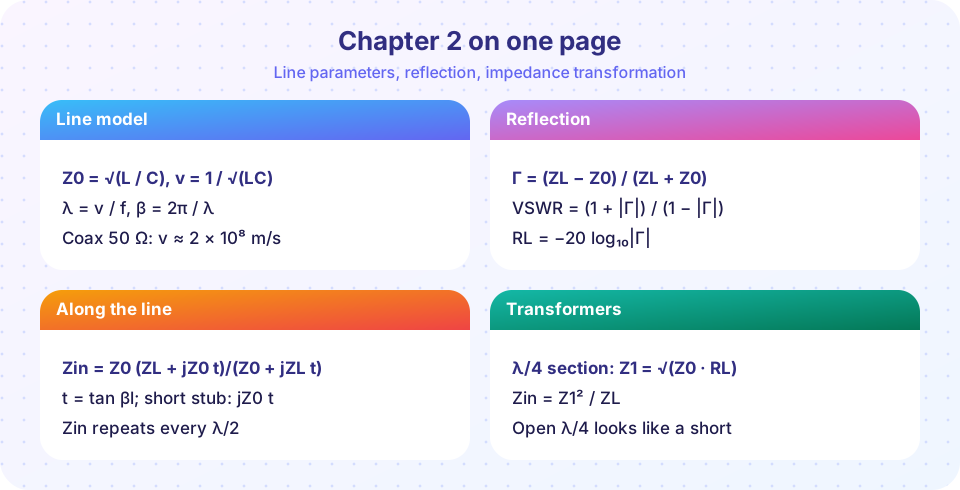
The chapter in a table
| Concept | Formula | Typical numbers |
|---|---|---|
| Characteristic impedance | Z0 = √(L/C) |
50 Ω coax: 250 nH/m, 100 pF/m |
| Velocity | v = 1/√(LC) = c/√εr |
2×10⁸ m/s in solid-PE coax |
| Wavelength in line | λ = v/f |
20 cm at 1 GHz |
| Reflection coefficient | Γ = (ZL − Z0)/(ZL + Z0) |
100 Ω on 50 Ω: 1/3 |
| VSWR | (1 + |Γ|)/(1 − |Γ|) |
|Γ| = 0.5 gives 3 |
| Return loss | −20 log₁₀|Γ| |
VSWR 2 gives 9.5 dB |
| Mismatch loss | −10 log₁₀(1 − |Γ|²) |
|Γ| = 0.2 gives 0.18 dB |
| Input impedance | Zin = Z0 (ZL + jZ0 t)/(Z0 + jZL t) |
t = tan βl |
| Quarter-wave | Zin = Z0²/ZL, Z1 = √(Z0 RL) |
70.7 Ω for 50 → 100 |
| Stubs | short: jZ0 tan βl, open: −jZ0 cot βl |
λ/8 gives ±j50 on 50 Ω |
How to think about a line problem
- Find the wavelength in the line. Use velocity factor, not the free-space value.
- Compute the electrical length
βl = 360° · l/λ. - Normalize impedances by
Z0if you plan to use the Smith chart. - Compute Γ at the load, then VSWR, RL and ML as needed.
- Move along the line with the
Zinformula or by rotating Γ by−2βl. - Check units and sanity:
|Γ| ≤ 1,VSWR ≥ 1, and for a lossless line Re(Zin) stays positive for a passive load.
If you get a negative real part of Zin for a passive load on a lossless line, you have made an algebra mistake, usually a sign or a conjugate error.
Try it
These practice problems are solved with code. Try each by hand first, then compare.
Press Run (or Ctrl + Enter) to see the result here.
Program input · what you'd type while the program runs
Type the answers before you press Run, one per line. Each time the program reads a line (with input()), it gets the next line from this box.
Next, a quick visual check that ties the chapter together: sweep the load resistance and plot VSWR and mismatch loss on the same chart.
Press Run (or Ctrl + Enter) to see the result here.
Program input · what you'd type while the program runs
Type the answers before you press Run, one per line. Each time the program reads a line (with input()), it gets the next line from this box.
Check your understanding
Quick check · 10 questions
of 10 answered You scored / 10 · perfect!
-
1. A coax has L = 200 nH/m and C = 80 pF/m. What is Z0?
Z0 = √(200×10⁻⁹/80×10⁻¹²) = √2500 = 50 Ω. -
2. A cable has a velocity factor of 0.66. What is the wavelength inside it at 500 MHz?
λ in air = 60 cm; times 0.66 gives 39.6 cm. -
3. A 50 Ω line is terminated in 200 Ω. What is |Γ|?
Γ = (200 − 50)/(200 + 50) = 150/250 = 0.6. -
4. VSWR 1.5 corresponds to what return loss?
|Γ| = 0.2, RL = 14 dB. -
5. A 50 Ω λ/4 line is terminated in 100 Ω. What impedance appears at the input?
Zin = 50²/100 = 25 Ω. -
6. What is the input impedance of an open-circuited λ/4 line?
The quarter-wave line inverts the open circuit into a short. -
7. Which statement is true for a lossless line terminated in a mismatched load?
Maxima repeat every λ/2 and are separated from minima by λ/4. VSWR is set by |Γ|, which does not change on a lossless line. -
8. A load has Γ = 0.25. How much power is reflected?
Reflected power fraction = |Γ|² = 0.0625. -
9. A shorted 50 Ω stub is λ/8 long. Its input impedance is
Zin = jZ0 tan(45°) = +j50 Ω. -
10. What does the VSWR number NOT tell you?
VSWR is a scalar built from |Γ|; the sign of the reactance is lost.
Summary
- A line is a distributed circuit with
Z0 = √(L/C)and velocity1/√(LC). - Mismatch creates
Γ, VSWR, return loss and mismatch loss: all four describe the same reflection. - On a lossless line
|Γ|is constant and the phase rotates with distance;Zinrepeats everyλ/2. - Quarter-wave lines invert impedance; stubs act as reactances.
- Chapter 3 turns these into a graphical tool, the Smith chart.
Track your progress
Create a free account to tick off lessons and pick up where you left off on any device.
of RF Engineering and Antennas lessons completed