


















Lesson 26 of 46 · Antenna Fundamentals
Antenna Fundamentals: The Big Picture
Preview the core antenna ideas: radiation patterns, directivity and gain, impedance and efficiency, polarization, effective aperture and the Friis equation.
An antenna is the transducer between a guided wave in a cable and a free wave in space. It does not amplify; it only decides where the power goes. A good antenna sends or collects power in the direction you care about, accepts the power your transmitter offers, and matches the polarization of the wave on the other end. This chapter turns those three ideas into numbers you can put into a link calculation.
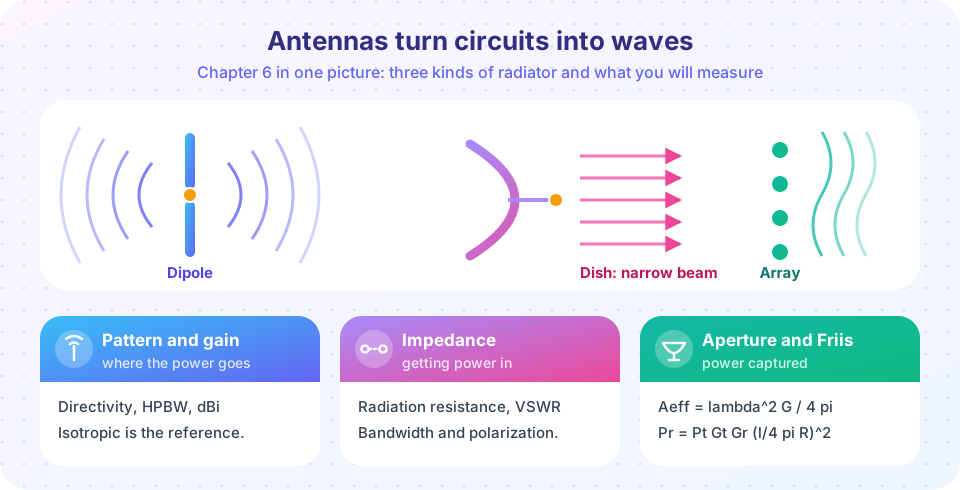
What you will learn
- What a radiation pattern shows and how beamwidth and sidelobes are read.
- How directivity, gain and efficiency differ, and what dBi means.
- How impedance, VSWR and polarization decide whether the power gets used.
- How effective aperture links an antenna to the Friis transmission equation.
Key terms
Isotropic radiator: an imaginary point source that radiates equally in all directions; the reference for dBi. Directivity D: peak radiation intensity divided by the average over all directions. Gain G: directivity multiplied by radiation efficiency. Effective aperture Aeff: the area that, times the power density, gives the received power. EIRP: transmit power times antenna gain, the power an isotropic antenna would need for the same peak density.
The questions this chapter answers
Antennas decide direction
Getting power in
Matching the wave
A mismatch costs decibels.
Capturing power
What each lesson covers
- Pattern, gain and directivity: reading polar and rectangular patterns, beamwidth, directivity of the dipole, dBi.
- Impedance, efficiency and polarization: radiation resistance, reflection loss, bandwidth, polarization mismatch.
- Aperture and the Friis equation: effective area, EIRP and a complete free-space link calculation.
- Chapter review: recap table and ten questions.
Reciprocity
An antenna behaves the same when it receives as when it transmits: its pattern, gain and impedance are identical in both directions (for linear, passive materials). This reciprocity theorem is why we usually describe an antenna as a transmitter and still use the results for reception.
Common misconceptions
"Gain means the antenna makes more power." A passive antenna cannot add power. It redistributes it: more in one direction means less in others.
"A bigger antenna always has more gain." Gain depends on the size measured in wavelengths. The same dish has more gain at a higher frequency.
Try it
Press Run (or Ctrl + Enter) to see the console output here.
No output.
Press Run (or Ctrl + Enter) to see the console output here.
No output.
Check your understanding
Quick check · 4 questions
of 4 answered You scored / 4 · perfect!
-
1. A passive antenna with 10 dBi gain
10 dBi is a factor of 10 in the peak direction relative to an isotropic radiator; the power is redistributed, not created. -
2. Reciprocity means
For passive linear antennas the transmit and receive properties are equal. -
3. Doubling the frequency of the same physical dish makes its gain
The dish is twice as large in wavelengths, gain rises as the square: +6 dB. -
4. Which describes EIRP?
EIRP = Pt x Gt, which is Pt(dBm) + Gt(dBi).
Summary
- Antennas redistribute power; they do not create it.
- Three questions: where does the power go, how much gets in, how well does the polarization match?
- Reciprocity lets transmit results describe reception.
Track your progress
Create a free account to tick off lessons and pick up where you left off on any device.
of RF Engineering and Antennas lessons completed