


















Lesson 2 of 46 · Getting Started
The Radio Spectrum and Frequency Bands
Learn how frequency and wavelength are linked, how the ITU and IEEE name the RF bands, and why wavelength decides whether a circuit is lumped or distributed.
Every radio signal is an electromagnetic wave. It has a frequency f (how many cycles per second) and a wavelength λ (how far the wave travels in one cycle). In empty space the two are tied together by the speed of light, so knowing one gives you the other. Engineers prefer to think in wavelengths because the size of a circuit or an antenna compared with λ decides how it behaves.
This lesson gives you the spectrum map: which frequencies carry which services, what the band names mean and how to convert between frequency and wavelength in your head.
What you will learn
- How
c = f × λlinks frequency and wavelength, and the shortcutλ(m) ≈ 300 / f(MHz). - The ITU decade bands (VLF to EHF) and the IEEE letter bands (L, S, C, X, Ku, K, Ka).
- Where common services such as FM, GPS, Wi-Fi, 5G and radar live.
- How wavelength inside a cable or on a circuit board differs from wavelength in air.
- The
λ/10rule that separates lumped circuits from distributed ones.
Key terms
- Frequency (f): cycles per second, in hertz (Hz). 1 MHz is 10⁶ Hz and 1 GHz is 10⁹ Hz.
- Wavelength (λ): the distance one cycle covers,
λ = v / f, in meters. - Band: a named range of frequencies; the ITU bands each span one decade (a factor of 10).
- Velocity factor: the speed of a wave in a medium divided by
c; always 1 or less. - Electrical length: the length of a line or element expressed in wavelengths or degrees (
360°perλ).
Frequency, wavelength and the speed of light
In vacuum (and, to a very good approximation, in air) electromagnetic waves travel at
c = 299 792 458 m/s ≈ 3 × 10⁸ m/s
so λ = c / f. A useful shortcut: λ (m) ≈ 300 / f (MHz). Here are some worked values.
| Frequency | Wavelength in air | Where you meet it |
|---|---|---|
| 100 MHz | 3.00 m | FM radio |
| 433 MHz | 69.2 cm | Short-range devices, remote controls |
| 1.575 GHz | 19.0 cm | GPS L1 |
| 2.45 GHz | 12.2 cm | Wi-Fi, Bluetooth, microwave ovens |
| 28 GHz | 10.7 mm | 5G millimeter wave |
| 77 GHz | 3.89 mm | Automotive radar |
The pattern is simple: multiply the frequency by ten and the wavelength divides by ten. That is why the table spans from the size of a room to the size of a grain of rice.
The ITU bands
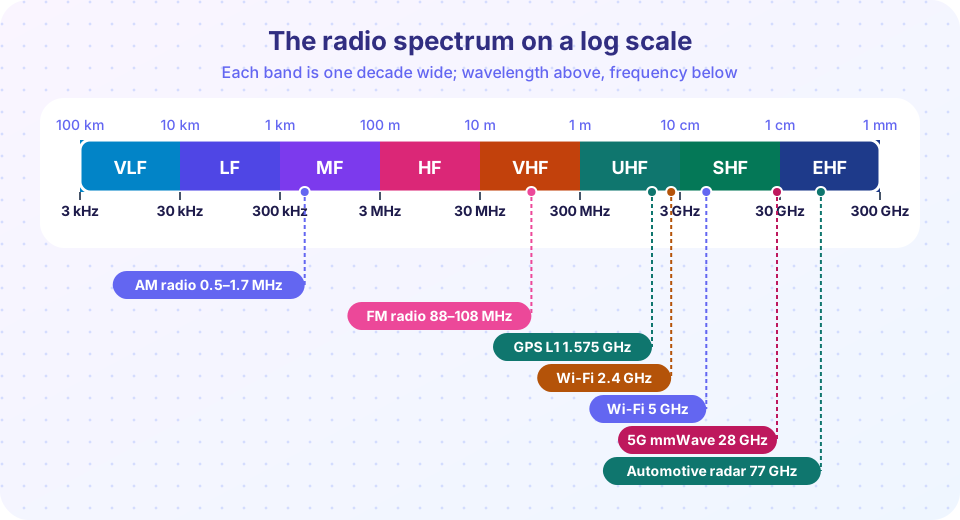
The International Telecommunication Union names each decade of the spectrum by a pair of letters. The numbers in the table are exact decade edges.
| Band | Frequency | Wavelength | Typical use |
|---|---|---|---|
| VLF | 3 – 30 kHz | 100 – 10 km | Navigation, submarine communication |
| LF | 30 – 300 kHz | 10 – 1 km | Time signals, beacons |
| MF | 300 kHz – 3 MHz | 1 km – 100 m | AM broadcast |
| HF | 3 – 30 MHz | 100 – 10 m | Shortwave, amateur radio |
| VHF | 30 – 300 MHz | 10 – 1 m | FM radio, air traffic, TV |
| UHF | 300 MHz – 3 GHz | 1 m – 10 cm | Mobile phones, GPS, Wi-Fi 2.4 GHz |
| SHF | 3 – 30 GHz | 10 – 1 cm | Satellite, radar, Wi-Fi 5 GHz |
| EHF | 30 – 300 GHz | 1 cm – 1 mm | 5G mmWave, automotive radar |
"Microwave" has no sharp definition. Most engineers use it for roughly 300 MHz and above (wavelengths of a meter or less), and "millimeter wave" for 30 to 300 GHz, where the wavelength is under a centimeter.
The IEEE letter bands
Radar and satellite engineers use a different set of names that date back to wartime secrecy. They are still everywhere in datasheets.
| Letter | Approximate range | Typical use |
|---|---|---|
| L | 1 – 2 GHz | GPS, aviation, mobile |
| S | 2 – 4 GHz | Wi-Fi, weather radar |
| C | 4 – 8 GHz | Satellite TV, Wi-Fi 5/6 GHz |
| X | 8 – 12 GHz | Military and weather radar |
| Ku | 12 – 18 GHz | Satellite TV and broadband |
| K | 18 – 27 GHz | Short-range radar |
| Ka | 27 – 40 GHz | High-throughput satellites, 5G |
Whenever a document uses a letter band, look for the actual frequency in GHz. Edges differ a little between standards and sources.
Who decides what a band is used for
Spectrum is a shared, limited resource. The ITU divides the world into three regions and publishes a table of allocations. Each country then licenses the bands, and manufacturers must keep their products inside the rules. A few ISM bands (industrial, scientific and medical) are open for unlicensed low-power use under power limits, which is why 2.4 GHz is crowded with Wi-Fi, Bluetooth, Zigbee and microwave ovens. Exact ISM edges and limits vary by country, so always check the local regulator before building a transmitter.
Wavelength in a cable or on a board
Inside a coaxial cable filled with polyethylene, or on an FR-4 circuit board, the wave moves slower than in air. If the relative permittivity is εr, the velocity is v = c / √εr, and the wavelength is shorter by the same factor:
λg = λ₀ / √εeff
For solid polyethylene coax εr ≈ 2.25, so v ≈ 0.667 c and wavelengths are one third shorter than in air. For a microstrip line on FR-4, a typical effective permittivity εeff is about 3.3, so λg ≈ λ₀ / 1.82.
Worked example. At 2.4 GHz, λ₀ = 12.49 cm. On FR-4 with εeff = 3.3, λg = 12.49 / 1.817 = 6.9 cm, so a quarter wavelength line is about 17 mm long. That is a convenient size for a Wi-Fi module and a reason Wi-Fi boards are so small.
Lumped or distributed?
At low frequency a 10 cm wire is just a wire: the voltage is the same along it at any instant. At 2.4 GHz a 10 cm wire is about 0.8 λ, so the voltage at one end can be completely different from the other. The practical rule:
- If a conductor is shorter than about
λ/10, treat it as a lumped connection (the usual circuit theory works). - If it is longer, treat it as a distributed element, a transmission line, which you will study in chapter 2.
At 100 MHz, λ/10 is 30 cm. At 10 GHz it is 3 mm, which is why microwave design looks so different from audio design: nearly everything is "long".
Common misconceptions
- "Higher frequency means faster." All electromagnetic waves travel at the same speed in the same medium. A higher frequency simply fits more cycles in each meter.
- "The band letters are standard." The ITU names (VLF to EHF) are a standard. The IEEE letters are an informal convention with slightly different edges in different documents.
Try it
A table of services is easy to tabulate. This script turns a list of frequencies into wavelengths, finds the ITU band for each and plots the whole thing on log axes so you can see why every decade is a straight step.
Press Run (or Ctrl + Enter) to see the result here.
Program input · what you'd type while the program runs
Type the answers before you press Run, one per line. Each time the program reads a line (with input()), it gets the next line from this box.
The next tool applies the λ/10 rule. Give it a trace length and a substrate, and it tells you whether the trace should be treated as a transmission line.
Check your understanding
Quick check · 5 questions
of 5 answered You scored / 5 · perfect!
-
1. What is the wavelength in air of a 300 MHz signal?
λ = 300 / f(MHz) = 300 / 300 = 1 m. -
2. Which ITU band contains 2.45 GHz Wi-Fi?
UHF spans 300 MHz to 3 GHz, so 2.45 GHz is UHF. SHF starts at 3 GHz. -
3. A signal travels in a cable with velocity factor 0.667. Compared with air, its wavelength at the same frequency is
λ = v / f, so the wavelength scales with the velocity factor. -
4. At what length does a conductor usually need transmission-line treatment?
The rule depends on length compared with wavelength: about λ/10 or more. -
5. Which statement about band letters (L, S, C, X...) is true?
IEEE letters are a historical convention; always check the actual GHz range.
Summary
c = f λ; in airλ (m) ≈ 300 / f (MHz).- ITU bands are decades from VLF (3 kHz) to EHF (300 GHz); IEEE letters name the microwave bands.
- Inside cables and boards the wavelength is shorter by
1/√εeff. - If an element is longer than about
λ/10, use transmission-line theory. - Unlicensed ISM bands are shared, so power limits and local rules apply.
Track your progress
Create a free account to tick off lessons and pick up where you left off on any device.
of RF Engineering and Antennas lessons completed