


















Lesson 33 of 46 · Antenna Types and Arrays
Horns and Dishes: Aperture Antennas
Learn how aperture antennas work, compute horn and parabolic reflector gain and beamwidth, and understand aperture efficiency, feed illumination and blockage.
When you need a narrow beam and plenty of gain at microwave frequencies, you stop thinking about currents on wires and start thinking about fields across an opening. An aperture antenna radiates through an area; the bigger that area is in wavelengths, the narrower the beam. A horn is the simple version; a parabolic dish is the workhorse of satellite and microwave links. In this lesson you will compute gain and beamwidth from the aperture size and see why real dishes reach 50 to 70 percent of the ideal.
What you will learn
- Why aperture size in wavelengths sets gain and beamwidth.
- How to compute horn gain and the typical gain of a dish.
- What aperture efficiency, spillover and blockage are.
- How a parabola turns a spherical wave into a plane wave.
Key terms
Aperture efficiency η: ratio of effective to physical aperture, Aeff / A.
Spillover: feed power that misses the reflector.
Blockage: shadowing of the aperture by the feed and its supports.
f/D ratio: focal length divided by dish diameter; typical values are 0.3 to 0.5.
Illumination taper: the way the feed pattern falls off toward the dish edge.
From aperture to gain
By the reciprocity argument of the last chapter, G = 4π Aeff / λ² and Aeff = η A, so
G = η · 4π A / λ²
For a circular dish of diameter D this is G = η (π D / λ)². Doubling D, or doubling the frequency, adds 6 dB. A uniform aperture field would give η = 1; real feeds taper the illumination toward the edge to limit sidelobes and spillover, and the structure blocks some of the aperture. Together the losses give typical η = 0.5 to 0.7.
Beamwidth falls in step. For a uniformly illuminated circular aperture HPBW ≈ 58.9 λ/D degrees; a practical tapered dish is about 65 to 70 λ/D degrees. A 1 m dish at 10 GHz (λ = 3 cm) has about 2 degrees HPBW, so a pointing error of one degree already costs about 3 dB. Aiming is critical for large dishes.
Horns
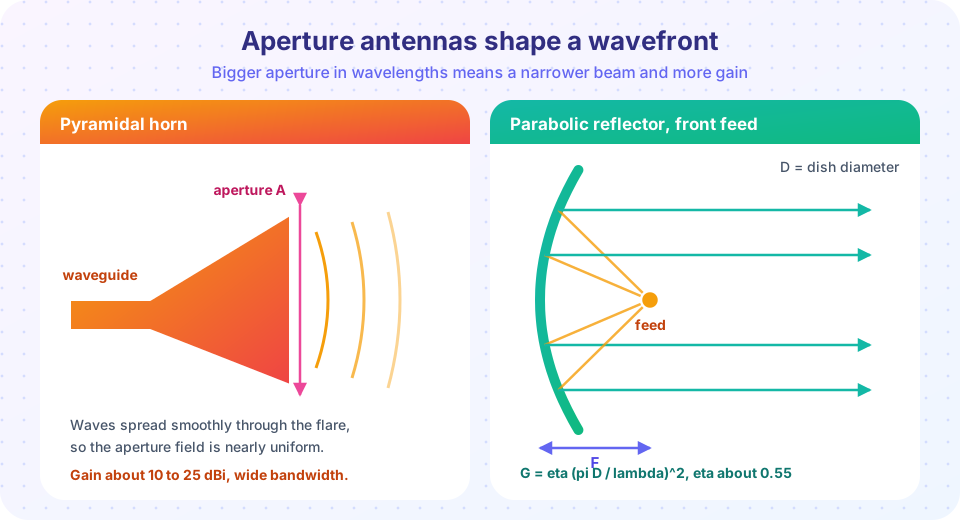
A horn is a waveguide whose walls flare out so the field spreads smoothly instead of diffracting abruptly at the open end. Pyramidal horns flare in both planes, sectoral horns in one. A well-designed pyramidal horn has aperture efficiency near 50 percent and a clean pattern, which is why standard gain horns (typically 10 to 25 dBi) serve as calibration references in antenna ranges. Gain follows G ≈ 0.5 · 4π a b / λ² for aperture dimensions a and b. Longer horns for a given aperture have a flatter phase front, so there is an optimum length for a given gain. Horns also make good feeds for dishes: they are wideband, symmetrical and have low loss.
Parabolic reflectors
A parabola has the property that rays leaving the focus reflect into rays parallel to the axis, all with the same path length to any plane perpendicular to the axis. A feed at the focus, therefore, converts its spherical wave into a plane wave across the aperture, which is exactly what a high-gain aperture needs. With the vertex at the origin, the surface is y² = 4 F x where F is the focal length.
Common arrangements:
- Prime focus: the feed sits at the focus in front of the dish. Simple, but the feed and struts block the aperture and the receiver sits in the beam path.
- Offset-fed: the dish is cut from the side of a larger paraboloid so the feed is outside the beam, removing blockage; familiar from satellite television dishes.
- Cassegrain: a small subreflector sits near the vertex side and sends the wave back to a feed behind the main dish. This puts the electronics in a convenient place and permits a longer effective focal length.
The ratio f/D determines how deep the dish is and how widely the feed must illuminate it. The best feeds have a pattern that falls about 10 dB at the dish edge, trading between spillover (too wide) and under-illumination (too narrow).
Surface errors reduce gain too. An RMS error ε costs exp(-(4π ε/λ)²) of the gain (Ruze's formula), so dishes for millimeter waves need surfaces accurate to a fraction of a millimeter.
Common misconceptions
"A bigger dish always gives a stronger signal." Gain grows with size, but so does pointing sensitivity and wind loading. Past a point, the narrow beam is harder to keep on target.
"A perforated or mesh dish is a poor reflector." If holes are much smaller than a wavelength, it reflects almost as well as a solid dish. That is why mesh dishes work at lower frequencies.
"Gain at the feed horn adds to the dish gain." The feed only illuminates the dish; the total gain is set by the dish aperture and efficiency.
Try it
Press Run (or Ctrl + Enter) to see the result here.
Program input · what you'd type while the program runs
Type the answers before you press Run, one per line. Each time the program reads a line (with input()), it gets the next line from this box.
Press Run (or Ctrl + Enter) to see the result here.
Program input · what you'd type while the program runs
Type the answers before you press Run, one per line. Each time the program reads a line (with input()), it gets the next line from this box.
Press Run (or Ctrl + Enter) to see the console output here.
No output.
Check your understanding
Quick check · 4 questions
of 4 answered You scored / 4 · perfect!
-
1. A dish with diameter 2 m and efficiency 0.6 at lambda = 0.05 m has gain close to
G = 0.6 (pi x 2 / 0.05)^2 = 0.6 x 15791 = 9475, which is 39.8 dBi. -
2. Doubling the diameter of a dish at the same frequency changes the beamwidth by
HPBW is proportional to lambda/D. -
3. Spillover refers to
Power radiated past the dish edge is wasted and raises noise. -
4. A key advantage of an offset-fed dish is
The feed sits outside the beam.
Summary
G = η(πD/λ)²withηabout 0.5 to 0.7; HPBW about65 to 70 λ/Ddegrees.- Horns flare a waveguide smoothly; efficiency near 50 percent, ideal as feeds and references.
- A parabola turns a feed's spherical wave into a plane wave; blockage, spillover and surface error cost gain.
Next: Arrays and beamforming
Track your progress
Create a free account to tick off lessons and pick up where you left off on any device.
of RF Engineering and Antennas lessons completed