


















Lesson 20 of 46 · S-Parameters and Microwave Networks
Chapter 4 Review: S-Parameters and Microwave Networks
Review chapter 4: S-parameter definitions and properties, ABCD matrices and cascading, pi and T attenuators, Wilkinson dividers and couplers, with practice code and a quiz.
You now speak the language of microwave components. Chapter 4 showed that a network is best described by waves at its ports, that the four S-parameters of a two-port are ratios of those waves, and that chains of blocks are easiest to compute with ABCD matrices. You also met the three most common passive parts: attenuators, dividers and couplers. This review ties them together and checks that you can move between the descriptions without error.
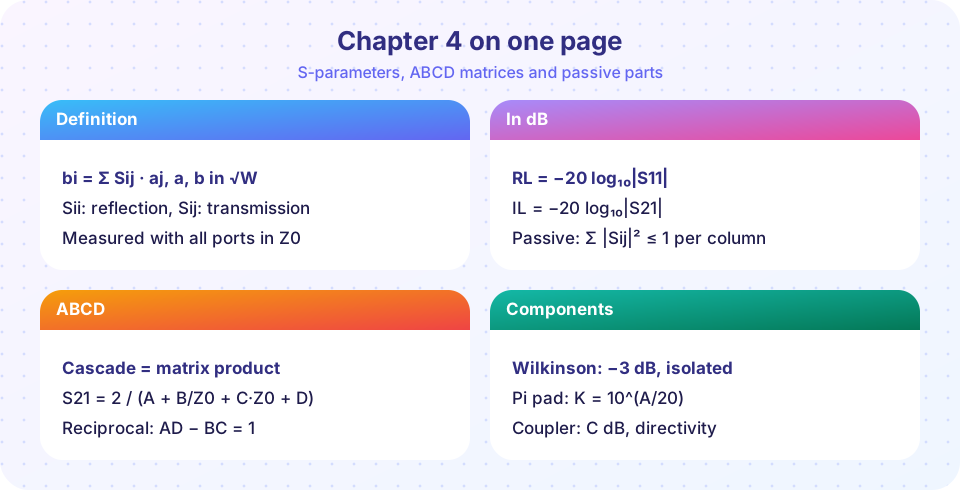
The chapter in a table
| Topic | Key facts |
|---|---|
| Waves | a = (V + Z0 I)/(2√Z0), b = (V − Z0 I)/(2√Z0); ` |
| S-matrix | b1 = S11 a1 + S12 a2, b2 = S21 a1 + S22 a2; measured with matched terminations |
| dB forms | `RL = −20 log₁₀ |
| Properties | reciprocal: S12 = S21; passive: column power sum ≤ 1; lossless: = 1 |
| Reference plane | S11' = S11 e^(−j2θ), S21' = S21 e^(−j(θ1 + θ2)) |
| ABCD | series [1 Z; 0 1], shunt [1 0; Y 1], line [cos θ, jZ0' sin θ; j sin θ/Z0', cos θ]; multiply to cascade |
| ABCD to S | Δ = A + B/Z0 + C Z0 + D; S21 = 2/Δ, S11 = (A + B/Z0 − CZ0 − D)/Δ |
| Pi pad | Rsh = Z0 (K + 1)/(K − 1), Rse = Z0 (K² − 1)/(2K), K = 10^(A/20) |
| Wilkinson | 70.7 Ω arms, 100 Ω resistor, S21 = S31 = −3 dB |
| Coupler | C, I, D = I − C; through loss −10 log₁₀(1 − 10^(−C/10)) |
A routine for any network question
- Identify the reference impedance and the ports.
- Break the circuit into blocks you know (series, shunt, line).
- Multiply their ABCD matrices in the signal order.
- Convert to S-parameters and express in dB.
- Sanity-check: passive and reciprocal? Column power sum at most 1? Lossless? Right sign for dB values?
If your passive network has |S11|² + |S21|² > 1, check the matrix order, the sign of I2 and the units (nH versus H, pF versus F).
Try it
Solve each problem by hand first, then run the code.
Press Run (or Ctrl + Enter) to see the result here.
Program input · what you'd type while the program runs
Type the answers before you press Run, one per line. Each time the program reads a line (with input()), it gets the next line from this box.
The second tool shows a two-section lowpass design compared with the single-section from the lesson: the more elements, the steeper the roll-off. Compare the stop-band attenuation at twice the cutoff frequency.
Press Run (or Ctrl + Enter) to see the result here.
Program input · what you'd type while the program runs
Type the answers before you press Run, one per line. Each time the program reads a line (with input()), it gets the next line from this box.
Check your understanding
Quick check · 10 questions
of 10 answered You scored / 10 · perfect!
-
1. A series 100 Ω resistor in a 50 Ω system has S21 equal to
S21 = 2Z0/(R + 2Z0) = 100/200 = 0.5 (−6 dB). -
2. What is the VSWR corresponding to S11 = −20 dB?
|S11| = 0.1, VSWR = 1.1/0.9 = 1.22. -
3. In the ABCD convention, the output current I2
The ABCD definition takes I2 leaving the network, so cascading is a simple product. -
4. A passive, reciprocal, lossless two-port has |S11| = 0.8. What is |S21|?
0.64 + |S21|² = 1, so |S21|² = 0.36 and |S21| = 0.6. -
5. Which matrix operation gives the cascade of two networks in ABCD form?
M = M1 · M2 with M1 nearest the source. -
6. An ideal 20 dB coupler passes how much of the main-line power (through loss)?
1% is coupled away; the through loss is 0.044 dB. -
7. What do S11 = 0 and S21 = 0 together say about a passive two-port?
No reflection and no transmission means all incident power is absorbed (like a matched load). -
8. The isolation resistor of a Wilkinson divider is
R = 2 Z0 = 100 Ω in a 50 Ω system. -
9. Adding a lossless 2 cm cable at port 2 of a measurement changes S22 by
S22' = S22 e^(−j2θ2); the magnitude is unchanged. -
10. Which statement about a Wilkinson divider is right?
That combination (match at all ports plus isolation) is exactly what the isolation resistor and quarter-wave arms provide.
Summary
- S-parameters are wave ratios measured with matched terminations; S11, S22 are reflections, S21, S12 transmissions.
- Passivity, reciprocity and losslessness give quick checks on any data.
- ABCD matrices cascade by multiplication and convert to S with
Δ = A + B/Z0 + C Z0 + D. - Pads, Wilkinson dividers and couplers are standard parts, each with simple design equations.
- Chapter 5 uses all of this to analyze amplifiers, noise and mixers.
Track your progress
Create a free account to tick off lessons and pick up where you left off on any device.
of RF Engineering and Antennas lessons completed