


















Lesson 3 of 46 · Getting Started
Decibels, dBm and Power Levels
Master the decibel for RF work: power and voltage ratios, dBm, dBW, dBc and dBi, the 3 dB rule, signal chains and the mistakes that trip up beginners.
RF signals span an enormous range. A transmitter may put out 100 W while the receiver at the other end hears a few femtowatts, a ratio of more than 10¹⁶. Writing such numbers in watts is hopeless, and multiplying them through a chain of gains and losses is error-prone. The decibel solves both problems: it compresses the range onto a small scale and turns multiplication into addition.
If you remember only one skill from this course, make it this one. Every link budget, noise calculation and amplifier specification you will meet uses decibels.
What you will learn
- The definition of the decibel for power and for voltage, and why they differ by a factor 2.
- How to convert between ratios, dB and dBm quickly, using the 3 dB and 10 dB rules.
- What dBm, dBW, dBc, dBi and dBµV mean.
- How to add dB along a signal chain, and what you must never add.
Key terms
- Decibel (dB): ten times the base-10 logarithm of a power ratio,
10 log₁₀(P₂/P₁). - dBm: power relative to 1 milliwatt. 0 dBm = 1 mW, 30 dBm = 1 W.
- dBW: power relative to 1 watt.
- dBc: level relative to the carrier (the main signal), used for spurs and noise.
- dBi: antenna gain relative to an isotropic radiator.
The definition
A decibel compares two powers:
G (dB) = 10 · log₁₀(P₂ / P₁)
Power gain of 2 gives 10 log₁₀ 2 = 3.01 dB, gain of 10 gives 10 dB and gain of 100 gives 20 dB. A loss is a negative number: halving the power is −3.01 dB.
For voltages (or currents) across the same impedance, power goes with the square of voltage (P = V²/R), so
G (dB) = 20 · log₁₀(V₂ / V₁)
A voltage ratio of 10 therefore means 20 dB, the same 100× power ratio. If the two voltages are across different impedances, convert to power first; the "20 log" rule only applies with equal impedances.
The rules of thumb that save time
| Power ratio | dB | Easy way to remember |
|---|---|---|
| 1 | 0 | no change |
| 2 | +3 | double |
| 4 | +6 | double twice |
| 10 | +10 | one decade |
| 100 | +20 | two decades |
| 1000 | +30 | three decades |
| 0.5 | −3 | halve |
| 0.1 | −10 | one tenth |
Any ratio can be built from these. For example ×50 = ×100 ÷ 2, which is +20 − 3 = +17 dB (the exact value is 16.99 dB). A gain of 25 dB is 30 − 5 dB. Since 5 dB is about ÷3.16, that is ×1000 ÷ 3.16, or about ×316.
Absolute levels: dBm and friends
A decibel is a ratio. To express an absolute power, pick a reference and put it in the unit:
P (dBm) = 10 log₁₀(P / 1 mW). Examples: 1 mW = 0 dBm, 100 mW = 20 dBm, 1 W = 30 dBm, 1 µW = −30 dBm.P (dBW) = 10 log₁₀(P / 1 W), which equalsdBm − 30.- dBc is relative to the carrier: a spurious tone at −60 dBc is one millionth of the carrier power.
- dBi measures antenna gain compared with an ideal isotropic radiator (chapter 6). dBd compares with a half-wave dipole;
dBi = dBd + 2.15. - dBµV is a voltage level relative to 1 µV, used for field strengths and EMC. In a 50 Ω system,
dBm = dBµV − 107.
Converting back: P (mW) = 10^(dBm/10).
Worked example. A radio outputs 23 dBm. In watts: 10^2.3 = 199.5 mW ≈ 0.2 W. A weak signal of −97 dBm is 10^−9.7 mW = 2 × 10⁻¹⁰ mW = 0.2 pW.
Voltage and dBm in a 50 Ω system
RF test gear is built around 50 Ω. With P = V²/R, the rms voltage for a level P is V = √(P R).
| Level | Power | RMS voltage across 50 Ω |
|---|---|---|
| −30 dBm | 1 µW | 7.07 mV |
| 0 dBm | 1 mW | 223.6 mV |
| +10 dBm | 10 mW | 707 mV |
| +20 dBm | 100 mW | 2.236 V |
The peak voltage of a sine is √2 times the rms value, so a 0 dBm sine has a peak of 316 mV.
Following a signal along a chain
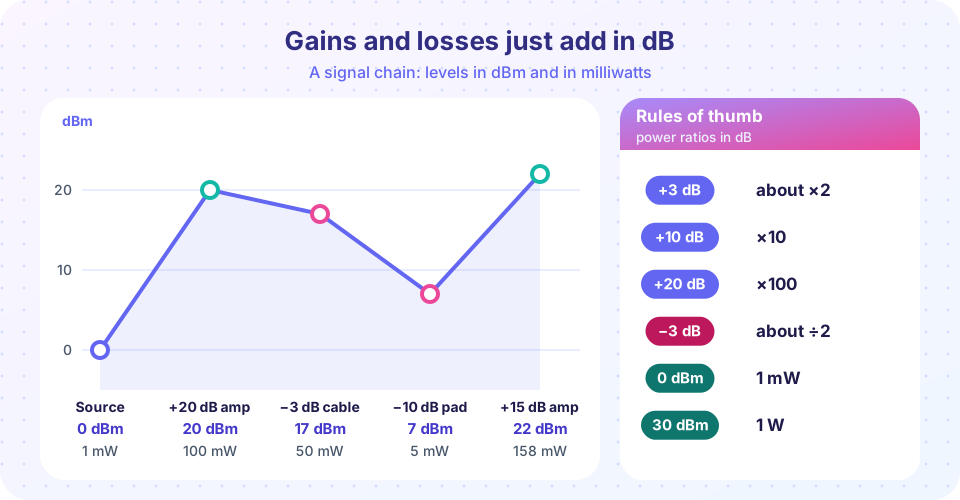
Gains add and losses subtract, so the level at any point is the starting level plus the sum of the dB values before it.
Worked example (the chain in the picture). A source delivers 0 dBm. A 20 dB amplifier brings it to 20 dBm (100 mW). A cable with 3 dB loss gives 17 dBm (50 mW). A 10 dB attenuator drops it to 7 dBm (5 mW). A final 15 dB amplifier lifts it to 22 dBm (158 mW). Total gain: 20 − 3 − 10 + 15 = +22 dB, matching 22 dBm − 0 dBm.
The mistakes everyone makes once
- "I can add two dBm values." Adding
10 dBm + 10 dBmdoes not give 20 dBm. Adding the dB of two levels multiplies their powers (10 mW × 10 mW, which has no physical meaning). Two equal signals added in power give+3 dB:10 dBm + 10 dBm = 13 dBm(20 mW). Convert to milliwatts, add, and convert back. - "dB and dBm are the same." dB is a ratio and has no reference. dBm is an absolute level.
dBm + dB = dBm,dBm − dBm = dB. - "Voltage dB is always 20 log." Only when both voltages are across the same impedance.
Try it
First, a calculator that converts between all the forms in one place. Type into any box.
Second, the signal chain from the picture in code. Edit the list of stages to build your own chain and the plot follows.
Press Run (or Ctrl + Enter) to see the result here.
Program input · what you'd type while the program runs
Type the answers before you press Run, one per line. Each time the program reads a line (with input()), it gets the next line from this box.
Check your understanding
Quick check · 5 questions
of 5 answered You scored / 5 · perfect!
-
1. A power gain of 1000 is how many decibels?
10 log₁₀(1000) = 30 dB. -
2. What is 20 dBm in milliwatts?
10^(20/10) = 100 mW. -
3. Two equal 10 dBm signals are added in power. The sum is about
Each is 10 mW; the sum is 20 mW, which is 13 dBm (+3 dB). -
4. A voltage ratio of 10 across the same impedance corresponds to
Power goes as the square of voltage, so 20 log₁₀(10) = 20 dB. -
5. A signal at -40 dBm passes through a 25 dB amplifier and a 6 dB attenuator. What is the output level?
-40 + 25 - 6 = -21 dBm.
Summary
dB = 10 log₁₀(P₂/P₁)for power and20 log₁₀(V₂/V₁)for voltages across equal impedances.- Memorize 3 dB ≈ ×2, 10 dB = ×10, and you can build any ratio.
- dBm is relative to 1 mW;
dBm + dB = dBmanddBm − dBm = dB. - In 50 Ω, 0 dBm is 223.6 mV rms.
- Never add dBm values; convert to milliwatts, add, convert back.
Track your progress
Create a free account to tick off lessons and pick up where you left off on any device.
of RF Engineering and Antennas lessons completed