


















Lesson 24 of 46 · Amplifiers and Mixers
Mixers and Frequency Conversion
Learn how a mixer multiplies RF by a local oscillator, creates sum and difference tones, why the image frequency is a problem, and how superheterodyne receivers work.
Filtering a weak signal is far easier at a low, fixed frequency than at the carrier. A mixer lets you do that: it shifts any band to a chosen intermediate frequency, so the same filters and amplifiers serve many channels. Mixers are also at the heart of every transmitter, where the shift goes upward. In this lesson you will see why multiplication creates new frequencies, how the image frequency sneaks in, and how real receivers deal with it.
What you will learn
- Why multiplying two sinusoids gives sum and difference frequencies.
- How to choose LO frequency and compute IF and image frequencies.
- What conversion loss, isolation and mixer spurs are.
- How superheterodyne, zero-IF and image-reject receivers compare.
Key terms
Conversion loss: ratio of RF input power to IF output power for a passive mixer, usually 5 to 9 dB. Image frequency: the unwanted frequency that is the mirror of the wanted one about the LO, and also converts to the IF. LO leakage / isolation: how much LO power appears at the RF or IF port. Superheterodyne: receiver architecture that converts to a fixed IF. Zero-IF (direct conversion): receiver whose LO equals the carrier frequency, so the IF is baseband.
Multiplication makes new frequencies
The trigonometric identity is the whole story:
cos(a) cos(b) = (1/2) [cos(a - b) + cos(a + b)]
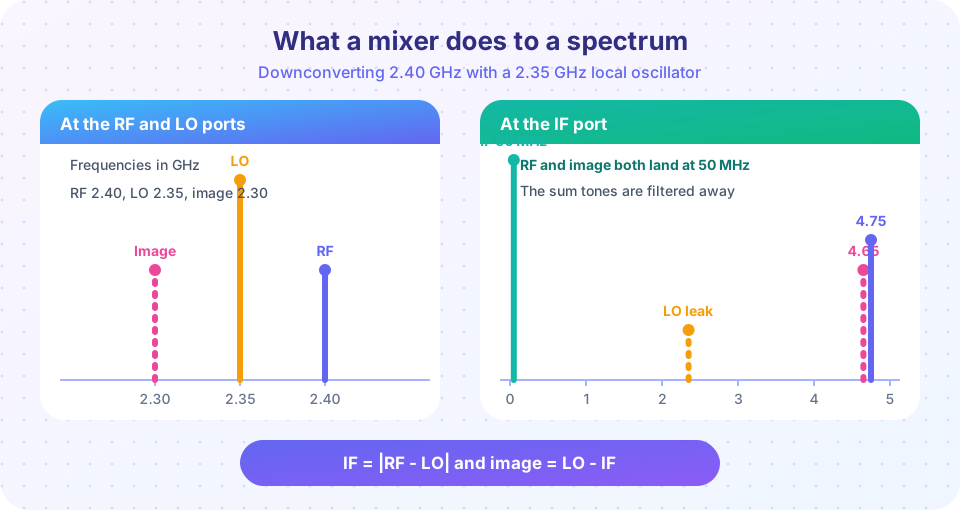
Let the RF signal be cos(2π f_RF t) and the LO cos(2π f_LO t). An ideal multiplier produces tones at |f_RF - f_LO| and f_RF + f_LO, each with half the amplitude. A filter at the IF port keeps one of them. With f_RF = 2.40 GHz and f_LO = 2.35 GHz the difference is the IF: 50 MHz. The sum, 4.75 GHz, is discarded.
A real mixer is a switch or a nonlinear device driven hard by the LO. Its output also contains harmonics of the LO and of the RF and their mixes, m f_RF ± n f_LO. These are the mixer spurs, and mixer data sheets give a spur table for them. Practical ratings include:
- Conversion loss of a diode ring mixer: 6 to 8 dB (active mixers can show gain).
- LO-to-RF and LO-to-IF isolation: 20 to 40 dB typical; leakage can radiate from the antenna.
- LO drive level: a passive mixer needs +7 dBm to +17 dBm of LO.
- P1dB and IIP3 as for any stage; they are usually specified at the RF port.
Low-side and high-side injection
You can place the LO below or above the RF:
- Low-side:
f_LO = f_RF - f_IF - High-side:
f_LO = f_RF + f_IF
In both cases the IF is |f_RF - f_LO|.
The image problem
Two input frequencies satisfy |f - f_LO| = f_IF: the wanted f_RF = f_LO + f_IF and the image f_IM = f_LO - f_IF. Both land on the same IF. In the figure, with LO = 2.35 GHz and IF = 50 MHz, the wanted signal is 2.40 GHz and the image is 2.30 GHz. A strong station at 2.30 GHz would be heard on top of your signal and cannot be separated afterwards.
The image sits 2 f_IF below the wanted signal. The remedy is to attenuate it before the mixer using a preselector filter. A higher IF pushes the image further away and makes that filter easier, but then the channel filter at the IF is harder to make narrow. This trade-off is the main design decision in a superheterodyne receiver.
Worked example. An FM broadcast receiver tunes 100.0 MHz with IF = 10.7 MHz and high-side injection. f_LO = 110.7 MHz and f_IM = 121.4 MHz. The preselector must reject 121.4 MHz, which is far outside the FM band (88 to 108 MHz), so a simple filter works.
Architectures
- Superheterodyne: one or two IF stages with sharp filters. Excellent selectivity, needs an image filter.
- Zero-IF:
f_LO = f_RF, the image is the signal's own mirror sideband, and two mixers driven 90 degrees apart (I and Q) separate the sidebands. It needs no image filter and integrates easily on a chip, but suffers from DC offset and LO leakage. - Image-reject mixers: combine I/Q mixing with a 90 degree hybrid to cancel the image electrically; 25 to 40 dB of rejection is typical.
- Up-conversion in transmitters: the same mixer moves a baseband or IF signal to the carrier.
Common misconceptions
"A mixer adds the two frequencies." It produces both the sum and the difference. You choose one with a filter.
"The image is a mixer defect." It follows from the mathematics of multiplication. Only filtering (or I/Q cancellation) removes it.
"Any LO level works." A passive mixer needs enough LO drive to switch properly; too little LO raises conversion loss and distortion.
Try it
Press Run (or Ctrl + Enter) to see the result here.
Program input · what you'd type while the program runs
Type the answers before you press Run, one per line. Each time the program reads a line (with input()), it gets the next line from this box.
Check your understanding
Quick check · 5 questions
of 5 answered You scored / 5 · perfect!
-
1. RF = 1.8 GHz and LO = 1.73 GHz. What is the IF?
IF = |1.80 - 1.73| GHz = 70 MHz. -
2. With high-side injection, f_RF = 900 MHz and IF = 70 MHz, the image frequency is
LO = 970 MHz, image = LO + IF = 1040 MHz, which is RF + 2 IF. -
3. Why does a higher IF make the image filter easier to build?
The image is 2 x IF away, so a bigger IF gives more room for a preselector to roll off. -
4. Which architecture needs no separate image filter because the LO equals the carrier?
In zero-IF the image is the mirrored sideband of the signal itself, separated by I/Q processing. -
5. An ideal mixer's output amplitude for unit-amplitude RF and LO tones is
cos a cos b = 1/2 [cos(a-b) + cos(a+b)].
Summary
- Multiplying RF by an LO gives
|f_RF - f_LO|andf_RF + f_LO; a filter selects one. - The image frequency lies
2 f_IFfrom the wanted signal and must be filtered before the mixer. - Real mixers add conversion loss, leakage and spurs.
- Superheterodyne, zero-IF and image-reject designs trade filtering effort against integration.
Next: Chapter review
Track your progress
Create a free account to tick off lessons and pick up where you left off on any device.
of RF Engineering and Antennas lessons completed