


















Lesson 23 of 46 · Amplifiers and Mixers
Linearity and Stability
Understand gain compression, the 1 dB point, third-order intermodulation, intercept points, dynamic range and the Rollett stability factor of RF amplifiers.
An ideal amplifier multiplies its input by a constant. A real one does so only for small signals. Push the input up and the gain sags, harmonics appear, and two nearby signals mix into new tones that land right on top of what you wanted to hear. This lesson gives you the numbers that describe that behavior (P1dB and the third-order intercept point), shows how to combine them for a chain, and finishes with a second way an amplifier can fail: oscillating when you did not ask it to.
What you will learn
- How gain compression and the 1 dB compression point are defined.
- How two tones create third-order intermodulation, and what IIP3 measures.
- How to cascade IIP3 and estimate spurious-free dynamic range.
- How to test an amplifier for stability with K and the delta determinant.
Key terms
P1dB: the power level at which the gain has dropped 1 dB below its small-signal value.
IM3: third-order intermodulation products at 2f1 - f2 and 2f2 - f1.
IIP3 / OIP3: the input or output power where the extrapolated fundamental and IM3 lines intersect. OIP3 = IIP3 + G.
SFDR: spurious-free dynamic range, the span between the noise floor and the level where IM3 reaches the noise floor.
K factor: Rollett stability factor computed from S-parameters.
Compression
Model a weakly nonlinear amplifier as y = a1 x + a3 x^3 with a3 negative. For a sine input of amplitude A the fundamental output amplitude is a1 A + (3/4) a3 A^3. The cubic term subtracts from the linear one, so the gain falls as A grows. The input amplitude where the gain has dropped by 1 dB is
A_1dB = sqrt(0.145 |a1/a3|)
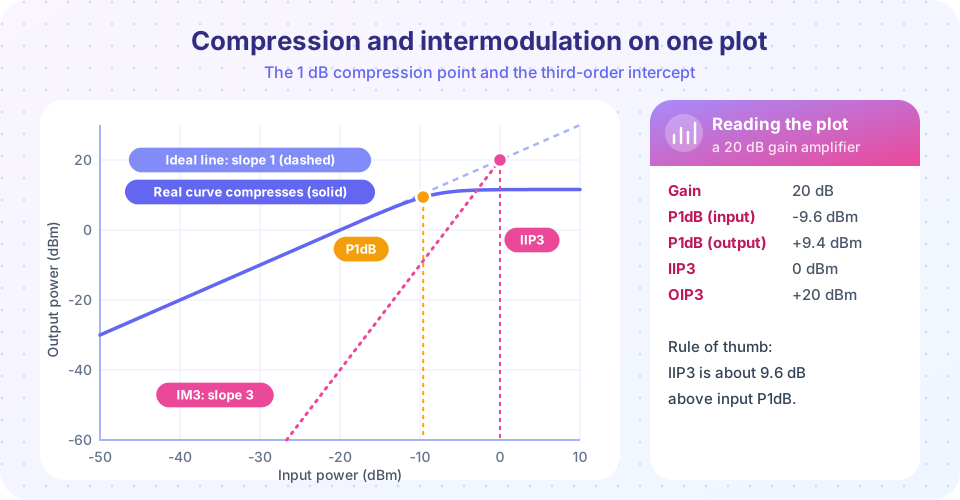
A real amplifier eventually saturates completely, but P1dB is the practical upper limit of linear operation. For the 20 dB amplifier in the figure, the input P1dB is about -9.6 dBm and the output P1dB is about +9.4 dBm (output P1dB = input P1dB + gain - 1 dB).
Intermodulation and the intercept point
Apply two tones at f1 and f2. The cubic term produces new tones at 2f1 - f2 and 2f2 - f1. If the tones are 10 kHz apart, these products sit 10 kHz outside them, inside any channel you might be listening to, and no filter can remove them afterwards.
Each IM3 product has amplitude (3/4) |a3| A^3. In dB terms this means the IM3 level rises 3 dB for every 1 dB rise of the input tones. Extending the fundamental line (slope 1) and the IM3 line (slope 3) on dB axes, they cross at the third-order intercept point. This crossing is only an extrapolation; the amplifier compresses long before it. The intercept is still the best single figure of merit because it does not depend on the test level:
P_IM3 = 3 P_out - 2 OIP3 (all in dBm, P_out per tone)
For the amplifier above, OIP3 = +20 dBm. With two tones at -10 dBm output each, IM3 = -30 - 40 = -70 dBm, which is 60 dBc below the tones. For a weakly nonlinear amplifier with only a cubic term, IIP3 is about 9.6 dB above the input P1dB. Real parts deviate, so quote the measured values.
Cascading linearity
Linearity gets worse toward the end of a chain, the opposite of noise. The IIP3 of a cascade, with linear (milliwatt) values and gains as ratios, is
1/IIP3_total = 1/IIP3_1 + G1/IIP3_2 + G1 G2/IIP3_3 + ...
Each stage's IIP3 is referred to the input by dividing by the gain in front of it, so a high-gain front end makes the later stages matter more. This creates the central trade-off of receiver design: gain in front helps noise but hurts linearity.
Dynamic range
The range of signal levels a receiver handles cleanly has two limits. The bottom is the noise floor -174 + 10 log10(B) + NF. The top, for third-order distortion, is where IM3 rises to that floor. For the two-tone test this gives
SFDR = (2/3) (IIP3 - floor) (dB, referred to the input)
With IIP3 = -10 dBm and a floor of -100 dBm, SFDR is about 60 dB.
Stability
An amplifier with feedback paths can oscillate if some source or load impedance reflects enough energy back with the right phase. S-parameters (the reflection and transmission coefficients you will meet in chapter 4) give a clean test. With Δ = S11 S22 - S12 S21 and
K = (1 - |S11|² - |S22|² + |Δ|²) / (2 |S12 S21|)
the device is unconditionally stable at that frequency if K > 1 and |Δ| < 1. If not, some passive terminations will make it oscillate, and the designer must pick them carefully or add resistive loading. A single-parameter alternative is μ = (1 - |S11|²) / (|S22 - Δ S11*| + |S12 S21|); stability requires μ > 1. Always check K across a wide frequency range, not only at the design frequency, because many amplifiers oscillate out of band.
Common misconceptions
"P1dB is the maximum power." It is the point of 1 dB compression, not the output ceiling. The amplifier still delivers more power beyond it.
"IP3 is a power I can reach." The intercept is an extrapolation of two straight lines; the device compresses before reaching it.
"If K > 1 the amplifier is stable." You also need |Δ| < 1, and the check is for every frequency, not just the operating one.
Try it
Press Run (or Ctrl + Enter) to see the result here.
Program input · what you'd type while the program runs
Type the answers before you press Run, one per line. Each time the program reads a line (with input()), it gets the next line from this box.
Press Run (or Ctrl + Enter) to see the result here.
Program input · what you'd type while the program runs
Type the answers before you press Run, one per line. Each time the program reads a line (with input()), it gets the next line from this box.
Press Run (or Ctrl + Enter) to see the result here.
Program input · what you'd type while the program runs
Type the answers before you press Run, one per line. Each time the program reads a line (with input()), it gets the next line from this box.
Check your understanding
Quick check · 5 questions
of 5 answered You scored / 5 · perfect!
-
1. An amplifier has 15 dB small-signal gain. At the 1 dB compression point its gain is
P1dB is where gain has fallen by 1 dB, so 15 - 1 = 14 dB. -
2. The input tones rise by 4 dB. By how much does each IM3 product rise (small-signal region)?
IM3 has slope 3, so it rises 3 times as many dB: 12 dB. -
3. An amplifier has OIP3 = +30 dBm and each tone is at +10 dBm output. What is IM3 (dBm)?
IM3 = 3(10) - 2(30) = -30 dBm. -
4. In a cascade, which stage's IIP3 usually matters most?
Each stage's IIP3 is divided by the gain ahead of it, so later stages dominate. -
5. A transistor has K = 0.8 and |Delta| = 0.3 at 2 GHz. What can you say?
Unconditional stability needs K > 1 and |Delta| < 1. With K < 1 some impedances can cause oscillation.
Summary
- P1dB marks where gain has dropped 1 dB; IIP3 is an extrapolated crossing used to compare devices.
- IM3 rises at 3 dB per dB of input;
IM3 = 3 P_out - 2 OIP3. - Linearity is limited by the last stages, noise by the first.
SFDR = (2/3)(IIP3 - floor).- Check stability across frequency: unconditional stability needs
K > 1and|Δ| < 1.
Track your progress
Create a free account to tick off lessons and pick up where you left off on any device.
of RF Engineering and Antennas lessons completed