


















Lesson 30 of 46 · Antenna Fundamentals
Chapter Review: Antenna Fundamentals
Review radiation patterns, directivity and gain, impedance and VSWR, polarization loss, effective aperture and the Friis equation with a recap table and ten questions.
This chapter gave you the vocabulary and formulas to describe any antenna on a link: the pattern says where the power goes, the impedance says how much gets in, the polarization says how much of the wave is usable, and the aperture says how much is captured.
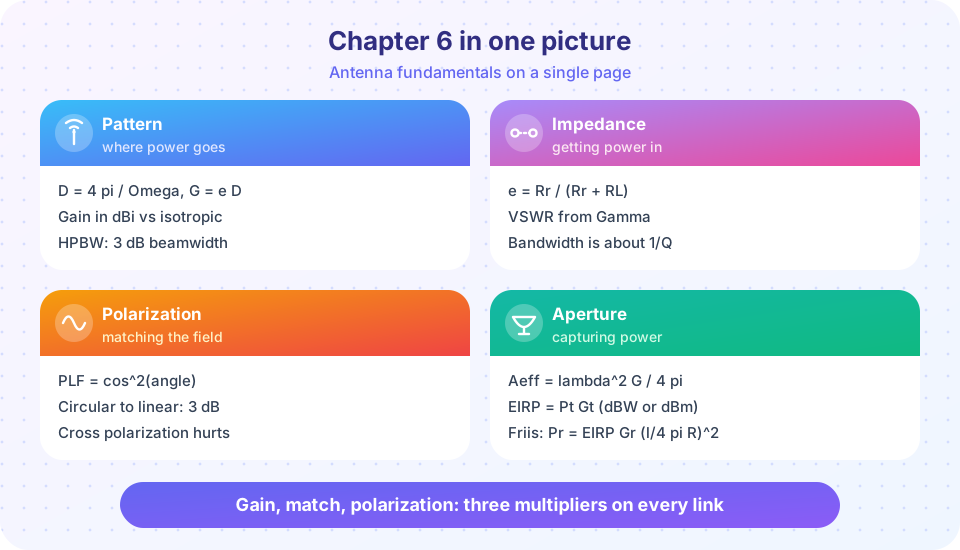
Recap table
| Topic | Key result | Typical value |
|---|---|---|
| Directivity | D = 4π U_max / P_rad |
Half-wave dipole 1.64 (2.15 dBi) |
| Gain | G = e D |
Efficiency lowers gain |
| Beam estimate | D ≈ 41253 / (θ1 θ2) |
5° x 5° gives about 32 dBi |
| Dipole HPBW | E-plane | 78 degrees |
| Radiation resistance | Half-wave dipole | 73 ohm |
| Reflection | Γ = (Za - Z0)/(Za + Z0) |
VSWR 2 means 9.54 dB return loss |
| Polarization | PLF = cos² ψ |
45 degrees costs 3 dB |
| Aperture | Aeff = λ² G / 4π |
Isotropic at 2.4 GHz: 12.4 cm² |
| Friis | Pr = Pt Gt Gr (λ/4πR)² |
+6 dB loss per doubling of R |
Try it
Press Run (or Ctrl + Enter) to see the result here.
Program input · what you'd type while the program runs
Type the answers before you press Run, one per line. Each time the program reads a line (with input()), it gets the next line from this box.
Press Run (or Ctrl + Enter) to see the console output here.
No output.
Check your understanding
Quick check · 10 questions
of 10 answered You scored / 10 · perfect!
-
1. A passive antenna has gain 20 dBi. Compared with an isotropic antenna its peak power density is
20 dBi is a factor of 100. -
2. A dipole of 73 ohm feeds a 50 ohm line directly. VSWR is about
Gamma = 23/123 = 0.187, VSWR = 1.187/0.813 = 1.46. -
3. Efficiency of an antenna with Rr = 2 ohm and RL = 3 ohm is
e = 2/(2+3) = 0.4. -
4. A linear antenna receives a circularly polarized wave. The loss is
Half the power is in each linear component. -
5. The effective aperture of a 20 dBi antenna at 5 GHz is about (lambda = 6 cm)
Aeff = 0.0036 * 100 / (4 pi) = 0.02865 m^2, about 286 cm^2. -
6. Doubling distance in free space changes Pr by
Pr ~ 1/R^2. -
7. A 8 dBd antenna has how many dBi?
dBi = dBd + 2.15. -
8. Which is true for a half-wave dipole's null?
The figure eight has nulls along the axis of the wire. -
9. The far field of a 2 m dish at 6 GHz (lambda = 5 cm) starts at about
2 D^2 / lambda = 2 * 4 / 0.05 = 160 m. -
10. Which is NOT part of the Friis equation in its basic form?
Noise is added when comparing Pr with the noise floor, not in Friis itself.
Summary
- Gain, match and polarization multiply together on every link.
- Aperture
λ²G/4πexplains why gain and wavelength control received power. - Use Friis for the free-space part, then add every real-world loss.
Track your progress
Create a free account to tick off lessons and pick up where you left off on any device.
of RF Engineering and Antennas lessons completed