


















Lesson 37 of 46 · Propagation and Link Budgets
Free Space, Fresnel Zones and the Radio Horizon
Calculate free-space path loss, Fresnel zone radius and clearance, the radio horizon with the 4/3 earth model, and estimate atmospheric and rain losses on microwave links.
A microwave tower can be 40 km from its neighbor and still deliver a clean signal, yet a single hill 10 meters beside the path can wipe it out. The first fact comes from the radio horizon, the second from Fresnel zones. This lesson turns both into numbers and adds the atmosphere's contribution, which grows with frequency.
What you will learn
- How to compute free-space path loss in two equivalent forms.
- How to find Fresnel zone radii and required antenna heights.
- How far the radio horizon reaches with the 4/3 earth model.
- Roughly how much loss rain, oxygen and water vapor add.
Key terms
FSPL: free-space path loss between isotropic antennas, (4πd/λ)².
First Fresnel zone: the ellipsoid where the extra path via a point is less than half a wavelength.
Effective earth radius: k × 6371 km, with k = 4/3 to account for average refraction.
Knife-edge diffraction: loss when a sharp obstacle blocks part of the path.
Specific attenuation: loss per kilometer from rain or gases, in dB/km.
Free-space loss
From Friis, the loss between two isotropic antennas is
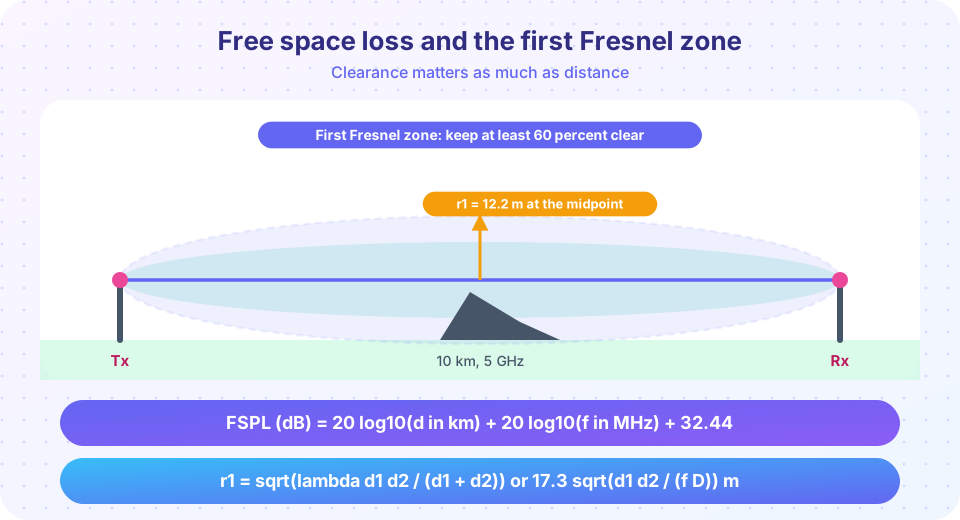
FSPL = (4π d / λ)², or FSPL (dB) = 20 log10(d_km) + 20 log10(f_MHz) + 32.44
Check with 10 km at 5 GHz: 20 log10(10) + 20 log10(5000) + 32.44 = 20 + 73.98 + 32.44 = 126.4 dB. Each doubling of d or f adds 6.02 dB. Real links use antennas with gain, which subtracts from the loss in the budget.
Fresnel zones
Light is not the only thing that takes a straight path; a radio wave occupies a volume around the line of sight. Draw the surface of points P such that the path Tx-P-Rx is longer than the direct path by exactly n λ/2. The surfaces are ellipsoids, the nth Fresnel zones. For a point at distance d1 from the transmitter and d2 from the receiver (with D = d1 + d2 the total path length):
r_n = sqrt(n λ d1 d2 / (d1 + d2))
At the midpoint of a 10 km link at 5 GHz (λ = 6 cm), r1 = sqrt(0.06 × 5000 × 5000 / 10000) = 12.2 m, as the figure shows. A practical formula with d in km and f in GHz is r1 = 17.3 sqrt(d1 d2 / (f D)) meters, which gives the same 12.2 m.
Parts of the wavefront inside odd zones reinforce the direct signal and those in even zones cancel it. An obstacle that just touches the LOS costs about 6 dB, and one that blocks more of the path costs more; with the first zone clear, the signal only ripples a little around the free-space level. The standard design rule is at least 60 percent of the first Fresnel zone clear, which keeps the loss within a fraction of a dB of free space. For the 10 km, 5 GHz example, that means the lowest terrain or tree must be at least 7.3 m below the line of sight at the midpoint.
The radio horizon
On a smooth Earth of radius R = 6371 km, an antenna at height h sees the geometric horizon at d = sqrt(2 R h). The atmosphere's refractive index decreases with height on average, which bends the waves slightly toward the ground. Engineers account for it by pretending the Earth is larger, with effective radius k R, k = 4/3. The radio horizon is then
d (km) ≈ 4.12 sqrt(h (m))
and for two antennas of heights h1 and h2 the maximum link distance is 4.12 (sqrt(h1) + sqrt(h2)). A 30 m tower reaches 22.6 km by itself; two 30 m towers can be 45 km apart. A handheld at 1.5 m height talking to a 30 m tower: 4.12 (1.22 + 5.48) = 27.6 km. Anomalous refraction (ducting) can extend a path far beyond this on some days, and sub-refraction can shorten it; links are designed with a worst-case k factor in mind, often 2/3.
Atmosphere and rain
Below about 10 GHz the clear atmosphere is almost transparent. Above that, absorption increases: water vapor has a peak near 22 GHz and oxygen has a strong band at 60 GHz, about 15 dB/km at sea level, which is why 60 GHz is used for short, secure links. Rain scatters and absorbs waves whose wavelength is comparable to a raindrop. Heavy rain (50 mm/h) costs several dB per kilometer at 20 GHz and roughly 10 to 20 dB per kilometer at 60 to 80 GHz. Satellite and terrestrial microwave links include a rain margin sized to the local climate and the required availability (for example 99.99 percent).
Common misconceptions
"Free-space loss is a property of the atmosphere." It is geometric spreading plus the antenna aperture effect and happens in vacuum.
"If the line from antenna to antenna just clears the hill, we are fine." It would be a 6 dB hit. You need clearance of at least 0.6 r1.
"The radio horizon equals the optical one." It is about 15 percent farther on average because of refraction.
Try it
Press Run (or Ctrl + Enter) to see the result here.
Program input · what you'd type while the program runs
Type the answers before you press Run, one per line. Each time the program reads a line (with input()), it gets the next line from this box.
Press Run (or Ctrl + Enter) to see the result here.
Program input · what you'd type while the program runs
Type the answers before you press Run, one per line. Each time the program reads a line (with input()), it gets the next line from this box.
Press Run (or Ctrl + Enter) to see the console output here.
No output.
Check your understanding
Quick check · 5 questions
of 5 answered You scored / 5 · perfect!
-
1. FSPL for 1 km at 900 MHz is about
32.44 + 20 log10(900) + 0 = 32.44 + 59.08 = 91.5 dB. -
2. Fresnel zone radius grows with
r1 is proportional to sqrt(lambda). -
3. The recommended minimum clearance of the first Fresnel zone is
About 60 percent keeps loss near free-space level. -
4. Two 25 m towers, 4/3 earth. Maximum LOS distance is about
4.12 x (5 + 5) = 41.2 km. -
5. Which frequency band is strongly absorbed by oxygen?
Oxygen has a broad absorption peak near 60 GHz.
Summary
FSPL (dB) = 20 log10 d_km + 20 log10 f_MHz + 32.44.r1 = sqrt(λ d1 d2 / D); keep at least 60 percent of it clear.- Radio horizon:
4.12 (√h1 + √h2)km withk = 4/3. - Above 10 GHz, add rain and gas attenuation, and above 50 GHz oxygen too.
Next: Building a link budget
Track your progress
Create a free account to tick off lessons and pick up where you left off on any device.
of RF Engineering and Antennas lessons completed