


















Lesson 36 of 46 · Propagation and Link Budgets
Propagation and Link Budgets: The Big Picture
See how radio waves travel by ground wave, sky wave and line of sight, and how a link budget adds gains and losses to predict whether a signal arrives.
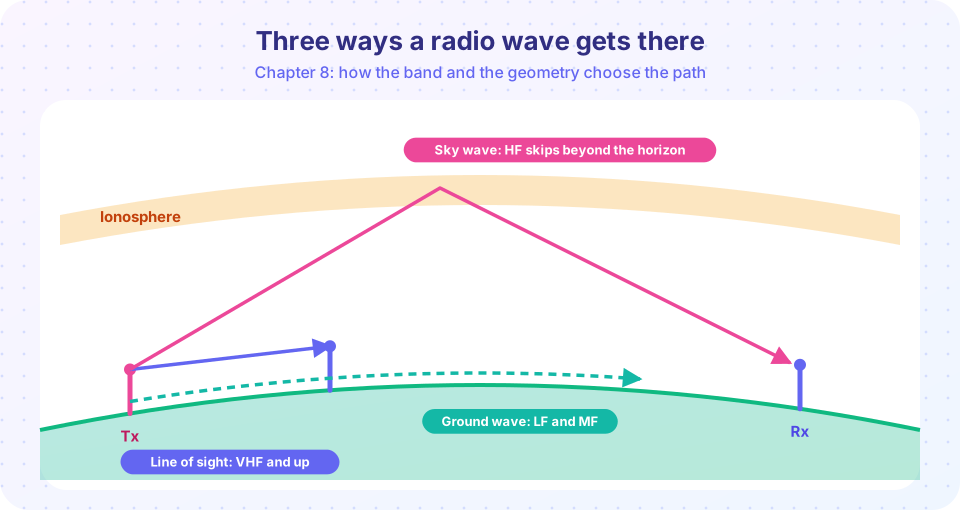
You now know how to make a signal, amplify it, radiate it and receive it. What remains is the space in between. Radio waves do not just fly in straight lines: depending on frequency they follow the ground, bounce off the upper atmosphere, graze obstacles, or arrive by several paths at once. This chapter gives you the models engineers use to predict what happens, and the link budget, the bookkeeping that tells you whether the receiver will hear a clean signal.
What you will learn
- Which propagation mechanisms dominate in each frequency band.
- How free-space loss, Fresnel zones and the radio horizon limit line-of-sight links.
- How to build and read a link budget.
- Why real signals fade, and how much margin to add.
Key terms
Line of sight (LOS): a path where the transmit and receive antennas can "see" each other, with enough clearance. Radio horizon: the maximum LOS distance over a curved Earth, extended by atmospheric refraction. Fresnel zone: the ellipsoid around the LOS path that must stay mostly clear. Link budget: a table adding gains and subtracting losses from transmitter to receiver. Fade margin: extra dB reserved so the link survives signal dips.
Bands and mechanisms
Ground wave
AM broadcast reaches hundreds of km.
Sky wave
Skips beyond the horizon, varies by day and night.
Line of sight
The budget
What each lesson covers
- Free space, Fresnel zones and the horizon: path loss, clearance, radio horizon, atmosphere.
- Building a link budget: EIRP, path loss, receiver noise, margin and a Wi-Fi example.
- Fading and multipath: two-ray model, Rayleigh and Rician fading, fade margin and diversity.
- Chapter review: recap and ten questions.
Common misconceptions
"Radio waves only travel in straight lines." Below 30 MHz they follow the curve of the Earth or reflect from the ionosphere; at any frequency the atmosphere bends them slightly.
"If I can see the other antenna, the link is fine." Visual LOS is not the same as radio clearance: obstacles within the first Fresnel zone can cost many decibels.
Try it
Press Run (or Ctrl + Enter) to see the console output here.
No output.
Press Run (or Ctrl + Enter) to see the console output here.
No output.
Check your understanding
Quick check · 3 questions
of 3 answered You scored / 3 · perfect!
-
1. Which band can reach beyond the horizon by reflecting from the ionosphere?
HF waves (3 to 30 MHz) are refracted by ionospheric layers. -
2. Fresnel clearance concerns
Obstacles inside the Fresnel ellipsoid affect the received field. -
3. A link budget is
It adds and subtracts dB to estimate received power and SNR.
Summary
- Frequency selects the mechanism: ground wave, sky wave or line of sight.
- Clearance, distance and atmosphere set the loss; the budget sums them.
- Fading demands margin on top of the average.
Track your progress
Create a free account to tick off lessons and pick up where you left off on any device.
of RF Engineering and Antennas lessons completed