


















Lesson 31 of 46 · Antenna Types and Arrays
Antenna Types and Arrays: The Big Picture
A tour of the main antenna families: wire antennas, patches, horns, dishes and phased arrays, with the idea that links them: aperture size measured in wavelengths.
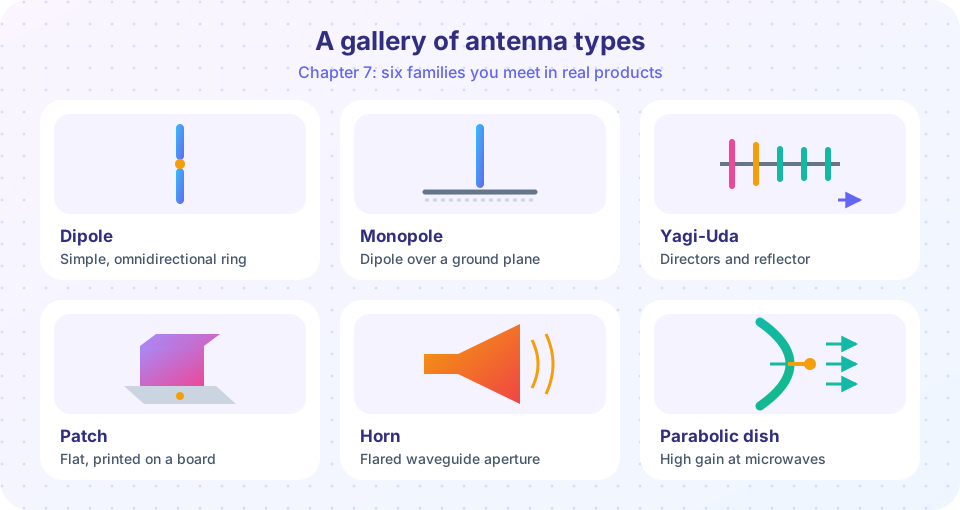
Walk around a city and you will see dozens of antenna shapes: whips on cars, flat panels on towers, dishes on balconies, tiny chips in phones. They look different but obey the same rules from the last chapter. Each one is a way of making a particular pattern, impedance and bandwidth out of metal, a dielectric, or a combination. This chapter surveys the families and then shows how to combine many small elements into an array whose beam you can steer with electronics.
What you will learn
- How the main antenna families are built and what each is good at.
- How to choose between a wire, a patch, an aperture and an array for a task.
- Why the size of an antenna is always quoted in wavelengths.
Key terms
Resonant antenna: an antenna whose reactance cancels at the operating frequency, usually near a half or quarter wavelength. Ground plane: a conducting sheet that acts as a mirror and creates the "other half" of a monopole. Aperture antenna: one that radiates through an opening, such as a horn or a dish. Array: several elements fed together to shape or steer a beam. Electrical size: physical size divided by wavelength.
The map
Wire antennas
Printed antennas
Narrow bandwidth, moderate gain.
Aperture antennas
Arrays
What each lesson covers
- Wire and patch antennas: dipole, monopole, Yagi-Uda, microstrip patch design equations.
- Horns and dishes: aperture fields, horn gain, parabolic reflector, feed illumination and efficiency.
- Arrays and beamforming: array factor, pattern multiplication, spacing, grating lobes, steering, tapering.
- Chapter review: recap and ten questions.
Size is measured in wavelengths
A half-wave dipole is 6.1 cm long at 2.45 GHz and 1.5 m long at 100 MHz. The same shape works at both frequencies because only L/λ matters. For aperture antennas, gain grows with (D/λ)². That is why handheld devices need arrays or special tricks at low frequencies where a resonant antenna would be longer than the device, and why millimeter-wave systems can put dozens of elements on a fingernail-sized chip.
Common misconceptions
"Longer is always better." Beyond about 1.25 wavelengths a single wire's pattern splits into extra lobes. For more gain you add structure: directors, reflectors or elements.
"A patch antenna is a small dipole." It radiates from two edges of a resonant cavity formed between the patch and the ground plane, a different mechanism.
Try it
Press Run (or Ctrl + Enter) to see the console output here.
No output.
Press Run (or Ctrl + Enter) to see the console output here.
No output.
Check your understanding
Quick check · 4 questions
of 4 answered You scored / 4 · perfect!
-
1. A quarter-wave monopole over ground behaves like
The ground plane produces an image of the monopole, so together they act as a dipole. -
2. The best antenna for a narrow, high-gain beam at 12 GHz is probably
Large apertures in wavelengths give narrow beams. -
3. Why quote antenna size in wavelengths?
The same electrical size gives the same pattern at any frequency. -
4. A half-wave dipole at 600 MHz has an ideal length of about
lambda = 50 cm, half is 25 cm (slightly less in practice).
Summary
- Families: wire (dipole, monopole, Yagi), printed (patch), aperture (horn, dish) and arrays.
- Electrical size, not physical size, controls the pattern.
- Arrays build high gain and steering from many small elements.
Next: Wire and patch antennas
Track your progress
Create a free account to tick off lessons and pick up where you left off on any device.
of RF Engineering and Antennas lessons completed