


















Lesson 39 of 46 · Propagation and Link Budgets
Fading and Multipath
Understand multipath, the two-ray ground model, Rayleigh and Rician fading, Doppler and delay spread, and how fade margin and diversity keep a radio link reliable.
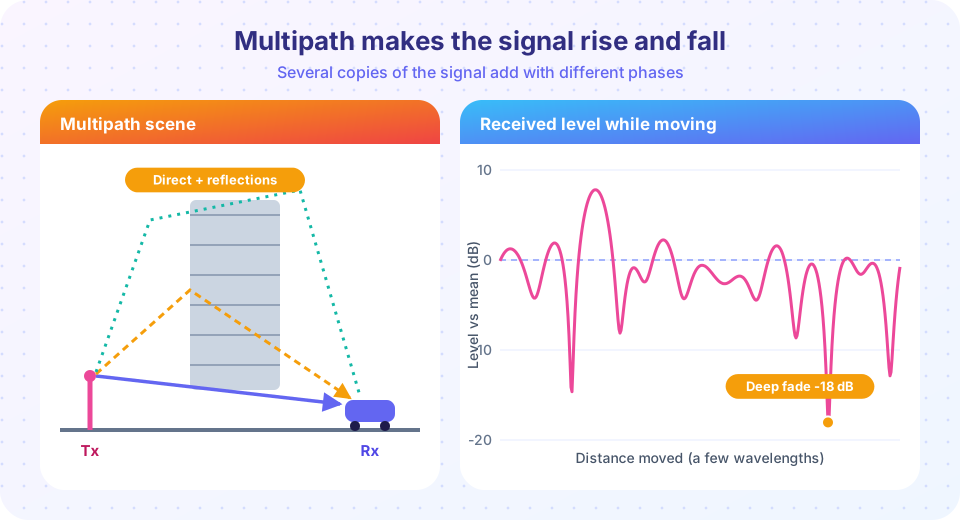
Free-space loss tells you the average. But a phone moving through a street, or a Wi-Fi laptop placed a few centimeters differently, sees the signal rise and fall by 20 dB or more. The reason is multipath: the wave reaches the receiver by several routes, direct and reflected, and the copies add with different phases. This lesson shows how to model that, how to size a fade margin, and which tricks (diversity, wideband signals) fight the effect.
What you will learn
- How two rays can add or cancel, and why ground reflection gives a
1/d⁴law. - What Rayleigh and Rician fading are and when each applies.
- How to choose a fade margin for a target availability.
- How delay spread, Doppler and diversity affect real systems.
Key terms
Multipath: arrival of the signal by more than one route.
Rayleigh fading: statistics of the envelope when many scattered paths add and none dominates.
Rician fading: the same with a strong direct path, described by the K factor (direct power to scattered power).
Delay spread: the time difference between the first and last significant paths.
Doppler shift: frequency shift f_d = v f / c caused by motion.
Two rays
Place a transmitter at height ht and a receiver at height hr, distance d apart over flat ground. The receiver gets a direct ray of length d1 and a ground-reflected ray of length d2. The reflection at shallow angles has a coefficient close to -1 (a 180 degree phase flip). The total field is the sum:
|E|² ∝ (λ / 4π d)² · |1 - e^{-j 2π Δ / λ}|² = (λ / 4π d)² · 4 sin²(π Δ / λ), where Δ = d2 - d1
The factor 4 sin² oscillates between 0 and 4: up to 6 dB above free space and a complete null where the paths differ by a whole number of wavelengths. At large d, Δ ≈ 2 ht hr / d, so sin(πΔ/λ) ≈ 2π ht hr/(λ d) and the received power becomes
Pr = Pt Gt Gr (ht hr)² / d⁴
independent of frequency and falling by 40 dB per decade. The crossover from oscillation to this regime is at the breakpoint d_c ≈ 4 ht hr / λ. That is why cellular towers raise antennas: height enters as ht².
Rayleigh fading
In a city, a mobile receives dozens of scattered rays with random phases and no dominant one. By the central limit theorem the I and Q components are Gaussian, and the envelope follows the Rayleigh distribution. The power relative to its mean x = P/P_mean has the exponential distribution:
Prob(P < x · P_mean) = 1 - e^{-x}
Reading it in decibels: the signal is below the mean by 10 dB about 9.5 percent of the time, by 20 dB about 1 percent, and by 30 dB about 0.1 percent. To keep the link up 99 percent of the time, a Rayleigh channel needs about 20 dB of fade margin; for 99.9 percent, 30 dB. Fading dips are about half a wavelength apart in space, so a user at 100 km/h at 900 MHz (f_d = 83 Hz) sees a deep fade every few milliseconds.
Rician fading
When there is a strong line-of-sight component (a satellite link, a microwave link, an indoor router in the same room) the envelope is Rician. The K factor, direct power divided by scattered power, ranges from 0 (Rayleigh) to large (almost no fading). A K of 10 dB cuts the margin needed for 99 percent availability to only a few dB.
Wideband effects: delay spread
Paths of different length arrive at different times. If the delay spread is comparable to the symbol time, symbols overlap (inter-symbol interference), and the channel is frequency selective: some parts of the band fade while others do not. The coherence bandwidth is about 1/(5 σ_τ) for rms delay spread σ_τ. In a typical urban macrocell σ_τ is around 1 μs (coherence bandwidth about 200 kHz), indoors tens of nanoseconds. OFDM, used in Wi-Fi and LTE, splits the signal into many narrow subcarriers, each flat-faded, which is why it handles multipath well.
Fighting fading
- Margin: the plain approach, budget the extra dB.
- Space diversity: two antennas a few wavelengths apart fade at different times. Selecting the stronger (or combining optimally, maximal-ratio combining) cuts the outage probability from
xto roughlyx^Lfor L branches. - Frequency, time and polarization diversity: coding with interleaving, frequency hopping, and orthogonal polarizations.
- Equalization and OFDM to survive delay spread.
- Higher antenna height and directional antennas reduce the number of scattered paths and raise K.
Common misconceptions
"Fading is noise." It is a real change of signal strength caused by interference between copies of the signal, not random added power.
"A 10 dB margin is plenty." For Rayleigh fading 10 dB leaves nearly 10 percent outage; you need 20 to 30 dB without diversity.
"Fading depends only on frequency." It depends on geometry and motion: the same frequency in a field or in a street fades differently.
Try it
Press Run (or Ctrl + Enter) to see the result here.
Program input · what you'd type while the program runs
Type the answers before you press Run, one per line. Each time the program reads a line (with input()), it gets the next line from this box.
Press Run (or Ctrl + Enter) to see the result here.
Program input · what you'd type while the program runs
Type the answers before you press Run, one per line. Each time the program reads a line (with input()), it gets the next line from this box.
Press Run (or Ctrl + Enter) to see the console output here.
No output.
Check your understanding
Quick check · 5 questions
of 5 answered You scored / 5 · perfect!
-
1. Rayleigh fading is likely when
Rayleigh results from the sum of many random-phase paths. -
2. About what fade margin gives 99 percent availability in a Rayleigh channel (no diversity)?
Probability below -20 dB is 1 - exp(-0.01), about 1 percent. -
3. In the two-ray model beyond the breakpoint, power falls as
The direct and reflected rays nearly cancel, leaving a 1/d^4 law. -
4. Doppler shift for 100 km/h at 1.8 GHz is about
v = 27.8 m/s, f_d = 27.8 x 1.8e9 / 3e8 = 167 Hz. -
5. Two-branch selection diversity roughly does what to the outage probability x?
Both branches must be faded at once: probability x squared.
Summary
- Multipath makes the signal fluctuate; two rays give
1/d⁴beyond the breakpoint4 ht hr/λ. - Rayleigh:
P(P < x·mean) = 1 - e^{-x}, so 20 dB margin for 99 percent, 30 dB for 99.9 percent. - Rician fading has a direct path (K factor) and needs far less margin.
- Diversity, OFDM, coding and height are the standard countermeasures.
Next: Chapter review
Track your progress
Create a free account to tick off lessons and pick up where you left off on any device.
of RF Engineering and Antennas lessons completed