


















Lesson 8 of 46 · Waves and Transmission Lines
Reflection Coefficient, VSWR and Return Loss
Learn how a mismatched load reflects part of the wave, how to compute the reflection coefficient, VSWR, return loss and mismatch loss, and how standing waves form.
If you connect a transmission line to a load whose impedance is not Z0, the load cannot absorb the whole wave. The remainder turns around and travels back. This reflected wave, added to the forward wave, makes the voltage along the line rise and fall in a fixed pattern called a standing wave. The strength of the reflection tells you how good the match is, and it is one of the most measured quantities in all of RF: every antenna datasheet quotes it.
This lesson gives you four equivalent ways to say the same thing: the reflection coefficient, VSWR, return loss and mismatch loss. You will learn to convert between them in seconds.
What you will learn
- How to compute the reflection coefficient
Γfrom the load and line impedances. - What happens for an open, a short and a matched load.
- How
Γleads to VSWR, return loss and mismatch loss, and how to convert among them. - How to interpret VSWR numbers for antennas and amplifiers.
Key terms
- Reflection coefficient (Γ): ratio of reflected to incident voltage wave at a point, a complex number with
|Γ| ≤ 1for passive loads. - VSWR: voltage standing wave ratio
Vmax / Vmin, from 1 (perfect) to infinity. - Return loss (RL):
−20 log₁₀|Γ|in dB; larger is better. - Mismatch loss (ML): the power lost to reflection,
−10 log₁₀(1 − |Γ|²)in dB. - Standing wave: the fixed interference pattern of forward and reflected waves.
The reflection coefficient
At the load the voltage and current must satisfy V = ZL I. The forward wave brings V⁺ and I⁺ = V⁺/Z0; the reflected wave carries V⁻ and I⁻ = −V⁻/Z0. Matching these to the load gives
Γ = V⁻ / V⁺ = (ZL − Z0) / (ZL + Z0)
Three special cases tell you what to expect:
| Load | Γ | Meaning |
|---|---|---|
ZL = Z0 |
0 | all the power is absorbed |
open (ZL → ∞) |
+1 | total reflection, same polarity |
short (ZL = 0) |
−1 | total reflection, inverted |
A purely resistive load of 100 Ω on a 50 Ω line gives Γ = (100 − 50)/(100 + 50) = +1/3. A 25 Ω load gives Γ = −25/75 = −1/3: the same magnitude, opposite sign.
For a complex load the same formula works with complex arithmetic. For ZL = 25 + j25 Ω:
Γ = (−25 + j25) / (75 + j25) = −0.2 + j0.4, so |Γ| = 0.447 and the angle is 116.6°.
Moving along the line
On a lossless line the magnitude of Γ does not change with position, only its phase. At a distance d from the load toward the generator,
Γ(d) = Γ_L · e^(−j2βd)
Moving a full half wavelength rotates the phase by 4π, which is a full turn: the pattern repeats every λ/2. This rotation is the heart of the Smith chart in chapter 3.
Standing waves and VSWR
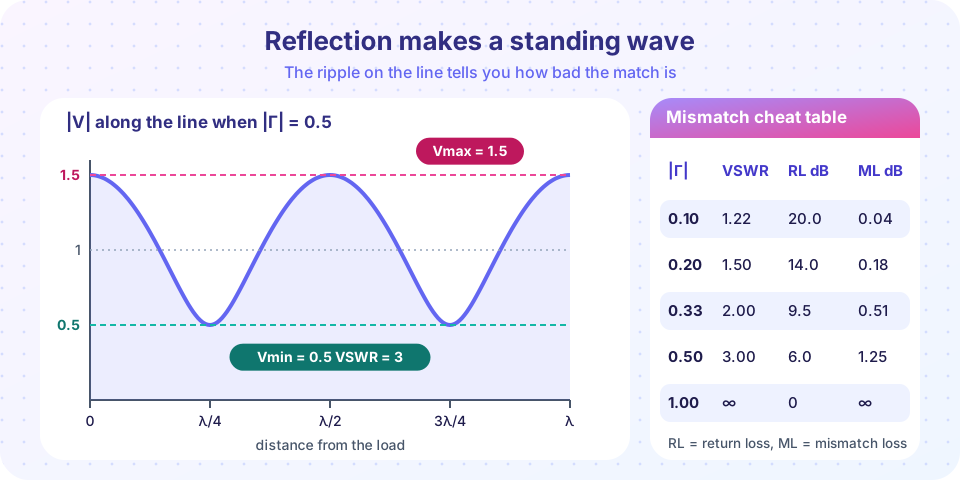
Add forward and reflected waves: |V(d)| = |V⁺| · |1 + Γ(d)|. The forward wave and the reflected wave sometimes line up and sometimes oppose. The maximum is |V⁺|(1 + |Γ|) and the minimum is |V⁺|(1 − |Γ|). Their ratio is
VSWR = (1 + |Γ|) / (1 − |Γ|), and inverting, |Γ| = (VSWR − 1) / (VSWR + 1)
The picture shows |Γ| = 0.5: the maximum is 1.5, the minimum 0.5 and VSWR = 3. Maxima and minima are a quarter wavelength apart.
Return loss and mismatch loss
The reflected power fraction is |Γ|². In decibels:
- Return loss
RL = −20 log₁₀|Γ|(how far below the incident wave the reflection is). A perfect match has infinite RL; a total reflection has 0 dB. - Mismatch loss
ML = −10 log₁₀(1 − |Γ|²)(how much power fails to reach the load).
| |Γ| | VSWR | RL (dB) | Power reflected | ML (dB) |
|---|---|---|---|---|
| 0.1 | 1.22 | 20.0 | 1% | 0.04 |
| 0.2 | 1.50 | 14.0 | 4% | 0.18 |
| 0.333 | 2.00 | 9.5 | 11.1% | 0.51 |
| 0.5 | 3.00 | 6.0 | 25% | 1.25 |
Worked example. An antenna has VSWR = 2:1 at its operating frequency. Then |Γ| = 1/3, RL = 9.5 dB, 11.1% of the power is reflected and 88.9% is delivered; the mismatch loss is only 0.51 dB. A VSWR of 2 is not a disaster for a link, but for a power amplifier it may trigger protection circuits, since the reflected power heats the output stage.
For our complex load 25 + j25 Ω on 50 Ω: |Γ| = 0.447, VSWR = 1.447/0.553 = 2.62, RL = 6.99 dB, ML = 0.97 dB.
Reading specs
- Many antennas guarantee
VSWR < 2:1(RL > 9.5 dB) over the band; high-quality ones aim for1.5:1(RL > 14 dB). - Receivers are more forgiving than transmitters; a power amplifier datasheet may specify survival at 3:1 or 10:1 mismatch.
- VSWR is a scalar number: it does not say whether the load looks inductive or capacitive. For that you need the complex
Γor the Smith chart.
Common misconceptions
- "Reflected power is destroyed." Reflected power goes back toward the source. In a real system it may be reflected again or absorbed in the source, so the exact loss depends on the whole system.
- "VSWR of 1:1 is always the goal." A perfect match costs bandwidth, size and money. Many designs accept 1.5:1 or 2:1 because the extra mismatch loss is a fraction of a dB.
- "The standing wave means the line is lossy." A lossless line carries a standing wave whenever the load is mismatched.
Try it
The first tool is a live standing-wave animation. Set the load resistance and reactance (relative to 50 Ω) and watch the forward and total voltage on the line, with the envelope drawn in pink. The load is at the right-hand end.
The second tool converts a list of loads into all four quantities. Add your own load impedances to the list.
Press Run (or Ctrl + Enter) to see the result here.
Program input · what you'd type while the program runs
Type the answers before you press Run, one per line. Each time the program reads a line (with input()), it gets the next line from this box.
Check your understanding
Quick check · 6 questions
of 6 answered You scored / 6 · perfect!
-
1. A 150 Ω load is connected to a 50 Ω line. What is Γ?
Γ = (150 − 50)/(150 + 50) = 100/200 = 0.5. -
2. What is the VSWR for |Γ| = 0.5?
VSWR = (1 + 0.5)/(1 − 0.5) = 3. -
3. A line has VSWR 1.5. What is the return loss?
|Γ| = 0.5/2.5 = 0.2, RL = −20 log₁₀(0.2) = 14 dB. -
4. For a short-circuited load, the reflection coefficient is
Short: Γ = (0 − Z0)/(0 + Z0) = −1. -
5. Which VSWR corresponds to about 11% of the power being reflected?
VSWR 2 gives |Γ| = 1/3, so |Γ|² = 11.1%. -
6. On a lossless line, moving along the line changes Γ by
|Γ| is constant on a lossless line; the phase rotates by 2βd.
Summary
Γ = (ZL − Z0)/(ZL + Z0): 0 for a match, +1 for an open, −1 for a short.- VSWR
= (1 + |Γ|)/(1 − |Γ|); RL= −20 log₁₀|Γ|; ML= −10 log₁₀(1 − |Γ|²). - VSWR 2:1 means RL 9.5 dB, 11% reflected power and 0.5 dB mismatch loss.
- On a lossless line
|Γ|is constant and its phase rotates with2βd. - VSWR ignores phase; use the complex Γ or the Smith chart when you need it.
Next: Impedance Along a Line
Track your progress
Create a free account to tick off lessons and pick up where you left off on any device.
of RF Engineering and Antennas lessons completed