


















Lesson 43 of 46 · Projects and Practice
Practice: An RF Problem Set
Ten RF and antenna practice problems covering dBm, cascaded noise figure, intermodulation, mixers, EIRP, path loss, Fresnel zones and fading, with worked solutions you can run.
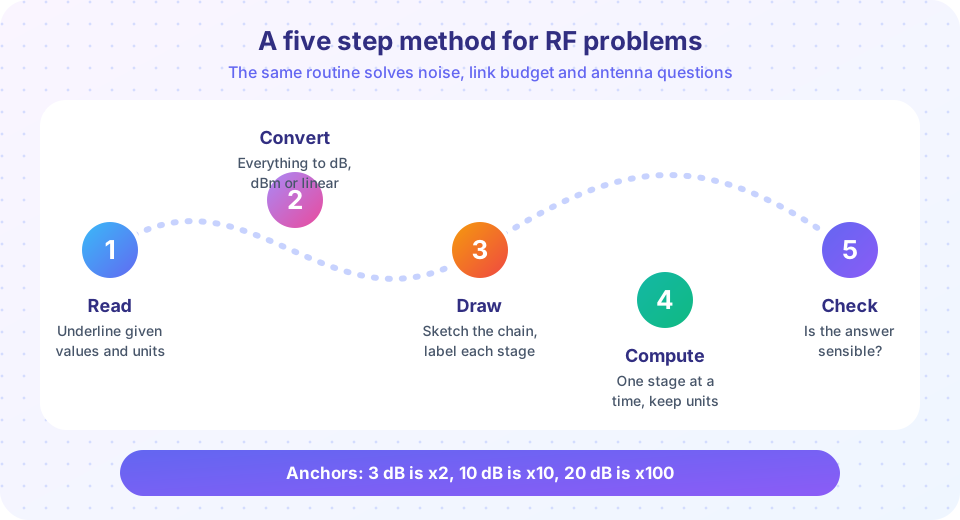
Reading formulas is not the same as using them. Below are ten problems that mix the chapters of this part of the course. Try each on paper first, write down the units, and check your answers with the runnable solutions. The method image shows the routine: read, convert, draw, compute, check.
What you will learn
- How to approach an RF problem with a repeatable routine.
- How to decide when a quick estimate is enough and when to compute exactly.
- How to sanity-check an answer with the 3, 10 and 20 dB anchors.
Key terms
Anchor values: 3 dB is a factor of 2, 10 dB a factor of 10, 20 dB a factor of 100 in power. Sanity check: a quick estimate that tells you whether the exact answer is in the right range. Units discipline: write dB, dBm, dBi and dBW every time; they are not interchangeable.
The problems
- A transmitter delivers 250 mW. Express this in dBm.
- A receive chain has a 1.5 dB filter, an LNA (gain 18 dB, NF 1.4 dB), a mixer (conversion loss 7 dB, NF 7.5 dB) and an IF amplifier (gain 25 dB, NF 4 dB). Find the system noise figure.
- An amplifier has gain 14 dB and OIP3 = +28 dBm. Two tones of -12 dBm each are applied at the input. Find the output level of each tone and of the IM3 products, and the difference in dB.
- A receiver tunes 433.92 MHz with IF = 10.7 MHz and high-side injection. Find the LO and image frequencies.
- A 30 W transmitter feeds a 9 dBd antenna through 1 dB of cable loss. Find the EIRP in dBm.
- A 5 GHz link, 300 m, Pt = 17 dBm, both antennas 6 dBi. Find FSPL and Pr.
- A 3 km link at 2.4 GHz. Find the first Fresnel radius at the midpoint and the clearance needed.
- What fade margin gives 99.9 percent availability in Rayleigh fading?
- Design a rectangular patch for 5.8 GHz on FR-4 (
εr = 4.4,h = 1.6 mm): find W and L. - A 12 m mast and a 3 m handheld antenna: what is the largest line-of-sight distance with the 4/3 earth model?
Try it
Press Run (or Ctrl + Enter) to see the result here.
Program input · what you'd type while the program runs
Type the answers before you press Run, one per line. Each time the program reads a line (with input()), it gets the next line from this box.
Press Run (or Ctrl + Enter) to see the result here.
Program input · what you'd type while the program runs
Type the answers before you press Run, one per line. Each time the program reads a line (with input()), it gets the next line from this box.
Solutions and notes
10 log10(250) = 23.98 dBm. Anchor check: 1 W is 30 dBm and 250 mW is a quarter of that, 6 dB lower, so about 24 dBm.- Run the code: the system noise figure is about 3.5 dB. The filter loss (1.5 dB) and the LNA (1.4 dB) already make 2.9 dB; the mixer and IF amplifier add roughly 0.6 dB more because the LNA gain divides their noise.
- Output tone:
-12 + 14 = +2 dBm. IM3:3(2) - 2(28) = -50 dBm. The products are 52 dB below the tones. - LO = 444.62 MHz, image = 455.32 MHz.
44.77 - 1 + 11.15 = 54.9 dBm, about 25 dBW or 310 W.- FSPL = 96.0 dB, Pr = -67.0 dBm.
r1 = 9.7 m, so keep the path at least 5.8 m clear at the midpoint.- About 30 dB.
- W = 15.7 mm, L = 11.7 mm (a starting design; tune in simulation).
- About 21.4 km.
Common misconceptions
"I can add dBm and dBm." Adding two powers in dBm is meaningless; add a power in dBm and a gain in dB. To add two powers, convert to milliwatts.
"dBd and dBi are the same." They differ by 2.15 dB, which changes EIRP and results in problem 5.
Check your understanding
Quick check · 5 questions
of 5 answered You scored / 5 · perfect!
-
1. Which is 33 dBm in watts?
30 dBm is 1 W, +3 dB doubles it: 2 W. -
2. A 20 dB gain LNA with NF 2 dB is followed by a 10 dB NF stage. System NF is about
F = 1.585 + (10 - 1)/100 = 1.675, which is 2.24 dB. -
3. Doubling the distance and doubling the frequency together changes FSPL by
Each doubling adds 6.02 dB. -
4. A signal at -80 dBm into a 50 ohm load is about
P = 1e-11 W, so V = sqrt(P x 50) = 22 microvolts. -
5. The best first step in any RF problem is to
A clean table of dB values makes the rest additions.
Summary
- Use the routine: read, convert, draw, compute, check.
- Keep units explicit: dB, dBm, dBi, dBd, dBW.
- Check answers against anchors before trusting the exact number.
Next: Glossary of RF terms
Track your progress
Create a free account to tick off lessons and pick up where you left off on any device.
of RF Engineering and Antennas lessons completed