


















Lesson 41 of 46 · Projects and Practice
Project: A 2 km Point-to-Point Link Budget
Design a 2 km, 5.8 GHz point-to-point link step by step: path loss, EIRP, received power, noise floor, SNR, Fresnel clearance and fade margin, then explore what-if cases.
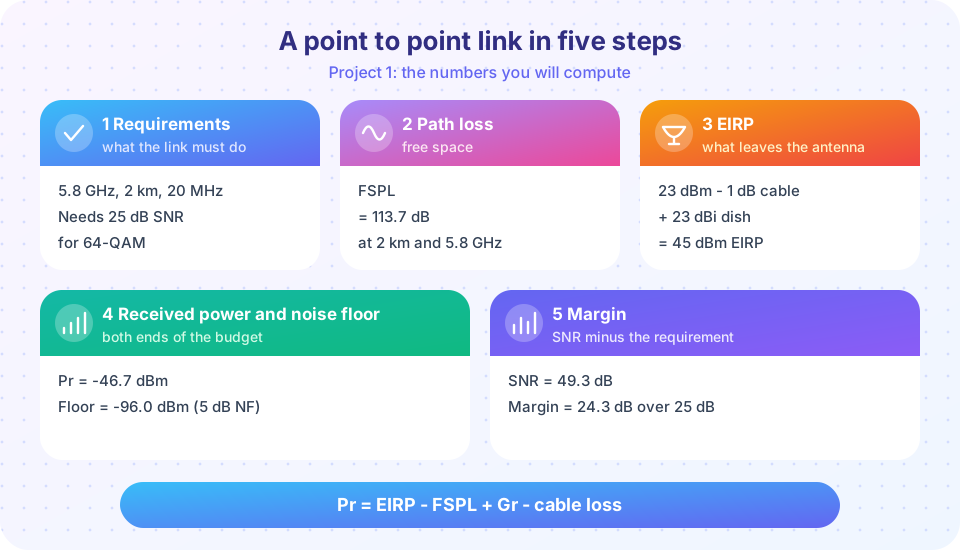
Two buildings 2 km apart need a wireless bridge. You have a pair of 23 dBi dishes, radios that put out 23 dBm, and a 20 MHz channel in the 5.8 GHz band. Will it work, how reliably, and how tall must the masts be? This project walks through the complete design using everything from the last four chapters: antenna gain, free-space loss, noise figure, Fresnel clearance and fade margin.
What you will learn
- How to organize a link design from requirements to margin.
- How to check Fresnel clearance and decide mast heights.
- How to run what-if cases: longer range, rain, a misaligned dish.
Key terms
Point-to-point link: a fixed link between two directional antennas. Required SNR: the SNR the chosen modulation needs; here 25 dB for 64-QAM. Link availability: percentage of time the link meets its requirement. Pointing loss: gain lost when a dish is not aimed exactly at the other.
Step 1: Requirements and assumptions
- Frequency 5.8 GHz (
λ = 5.17 cm), distance 2 km, clear line of sight. - Radio: transmit power 23 dBm, receiver noise figure 5 dB, 20 MHz bandwidth.
- Antennas: two 23 dBi dishes, 1 dB of cable and connector loss at each end.
- Needed: 64-QAM at 25 dB SNR.
Step 2: Path loss
FSPL = 20 log10(2) + 20 log10(5800) + 32.44 = 6.02 + 75.27 + 32.44 = 113.7 dB
Step 3: EIRP
EIRP = 23 dBm - 1 dB + 23 dBi = 45 dBm (about 32 W). Many regions limit EIRP in this band, and fixed point-to-point links often have different rules from general Wi-Fi; check local regulations before you build. If you must reduce it, lower the radio power; the antenna gain helps the receiver as much as the transmitter, so keep it.
Step 4: Received power and the noise floor
Pr = 45 - 113.7 + 23 - 1 = -46.7 dBmN = -174 + 73.0 + 5 = -96.0 dBm
Step 5: SNR and margin
SNR = -46.7 - (-96.0) = 49.3 dB, a margin of 49.3 - 25 = 24.3 dB over the requirement. In a Rayleigh channel that would only be about 99.6 percent availability, but a fixed LOS link is Rician with a strong direct component, so the real availability is much higher if the path is clear and the dishes stay aligned.
Step 6: Fresnel clearance and mast height
At the midpoint of 2 km, r1 = sqrt(λ d1 d2/D) = sqrt(0.0517 × 1000 × 1000 / 2000) = 5.1 m and 0.6 r1 = 3.1 m. The beam path must clear terrain and rooftops by 3.1 m at the middle. If the terrain there is 8 m above the end points, you need to raise both masts so the line of sight stays 3.1 m above that: about 11 m of mast at each end (a straight line from 11 m at each end passes 11 m above the middle). The curvature bulge over 2 km is only about 0.06 m with k = 4/3, negligible here.
Step 7: What-if cases
- Rain and gas: at 5.8 GHz the extra attenuation over 2 km is a small fraction of a dB, far below the margin.
- Pointing: the dish beamwidth is about 10 to 12 degrees (try the calculation below); a 3 degree error costs a fraction of a dB, so alignment is easy at this gain.
- Longer path: at 10 km the path loss rises by
20 log10(5) = 14 dBto 127.7 dB, leaving about 10 dB of margin, enough for a lower-order modulation but short of a comfortable fade margin for 64-QAM. - Cheaper antennas: with 14 dBi dishes at both ends the margin falls by 18 dB to about 6.3 dB, too little.
Common misconceptions
"A large margin means I can ignore the Fresnel zone." An obstructed path can lose 6 dB at grazing and far more beyond, plus unpredictable ripples.
"Higher EIRP is always the answer." It is limited by regulation and by interference to others; gain at the receive end is often cheaper.
Try it
Press Run (or Ctrl + Enter) to see the result here.
Program input · what you'd type while the program runs
Type the answers before you press Run, one per line. Each time the program reads a line (with input()), it gets the next line from this box.
Press Run (or Ctrl + Enter) to see the result here.
Program input · what you'd type while the program runs
Type the answers before you press Run, one per line. Each time the program reads a line (with input()), it gets the next line from this box.
Press Run (or Ctrl + Enter) to see the console output here.
No output.
Check your understanding
Quick check · 5 questions
of 5 answered You scored / 5 · perfect!
-
1. Doubling the link distance from 2 km to 4 km costs how many dB of path loss?
20 log10(2) = 6.02 dB. -
2. Which change adds the most margin for the same cost?
Two dishes with 9 dB more gain each add 18 dB. -
3. r1 at the midpoint of 2 km, 5.8 GHz is about
sqrt(0.0517 x 1000 x 1000 / 2000) = 5.08 m. -
4. Where in this budget does the receiver noise figure enter?
Floor = -174 + 10 log10(B) + NF. -
5. A margin of 24 dB over the requirement in a clear LOS link is
It covers typical fading and weather if the path is clear.
Summary
- Work through requirements, path loss, EIRP, received power, noise floor and margin in order.
- Check Fresnel clearance and regulations before building.
- Run what-if cases: distance, antenna gain, losses.
Track your progress
Create a free account to tick off lessons and pick up where you left off on any device.
of RF Engineering and Antennas lessons completed