


















Lesson 45 of 46 · Projects and Practice
RF and Antennas Cheat Sheet
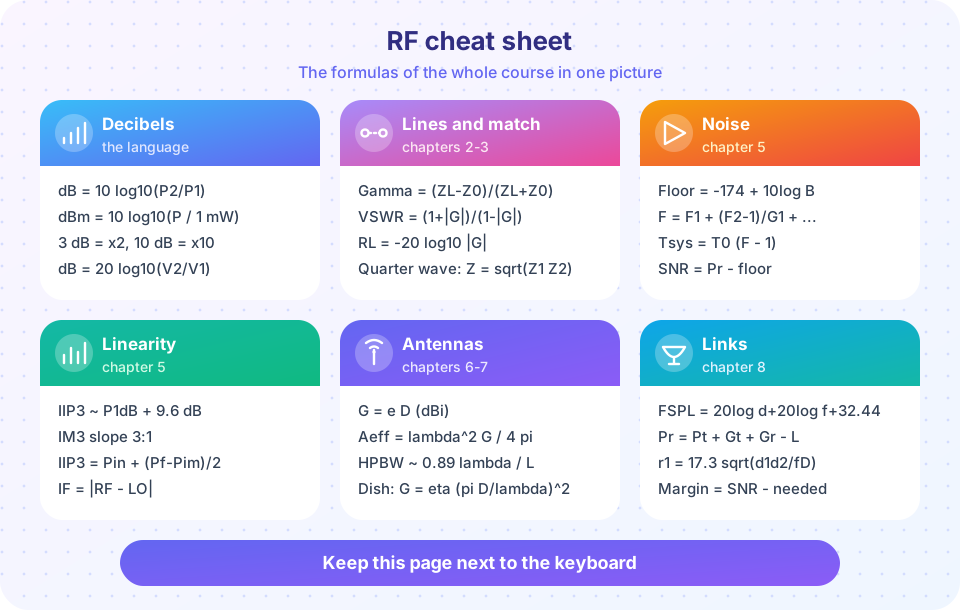
One-page recap of the key RF and antenna formulas: decibels, matching, noise, linearity, antennas and link budgets, with a calculator for the most used ones.
Everything you need most often, on one page. Keep it beside your keyboard while you design or study.
What you will learn
- Which formula to reach for in each situation.
- The typical numbers worth remembering.
Formulas and numbers
| Topic | Formula | Remember |
|---|---|---|
| Decibels | dB = 10 log10(P2/P1) |
3 dB = x2, 10 dB = x10 |
| dBm | 10 log10(P / 1 mW) |
0 dBm = 1 mW, 30 dBm = 1 W |
| Reflection | Γ = (ZL - Z0)/(ZL + Z0) |
VSWR 2 = return loss 9.54 dB |
| Noise floor | -174 + 10 log10(B) + NF |
1 MHz: -114 dBm before NF |
| Friis cascade | F = F1 + (F2-1)/G1 + ... |
LNA first |
| IM3 | 3 Pout - 2 OIP3 |
IIP3 about P1dB + 9.6 dB |
| Mixer | IF = abs(RF - LO) |
image = RF ∓ 2 IF |
| Gain | G = e D, D = 4π/Ω |
Half-wave dipole 2.15 dBi |
| Aperture | Aeff = λ²G/4π |
Dish: G = η(πD/λ)², η about 0.6 |
| FSPL | 20 log10 d_km + 20 log10 f_MHz + 32.44 |
+6 dB per doubling |
| Friis link | Pr = Pt + Gt + Gr - FSPL |
Add margin |
| Fresnel | r1 = 17.3 sqrt(d1 d2/(f D)) m |
keep 60 percent clear |
| Horizon | 4.12 (√h1 + √h2) km |
4/3 earth |
| Fading | Rayleigh margin 20 dB = 99 % | 30 dB = 99.9 % |
| Array | d < λ/(1 + abs(sin θ0)), β = -kd sin θ0 |
N elements, 10 log N dBi |
Try it
Press Run (or Ctrl + Enter) to see the result here.
Program input · what you'd type while the program runs
Type the answers before you press Run, one per line. Each time the program reads a line (with input()), it gets the next line from this box.
Press Run (or Ctrl + Enter) to see the console output here.
No output.
Check your understanding
Quick check · 3 questions
of 3 answered You scored / 3 · perfect!
-
1. Which relation links IM3 to OIP3?
Slope 3 against slope 1 gives IM3 = 3 Pout - 2 OIP3. -
2. Which formula gives the free-space loss in practical units?
That is the standard form. -
3. In a cascade, the first stage should have
Friis: later noise is divided by the first stage gain.
Summary
- Memorize the anchors: 3 dB = x2, 10 dB = x10.
- Link problems use FSPL, Friis and the noise floor; device problems use NF, P1dB and IP3.
- Antenna problems use directivity, gain and aperture.
Next: Further study
Track your progress
Create a free account to tick off lessons and pick up where you left off on any device.
of RF Engineering and Antennas lessons completed