


















Lesson 38 of 46 · Propagation and Link Budgets
Building a Link Budget
Build a complete RF link budget: transmit power and EIRP, path loss, receiver noise floor, SNR, Eb/N0 and link margin, with a worked Wi-Fi example and a range calculator.
A link budget is the bookkeeping of a radio link. On one side you add everything that helps: transmit power, antenna gains. On the other you subtract everything that hurts: path loss, cables, mismatch, fading. The result is the signal power at the receiver; compare it with the noise and you know whether the link works and by how much. Because everything is in decibels, the whole calculation is addition. This lesson builds a budget step by step and then uses it to find the maximum range.
What you will learn
- How to turn a link into a table of dB entries.
- How to compute the receiver noise floor and SNR.
- How SNR relates to Eb/N0 and data rate.
- How to compute link margin and the maximum range.
Key terms
EIRP: transmit power plus antenna gain minus feed losses, in dBm or dBW.
Received power Pr: EIRP - path loss + Gr - receive losses.
Receiver sensitivity: the minimum Pr that gives the required quality.
Link margin: Pr - sensitivity, or SNR - required SNR.
Eb/N0: energy per bit divided by noise power spectral density; the standard measure of digital link quality.
The budget, line by line
- Transmit power
Pt(dBm) at the antenna connector. - Feed losses
Lt(cables, connectors, filters) subtract. - Tx antenna gain
Gt(dBi) adds, giving EIRP = Pt - Lt + Gt. - Path loss
L_pathsubtracts: free space20 log10(4πd/λ)plus any additional losses such as diffraction, rain, foliage or building walls. - Rx antenna gain
Gradds. - Receive losses
Lrsubtract. - Pr
= EIRP - L_path + Gr - Lr. - Noise floor
N = -174 + 10 log10(B) + NF(dBm). - SNR
= Pr - N, then margin= SNR - SNR_required.
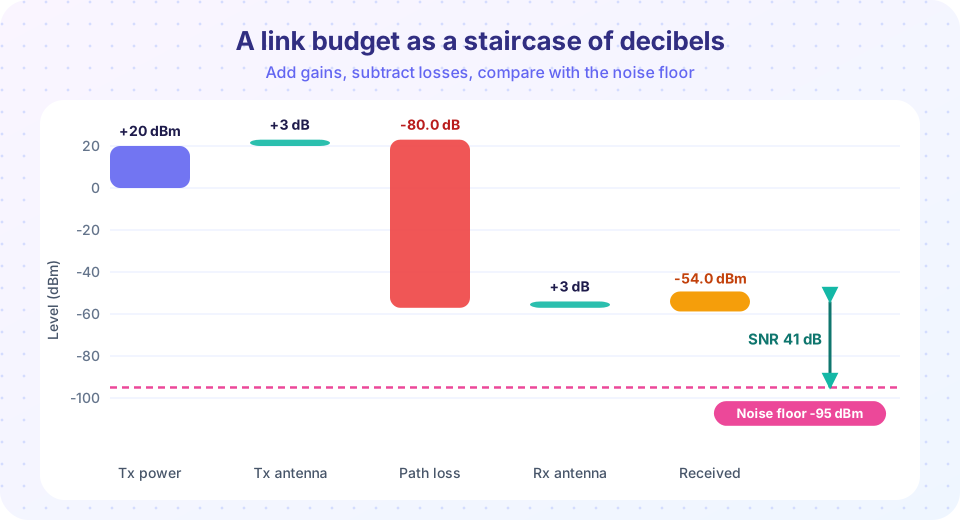
Worked example. A 2.4 GHz Wi-Fi link, 100 m, 20 MHz channel. Pt = 20 dBm, Gt = Gr = 3 dBi, no cable losses, NF = 6 dB.
FSPL = 20 log10(0.1) + 20 log10(2400) + 32.44 = -20 + 67.60 + 32.44 = 80.04 dB, about 80 dBPr = 20 + 3 - 80.04 + 3 = -54.04 dBm, about -54 dBmN = -174 + 73.0 + 6 = -95.0 dBmSNR = -54.04 - (-94.99) = 40.95 dB, about 41 dB
A high-order modulation such as 64-QAM needs roughly 25 dB SNR, so the margin is about 16 dB.
Eb/N0 and data rate
Digital performance depends on energy per bit, not on SNR alone. With signal bandwidth B and bit rate Rb:
Eb/N0 = SNR + 10 log10(B / Rb)
A BPSK link needs about 9.6 dB Eb/N0 for a bit error rate of 1e-5, with no coding; good error-correcting codes bring the requirement down to a few dB. Reducing the data rate by a factor of 10 buys 10 dB of Eb/N0, which is how deep-space probes talk at very low rates, and how LoRa-type systems reach kilometers on milliwatts.
Margin and range
The maximum path loss the link can tolerate is
L_max = EIRP + Gr - Lr - sensitivity - margin
Then convert path loss into distance. In free space, each +6.02 dB of tolerable loss doubles the range. In an urban environment, with a path-loss exponent of 3.5 (loss proportional to d^3.5), each +10 dB multiplies the range by only about 1.9.
Items often forgotten in budgets:
- Cable and connector loss at 5 GHz or above, which can be several dB.
- Polarization mismatch and antenna pointing losses.
- Body loss for handsets (3 to 10 dB).
- Building penetration (10 to 20 dB through brick or coated glass).
- Fade margin (next lesson), and interference raising the effective noise floor.
Common misconceptions
"A 3 dB gain increase doubles the range." In free space, +3 dB gives 41 percent more range; +6 dB doubles it.
"The noise floor is fixed." It depends on bandwidth and noise figure. Narrowing the channel by 10 times lowers the floor by 10 dB.
"A positive margin means a reliable link." Only if the margin covers the fading statistics (next lesson) and interference.
Try it
Press Run (or Ctrl + Enter) to see the result here.
Program input · what you'd type while the program runs
Type the answers before you press Run, one per line. Each time the program reads a line (with input()), it gets the next line from this box.
Press Run (or Ctrl + Enter) to see the result here.
Program input · what you'd type while the program runs
Type the answers before you press Run, one per line. Each time the program reads a line (with input()), it gets the next line from this box.
Press Run (or Ctrl + Enter) to see the console output here.
No output.
Check your understanding
Quick check · 5 questions
of 5 answered You scored / 5 · perfect!
-
1. Pt = 30 dBm, cable loss 2 dB, antenna 10 dBi. The EIRP is
30 - 2 + 10 = 38 dBm. -
2. Bandwidth 5 MHz and NF 4 dB. The noise floor is
-174 + 67 + 4 = -103 dBm. -
3. Free-space range doubles when the permitted path loss rises by
Loss is proportional to d^2 so 6.02 dB per doubling. -
4. Reducing the bit rate by a factor of 4 in the same bandwidth changes Eb/N0 by
Eb/N0 = SNR + 10 log10(B/Rb): a factor of 4 is +6 dB. -
5. A link has SNR 31 dB and the modulation needs 22 dB. The margin is
31 - 22 = 9 dB.
Summary
- Link budget:
Pr = Pt - Lt + Gt - L_path + Gr - Lr; noise floor-174 + 10 log B + NF. SNR = Pr - N;Eb/N0 = SNR + 10 log10(B/Rb); margin is what is left above the requirement.- Include real-world losses: walls, body, polarization, pointing and fading.
Next: Fading and multipath
Track your progress
Create a free account to tick off lessons and pick up where you left off on any device.
of RF Engineering and Antennas lessons completed