


















Lesson 5 of 46 · Getting Started
Chapter 1 Review: Getting Started
Review chapter 1 of the RF course: wavelength and bands, decibels and dBm, thermal noise and sensitivity, with a recap table, practice problems and a ten-question quiz.
You now have the three pieces of vocabulary that every later chapter uses: wavelength (the length scale), decibels (the arithmetic) and noise (the limit). This review pulls them together on one page, gives you a few problems to try and tests the chapter with ten questions.
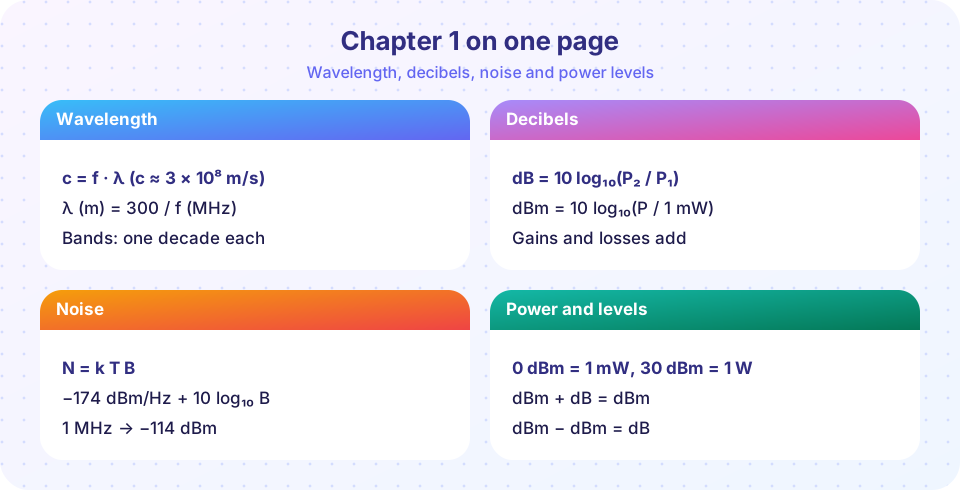
The chapter in a table
| Topic | Key formula | Remember |
|---|---|---|
| Wavelength | λ = c / f, λ(m) ≈ 300 / f(MHz) |
Shorter in cables by 1/√εr |
| Lumped or not | Length vs λ/10 |
Longer means transmission line |
| Power ratio | dB = 10 log₁₀(P₂/P₁) |
3 dB is ×2, 10 dB is ×10 |
| Voltage ratio | dB = 20 log₁₀(V₂/V₁) |
Same impedance only |
| Absolute level | dBm = 10 log₁₀(P/1 mW) |
0 dBm = 1 mW, 30 dBm = 1 W |
| Noise floor | N = −174 dBm/Hz + 10 log₁₀ B |
−114 dBm in 1 MHz |
| Noise figure | F = SNRin/SNRout, Te = T₀(F − 1) |
NF 3 dB ≈ 289 K |
| Sensitivity | −174 + 10 log₁₀ B + NF + SNRmin |
Examples gave −85 dBm for 20 MHz, NF 6, SNR 10 |
How the pieces fit
Wavelength tells you whether a piece of wire is a connection or a line. Decibels let you follow a signal from the transmitter to the receiver by adding numbers. Noise tells you where the chain stops: the sensitivity is the floor plus the noise figure plus the SNR you need. In chapter 8 these same steps become a full link budget.
When a problem seems messy, convert every quantity to dB or dBm first. The algebra becomes addition, and mistakes show up as obviously silly values.
Try it
These practice problems are solved by code. Do each one on paper first and write down your answer before you run the cell.
Press Run (or Ctrl + Enter) to see the result here.
Program input · what you'd type while the program runs
Type the answers before you press Run, one per line. Each time the program reads a line (with input()), it gets the next line from this box.
A second view of the same ideas: sweep bandwidth and noise figure together and see which choice moves sensitivity more.
Press Run (or Ctrl + Enter) to see the result here.
Program input · what you'd type while the program runs
Type the answers before you press Run, one per line. Each time the program reads a line (with input()), it gets the next line from this box.
Check your understanding
Quick check · 10 questions
of 10 answered You scored / 10 · perfect!
-
1. What is the wavelength in air at 600 MHz?
λ = 300 / 600 = 0.5 m = 50 cm. -
2. A conductor is 0.3 λ long. How should it be treated?
0.3 λ is well beyond λ/10, so voltage and current vary along it. -
3. Which number is closest to the dB value of a power ratio of 50?
50 ≈ 100 / 2, so 20 − 3 = 17 dB (exactly 16.99 dB). -
4. What is 33 dBm in watts?
30 dBm is 1 W and 3 dB doubles it: about 2 W. -
5. A signal at -80 dBm goes through a 25 dB LNA, a 2 dB filter loss and a 10 dB mixer gain. The level is
-80 + 25 - 2 + 10 = -47 dBm. -
6. The noise floor in a 100 kHz bandwidth at 290 K is
-174 + 10 log₁₀(10⁵) = -174 + 50 = -124 dBm. -
7. Which change improves sensitivity by 3 dB?
Half the bandwidth means half the noise power: −3 dB on the floor. -
8. The sensitivity of a receiver with B = 10 MHz, NF = 5 dB and SNRmin = 8 dB is closest to
-174 + 70 + 5 + 8 = -91 dBm. -
9. For the same impedance, a voltage ratio of 100 equals
20 log₁₀(100) = 40 dB (power ratio 10,000). -
10. A wave travels in a cable with velocity factor 0.5. A quarter wavelength at 1 GHz is about
λ in air at 1 GHz is 300 mm; with factor 0.5 it is 150 mm; a quarter of that is 37.5 mm.
Summary
- Wavelength decides lumped versus distributed; keep the
300 / f(MHz)shortcut handy. - Decibels turn a chain of gains and losses into addition; dBm is an absolute level.
- Thermal noise is
kTB= −174 dBm/Hz + 10 log B; noise figure measures added noise. - Sensitivity = floor + NF + required SNR.
- Next you will see why cables longer than a tenth of a wavelength need new rules.
Track your progress
Create a free account to tick off lessons and pick up where you left off on any device.
of RF Engineering and Antennas lessons completed