


















Lesson 35 of 46 · Antenna Types and Arrays
Chapter Review: Antenna Types and Arrays
Review dipoles, monopoles, Yagi-Uda antennas, patches, horns, dishes and phased arrays with a recap table, typical gains and a ten question quiz.
The families in this chapter all follow one rule: how large the radiating aperture is in wavelengths decides gain and beamwidth. Wires are small and broad, apertures are large and sharp, and arrays let you assemble an aperture from many parts and steer it.
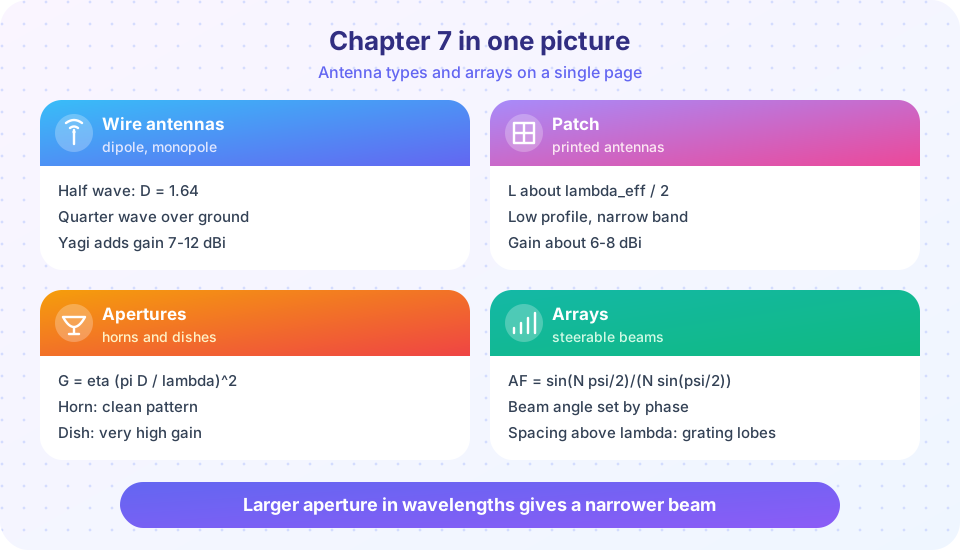
Recap table
| Antenna | Size | Typical gain | Notes |
|---|---|---|---|
| Half-wave dipole | 0.47 to 0.48 λ | 2.15 dBi | 73 Ω |
| Quarter-wave monopole | λ/4 over ground | 5.15 dBi (perfect ground) | 36.5 Ω |
| Yagi-Uda | 3 to 10 elements | 7 to 12 dBi | Narrow bandwidth |
| Microstrip patch | about λ/2 in the substrate | 5 to 8 dBi | 1 to 3 percent bandwidth |
| Horn | a few λ aperture | 10 to 25 dBi | Wideband, reference |
| Parabolic dish | many λ | 30 to 60 dBi | G = η(πD/λ)² |
| Uniform linear array | N elements, d = λ/2 | about 10 log10 N dBi | Beam steered by phase |
Try it
Press Run (or Ctrl + Enter) to see the result here.
Program input · what you'd type while the program runs
Type the answers before you press Run, one per line. Each time the program reads a line (with input()), it gets the next line from this box.
Press Run (or Ctrl + Enter) to see the console output here.
No output.
Check your understanding
Quick check · 10 questions
of 10 answered You scored / 10 · perfect!
-
1. Which antenna is the best choice for a 1.5 degree beam at 12 GHz?
HPBW about 68 lambda/D means D = 68 x 0.025 / 1.5 = 1.1 m. -
2. A quarter-wave monopole over a perfect infinite ground has directivity
All power goes into a half space, doubling the dipole's 1.64. -
3. The directors of a Yagi are
Slightly short parasitic elements in front carry currents that add forward. -
4. A patch antenna usually has
Patches are flat and cheap but narrowband. -
5. Aperture efficiency of a dish is reduced by
Those are the main loss terms. -
6. For a 30 degree scan limit, the largest element spacing avoiding grating lobes is about
d < lambda/(1 + 0.5) = 0.667 lambda. -
7. Tapering an array does what to the sidelobes?
Amplitude tapers trade beamwidth for sidelobe level. -
8. Eight elements with 0.5 lambda spacing, steered to 20 degrees. Phase step is about
-360 x 0.5 x sin 20 = -61.6 degrees. -
9. The array factor depends on
AF sums the weighted, delayed contributions of every element. -
10. Which has the widest bandwidth?
Horns are smooth, low-Q structures.
Summary
- Gain grows with aperture area in wavelengths; beamwidth shrinks.
- Choose wires for simplicity, patches for integration, apertures for gain and arrays for steering.
Track your progress
Create a free account to tick off lessons and pick up where you left off on any device.
of RF Engineering and Antennas lessons completed